
AI App Development Cost in 2026: What Does It Really Cost to Build an AI App?

• 22 min
I'm a content specialist at Fively keen on writing fresh articles that can help out business and tech specialists. I love to conduct research, hold interviews, and spotlight sophisticated tech issues.
Discover the AI app development cost range from lean MVPs to enterprise AI systems, as well as API pricing, team rates, hidden expenses, and ways to reduce your AI budget.
The AI app development cost in 2026 can be anything from a few thousand dollars for a no-code proof of concept to $1 million or more for a complex enterprise platform with proprietary models, strict compliance requirements, and large-scale infrastructure.
There is another distinction that matters just as much: the cost to build AI is not the same as the cost to run it. Traditional software already has cloud, maintenance, and support expenses. AI adds model inference, token consumption, vector databases, data pipelines, evaluation, observability, re-indexing, and sometimes human review. A cheap prototype can therefore become an expensive production system if operating costs are ignored during planning.
This guide breaks down AI software development cost in 2026, including development, infrastructure, LLM APIs, RAG, AI agents, team models, hidden expenses, and post-launch operations.
AI App Development Cost in 2026: The Quick Answer
For most commercial projects, a realistic initial cost of AI app development falls somewhere between $20,000 and $250,000.
A focused AI MVP may fit below that range, while enterprise products with custom machine learning, regulated data, complex integrations, or high-volume inference can exceed it substantially.
These are planning ranges, not vendor quotes. The same chatbot can cost $25,000 or $150,000 depending on whether it answers public FAQs or works with private customer records, performs transactions, integrates with five internal systems, supports multiple languages, and must meet enterprise security requirements.
At Fively, we have been building data-heavy and AI-enabled software since before generative AI became the default answer to every product idea. That experience leads to a simple budgeting principle, which is splitting the project into two buckets:
Cost to build = discovery + data preparation + UX/UI + AI engineering + application development + integrations + testing + deployment;
Cost to run = model/API usage + cloud infrastructure + databases + monitoring + security + data updates + support + ongoing evaluation and optimization.
That second number is where AI economics differ from a normal one-time app estimate. A production AI system is a living service, not a model you deploy once and forget.
What Determines the Cost of AI App Development?
Here, there are also several points to look at:
Type and Complexity of the AI Solution
The first pricing variable is what the AI actually has to do.
A summarizer that sends text to an existing LLM is relatively simple. A support assistant that retrieves approved answers from thousands of internal documents is usually more complex than mobile app development. An agent that can inspect an account, decide what action to take, call business tools, update a CRM, and ask for human approval before a sensitive action is more complex again.
Complexity is not determined by the model alone. A product using a standard API can still become an enterprise-scale engineering project if it needs complex permissions, auditable actions, strict latency targets, private deployment, or hundreds of integrations.
Project Scope: MVP vs Full-Scale vs Enterprise
An AI MVP should prove one valuable behavior, not reproduce the final product at smaller scale.
For example, an MVP for a legal knowledge assistant might support one document collection, one user role, and three high-value question types. The full product may later add multiple repositories, fine-grained access control, citations, multilingual retrieval, analytics, billing, integrations, and administrator workflows.
The cheapest path is rarely "build everything once." A focused MVP reduces the amount of data, UI, integration, and AI tool behavior that must be validated before the team knows whether users actually want the solution.
Data Collection, Cleaning, and Labeling
Data is one of the most underestimated factors influencing artificial application development cost estimates.
If you are building RAG, the team may need to extract documents from multiple sources, remove duplicates, normalize formats, preserve metadata, define access permissions, split content into retrievable chunks, generate embeddings, and establish a re-indexing process.
For supervised machine learning, the project may also require labeled training, validation, and test data sets. Labeling can range from a few cents for a simple binary classification task to several dollars - or much more - for expert annotation involving medical, legal, engineering, or highly contextual judgments.
A practical budgeting range is:
- Simple classification or tagging: roughly $0.02-$0.20 per item when the task is highly standardized and can be handled at scale;
- Moderate text/image annotation: roughly $0.20-$2 per item depending on complexity and quality requirements;
- Expert or domain-specific labeling: $2-$20+ per item, with specialist review potentially costing substantially more;
- Data engineering and cleaning: often a larger budget item than labeling itself, especially when source systems are inconsistent.
The important question is not "How much data do we have?" but "How much usable, governed, correctly permissioned data do we have?"
 Services Account
AI Model Approach: Off-the-Shelf API vs Fine-Tuning vs Training From Scratch
Model strategy can change an AI project budget by orders of magnitude.
For most startups and SMB products, the economically sensible default is to use an existing model through an API or a managed/open-source deployment. Fine-tuning is justified when prompts and retrieval cannot reliably produce the required behavior. Training a frontier-scale foundation model from scratch belongs to a completely different investment category.
McKinsey's generative AI cost analysis estimated $4 million to $200 million per training run for a large foundation model, while a "plug-in layer" around an existing model was estimated at roughly $1 million to $3 million in the enterprise example it modeled. Those figures were high-level 2023 total-cost estimates and should not be interpreted as the price of a normal AI application in 2026. They are useful because they illustrate the scale difference between using a foundation model and creating one.
For a normal commercial app, the decision usually looks like this:
Do existing models perform the task well enough?
├── Yes
│ └── Use an API or hosted open-source model
│ │
│ ├── Need private/current company knowledge?
│ │ └── Add RAG
│ │
│ └── Need highly consistent domain behavior?
│ └── Consider fine-tuning after evaluation
│
└── No
│
├── Can an existing model be adapted?
│ └── Fine-tune / distill / add specialized components
│
└── Is proprietary model capability itself the product moat?
└── Evaluate custom model training
For most businesses, training from scratch is unnecessary. The real engineering value is usually in the application layer: data, retrieval, workflows, integrations, evaluation, security, and UX.
Team & Engagement Model: In-House, Freelancers, Team Augmentation, or Full-Cycle Development
Who builds the product affects both the visible rate and the hidden management cost.
Fively works with both team augmentation and full-cycle development models. Augmentation is useful when a company already has strong product and engineering leadership but lacks artificial intelligence, data, backend, or DevOps capacity. Full-cycle development makes more sense when the partner needs to own architecture, UX, AI implementation, QA, and delivery as one coordinated project.
The lowest hourly rate is not automatically the lowest project cost. AI projects have enough uncertainty that weak architecture or fragmented ownership can create expensive rework later.
Development Team Location and Hourly Rates
Location still affects software rates in 2026, although senior AI expertise narrows the gap.
*Illustrative ranges for a small cross-functional team; actual staffing and utilization vary.
Nearshoring can reduce AI development cost without pushing the project to the cheapest available market. The advantage of Central and Eastern Europe, for example, is often the combination of senior engineering talent, manageable rates, time-zone overlap with European clients, and partial overlap with North America.
Tech Stack and Infrastructure
An AI app normally includes much more than an LLM.
A typical stack may include a React or mobile front end, a Node.js/Python backend, PostgreSQL, object storage, an LLM provider, vector search, queues, observability, authentication, analytics, and cloud hosting. Each component can be inexpensive at MVP scale, but production usage compounds.
A lean MVP can therefore run for hundreds rather than tens of thousands of dollars per month. The problem appears when usage scales, prompts become long, agent loops trigger multiple model calls, high-end models are used for every request, or GPU infrastructure is kept running continuously.
Good architecture treats model selection as a routing problem: use the cheapest model that reliably handles each task and reserve expensive reasoning models for requests that need them.
Compliance and Regulatory Requirements
Compliance affects architecture, development, testing, and documentation.
Depending on the product, requirements may include:
- GDPR for personal data involving EU/EEA users.
- HIPAA for certain protected health information workflows in the United States.
- CCPA/CPRA for applicable California consumer data.
- EU AI Act obligations based on the role of the company and risk classification of the AI system.
- SOC 2 controls when enterprise buyers expect evidence of security and operational maturity.
The EU AI Act is especially relevant in 2026. According to the European Commission's implementation timeline, major transparency and enforcement milestones apply from August 2, 2026, while some high-risk system requirements have later dates.
Compliance costs come from more than lawyers. Engineering may need audit logs, consent flows, access controls, data retention policies, model documentation, human oversight, monitoring, red-team testing, regional hosting, and vendor assessments.
Third-Party Integrations
AI becomes useful when it can access the systems where work already happens.
An integration is not merely an API call. Production work includes authentication, retries, rate limits, error handling, permissions, data mapping, logging, testing, and handling upstream changes.
Testing, QA, and Validation
Traditional QA asks whether the application behaves according to deterministic requirements. AI validation must also ask whether probabilistic outputs are good enough.
A production AI test plan may include:
- functional and regression testing;
- model quality evaluation against a curated test set;
- hallucination and groundedness checks;
- retrieval precision/recall for RAG;
- tool-call success and failure recovery for agents;
- adversarial and prompt-injection testing;
- latency and load testing;
- privacy and permission tests;
- human evaluation for subjective outputs.
Budgeting only for "does the button work?" QA is one of the fastest ways to ship an AI demo that fails in real use.
AI App Development Cost by Type of Solution: From Chatbots to AI Agents
Different AI products have different cost centers.
These ranges overlap because product scope matters more than the label. A narrow internal agent may be cheaper than a global customer chatbot with strict SLAs and dozens of integrations.
How Much Does It Cost to Build RAG Systems and AI Agents in 2026?
RAG and AI agents deserve their own budget category because both add infrastructure and evaluation work around the model.
RAG Development Cost
A RAG system retrieves relevant information from a controlled knowledge base and gives it to an LLM as context. The model itself is often the easy part.
Recurring RAG costs include embeddings, vector database hosting, LLM inference, storage, monitoring, and re-indexing when the knowledge base changes. Teams also need an evaluation process because retrieval quality can degrade even when the application code does not change.
The expensive RAG problems are usually not "How do we call an embedding API?" They are "Which version of this policy is authoritative?", "Can this employee retrieve this document?", and "How do we prove that the answer came from approved sources?"
AI Agent Development Cost
Agents introduce a different kind of complexity. Instead of producing one answer, an agent may reason through multiple steps, call tools, inspect results, revise its plan, and perform actions.
Costs increase because agentic systems need orchestration, state management, tool schemas, permissions, failure recovery, observability, and guardrails. For critical actions, they may also need human-in-the-loop approval.
Gartner predicted in 2025 that more than 40% of agentic AI projects would be canceled by the end of 2027 due to escalating costs, unclear business value, or inadequate risk controls. That is not an argument against agents. It is an argument for using them where multi-step autonomy creates measurable value instead of adding an agent because the architecture sounds modern.
Real Cost Example: Calculating Your AI Project Budget
A useful budget formula is:
Total first-year AI cost = discovery + data + product development + AI engineering + integrations + QA/security + deployment + first-year infrastructure/inference + support
Here are two simplified examples.
Example 1: Internal RAG Knowledge Assistant MVP
A 150-person company wants employees to search internal policies, technical documentation, and onboarding materials.
- Discovery and architecture: $5,000
- UX/UI: $5,000
- Data ingestion and document pipeline: $10,000
- RAG/retrieval engineering: $15,000
- Backend/front end/authentication: $15,000
- Evaluation, QA, and security: $7,000
- Deployment and monitoring: $3,000
Build cost: approximately $60,000
Assume model, embeddings, vector search, hosting, and observability average $700 per month during the first year.
First-year run cost: approximately $8,400
Illustrative first-year total: $68,400
The MVP can be cheaper if the company uses one clean data source and existing authentication. It can become much more expensive if document permissions must mirror multiple enterprise systems.
Example 2: AI Sales Agent MVP
A B2B company wants an agent that qualifies inbound leads, enriches account information, drafts personalized follow-ups, and updates its CRM after human approval.
- Discovery and workflow design: $7,000
- Agent architecture and orchestration: $20,000
- CRM and enrichment integrations: $15,000
- Application/backend development: $15,000
- Guardrails and approval workflow: $8,000
- Evaluation and QA: $8,000
- Deployment/observability: $5,000
Build cost: approximately $78,000
If inference, external APIs, hosting, and monitoring average $1,500 per month:
First-year run cost: approximately $18,000
Illustrative first-year total: $96,000
The point of these examples is not that every RAG system costs $60,000 or every agent costs $78,000. It is that an estimate becomes much more useful when the architecture and operating assumptions are visible.
Custom Development vs Off-the-Shelf AI vs No-Code and Vibe-Coding Platforms
Not every artificial intelligence idea requires custom development.
No-code and AI-assisted coding have dramatically reduced the price of proving an idea. That is good. A founder can validate a workflow before committing $100,000 to custom software.
The mistake is assuming that prototype economics automatically survive production. A vibe-coded MVP can accumulate architectural debt quickly: inconsistent data models, weak access controls, duplicated logic, limited testing, and dependencies chosen for speed rather than scale. If the product succeeds, some of that code may need to be redesigned.
The right question is therefore not "custom or no-code?" It is "What is the cheapest way to reduce the next important product risk?" Early on, that may be no-code. After validation, it may be a custom application.
AI Development Cost by Industry
Industry changes the cost because data, risk, workflows, and compliance change.
A healthcare chatbot and an e-commerce chatbot can have similar interfaces while requiring radically different controls. Industry is therefore not a pricing multiplier by itself; it is a proxy for risk, data sensitivity, integration complexity, and validation requirements.
Hidden Costs of AI Development Nobody Warns You About
The dangerous AI expenses are often not hidden because vendors are dishonest. They are hidden because a prototype does not expose them yet.
- Evaluation debt. Teams launch without a stable test set, then cannot tell whether a prompt, model, retrieval, or data change improved the product.
- Model migration. APIs, model families, prices, context windows, and behavior change. A good architecture expects model replacement instead of hard-wiring the entire product to one provider.
- Prompt and context inflation. Teams keep adding instructions, examples, retrieved documents, and tool results. Quality may improve, but token cost and latency grow quietly.
- RAG re-indexing. A knowledge base is not static. Documents change, permissions change, embeddings may need regeneration, and stale content has to be removed.
- Agent loops. One user request can generate many model calls. Poor stopping rules or retries can multiply inference cost.
- Human review. High-risk workflows may require people to approve or correct AI outputs. That labor belongs in total cost of ownership.
- Observability. Artificial intelligence teams need to inspect prompts, retrieval traces, model outputs, tool calls, latency, errors, and spend. Production visibility is a product requirement.
- Security testing. Prompt injection, data leakage, excessive agency, unsafe tool access, and tenant isolation require AI-specific testing.
- The cost of getting it wrong. Gartner reported in January 2026 that at least 50% of GenAI projects had been abandoned after proof of concept by the end of 2025, citing poor data quality, inadequate risk controls, escalating costs, and unclear business value. A failed pilot consumes engineering time and can also delay the business case the project was supposed to solve.
- Technical debt after a vibe-coded MVP. AI-assisted development can validate a concept cheaply, but scaling a prototype without architecture, tests, and security can turn the initial savings into a rewrite.
The best defense is to calculate total cost of ownership before the product reaches meaningful volume.
LLM API Pricing in 2026: How Token Costs Affect Your Budget
LLM prices change quickly, so this section should be treated as a snapshot as of August 2026, not a permanent rate card.
Representative standard text pricing from official provider pages:
*Anthropic lists the $2/$10 Sonnet 5 rate as introductory pricing through August 31, 2026, after which standard pricing is stated as $3/$15.
**Gemini 2.5 Pro pricing shown for prompts up to 200K tokens; longer prompts have higher rates.
Token math is simple:
Monthly LLM cost = (input tokens ÷ 1M × input price) + (output tokens ÷ 1M × output price) + tool/search/caching or other provider charges
Suppose a support assistant handles 30,000 conversations per month. Each conversation uses 5,000 input tokens across system instructions, retrieved context, and conversation history, plus 800 output tokens.
That is 150 million input tokens and 24 million output tokens. On a hypothetical $1 input / $6 output model, raw token cost is about $294/month before embeddings, retrieval, search tools, reranking, monitoring, or additional agent calls.
Now let the agent make five LLM calls per conversation and repeatedly send long context. The same product can become several times more expensive without gaining five times the business value.
This is why production teams optimize architecture, not only provider price. Prompt caching, context trimming, smaller models, batching, retrieval quality, model routing, and deterministic code for non-AI tasks can have more impact than negotiating fractions of a dollar per million tokens.
Sources: OpenAI API, Anthropic, and Google Gemini API.
Pricing Models: How AI Vendors Actually Charge for Projects
For exploratory AI work, Time & Material is often more realistic than pretending every model behavior and data problem can be specified in advance. Fixed price works best when the uncertainty has already been reduced.
How to Reduce AI App Development Costs Without Cutting Corners
The goal is not to make every engineering hour cheaper. It is to remove work that does not create enough value.
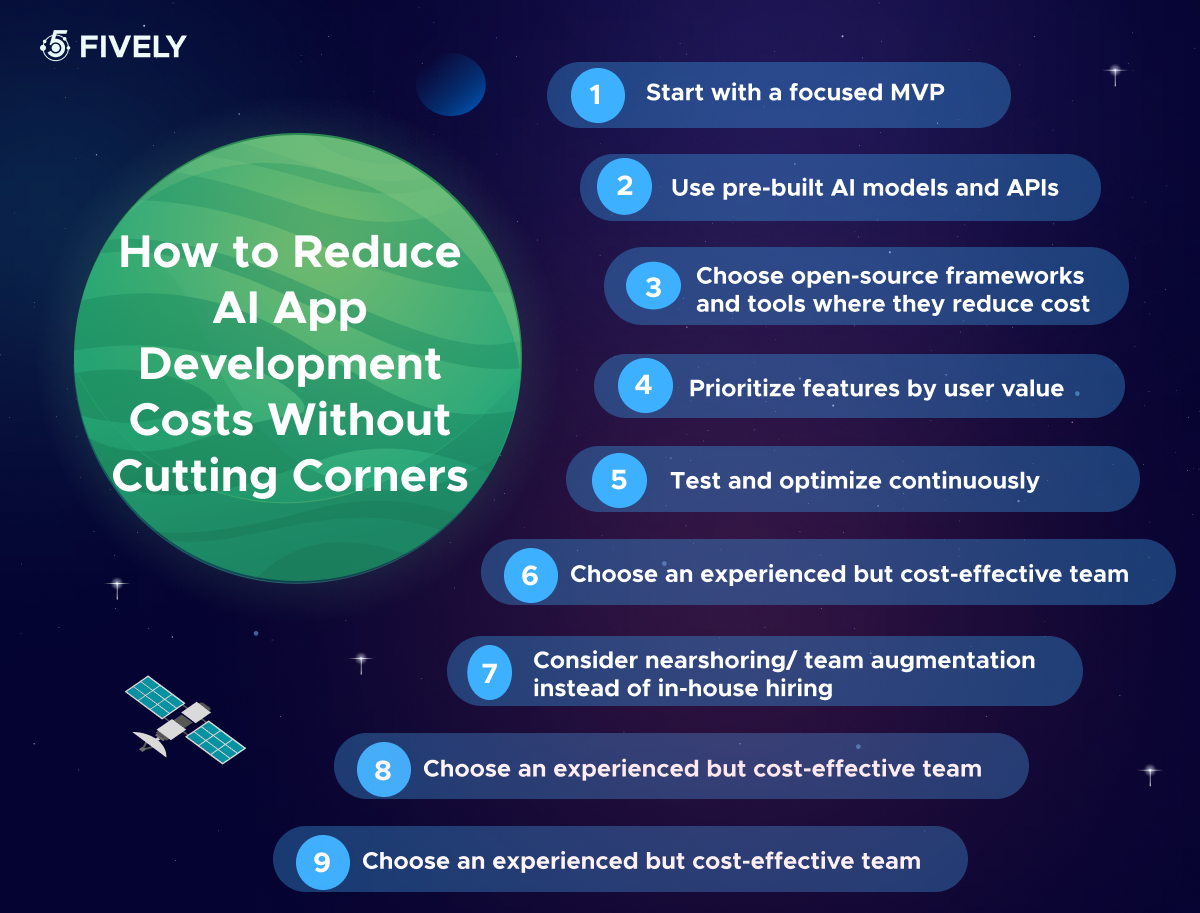
- Start with a focused MVP. Choose one user, one painful workflow, and one measurable outcome. A narrow AI MVP creates better evidence than a broad "AI platform" that does ten things badly.
- Use pre-built AI models and APIs. Do not train a custom model because custom sounds more defensible. Existing foundation models are usually the fastest path to product validation.
- Choose open-source frameworks and tools where they genuinely reduce lock-in or licensing cost. Open source is not automatically free: the team still owns deployment, updates, security, and operations.
- Prioritize features by user value. Admin dashboards, multiple personas, advanced analytics, and edge-case workflows can wait if they do not affect the core hypothesis.
- Test and optimize continuously. Build an evaluation set early. It is cheaper to catch retrieval or prompt problems before they become production architecture.
- Choose an experienced but cost-effective team. Senior engineers can look expensive per hour and still cost less overall if they avoid months of wrong architecture.
- Consider nearshoring or team augmentation instead of full in-house hiring. If your company already has a product team, adding two experienced AI/data engineers may be more economical than recruiting a complete permanent AI department.
- Route tasks to different models. Classification, extraction, summarization, and complex reasoning do not always need the same model.
- Design for cost visibility. Track cost per request, per workflow, per customer, and per successful business outcome - not only the monthly cloud invoice.
How to Evaluate an AI Development Quote: A Practical Checklist
A strong AI estimate should tell you what assumptions produced the number. Before comparing vendors, ask:
- Is the estimate broken down by stage? Data, AI/model work, application development, infrastructure, integrations, QA, deployment, and support should not disappear into one number.
- Does it include running costs, not just build costs? Ask for expected API/inference, hosting, vector database, monitoring, and third-party service costs at realistic usage levels.
- What exactly is covered by post-launch support, and for how long? "Support included" is meaningless without response times, scope, and duration.
- How will AI accuracy and performance be validated? Look for explicit quality metrics, test sets, acceptance criteria, or evaluation methodology.
- What assumptions are being made about my data? An estimate based on "clean documents ready for ingestion" changes if the real data is scattered across PDFs, SharePoint, CRM records, and legacy databases.
- How are model/provider changes handled? Ask whether the architecture can switch models without rewriting the product.
- What happens when usage grows 10×? A vendor should be able to explain both infrastructure and inference scaling.
- Why is this quote dramatically cheaper than the others? Find out whether the difference comes from scope, geography, seniority, missing QA, missing security, or optimistic data assumptions.
- Which pricing model is proposed, and why? Fixed Price, T&M, Dedicated Team, and Team Augmentation solve different uncertainty and ownership problems.
- Who owns the production system and IP? Confirm access to source code, infrastructure, accounts, prompts/configuration, data pipelines, and documentation.
 Services Account
Why Businesses Choose Fively for AI Development
AI projects need two kinds of engineering at once: experimentation and production discipline.
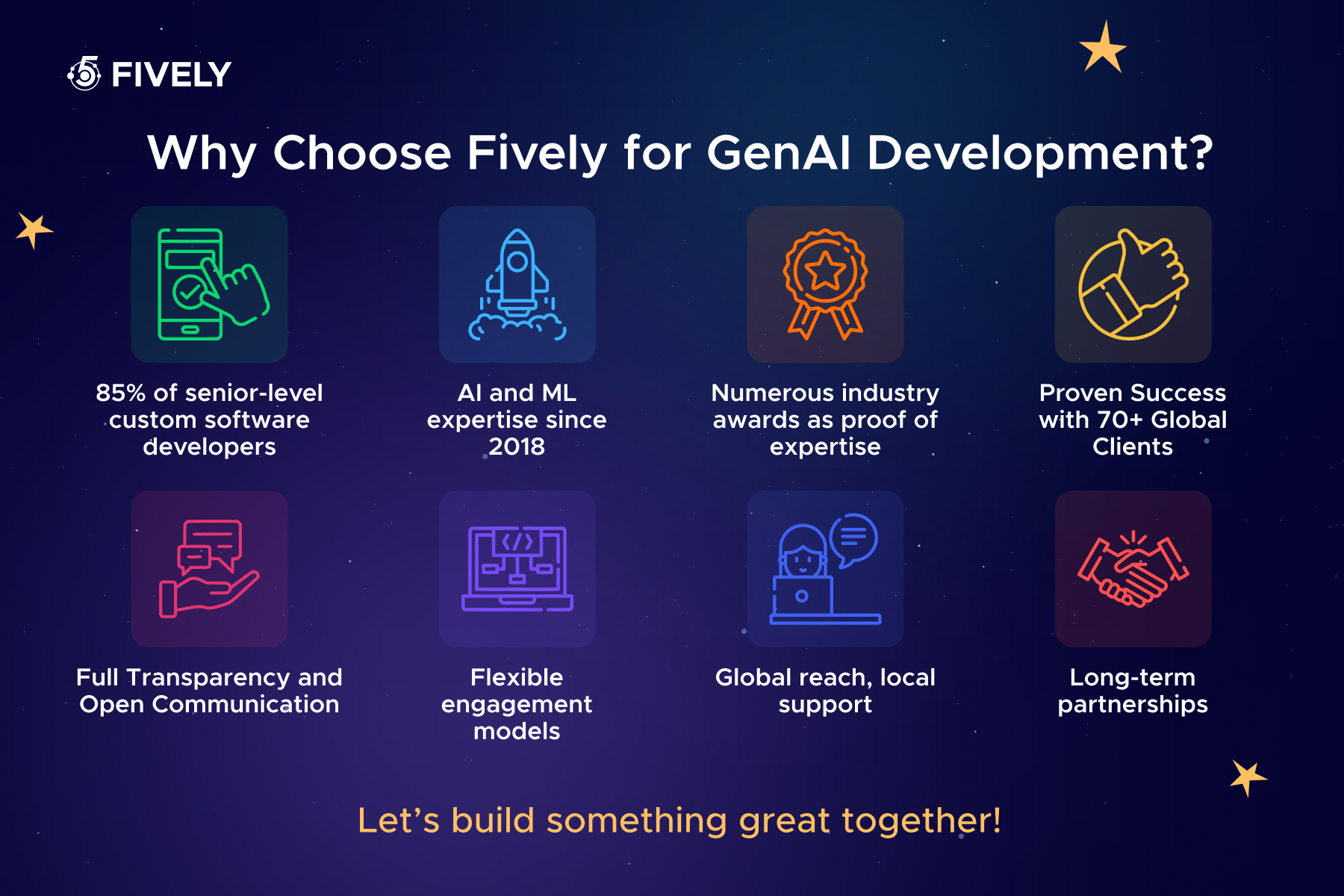
Fively approaches AI as a software product problem first. That means the work does not stop at connecting an LLM API. A production solution may require data pipelines, RAG, agent orchestration, backend services, user-facing interfaces, cloud infrastructure, security, testing, analytics, and integrations with the systems a business already uses.
That is also why we support different engagement models. A company with a strong internal product organization may need team augmentation - for example, senior artificial intelligence, backend, data, or DevOps engineers added to an existing team. Another company may need a full-cycle development partner that owns discovery, architecture, UX/UI, engineering, QA, and deployment.
For knowledge-heavy products, Fively provides retrieval-augmented generation development. For workflows that need planning, tool use, and controlled autonomy, we provide AI agent development services.
The goal is not to sell the most complicated AI architecture. It is to find the architecture that can produce the required business result at a cost the business can sustain after launch.
Conclusion
So, how much does it cost to develop an AI app in 2026?
A focused prototype may cost $5,000-$25,000, a production-minded AI MVP often falls around $20,000-$60,000, and a full custom AI application commonly reaches $60,000-$250,000. Enterprise systems can exceed $250,000-$1 million, particularly when they involve proprietary machine learning, sensitive data, complex integrations, custom infrastructure, or strict regulatory requirements.
But build cost is only half of the answer.
A useful AI budget also accounts for model inference, cloud infrastructure, data updates, RAG indexing, observability, evaluation, security, and post-launch support. The cheapest architecture is the one that reaches the required quality and business outcome with the least unnecessary complexity - not necessarily the one with the lowest initial quote.
 Services Account
Need Help With A Project?
Drop us a line, let’s arrange a discussion
Frequently Asked Questions
Yes. A narrow proof of concept can start below $20,000, and a focused AI MVP often falls in the $20,000-$60,000 range. The key is to reduce scope rather than quality: solve one high-value workflow, use an existing model, avoid unnecessary custom infrastructure, and postpone secondary features until users validate the core product. No-code and AI-assisted development can reduce the cost of early validation further. Just treat the result as a prototype unless its architecture, security, tests, and data model have been reviewed for production use.
A full development team can own the entire project: discovery, architecture, AI, backend, front end, QA, DevOps, and delivery. It is useful when you do not have the internal capacity to manage those functions. Team augmentation adds specific specialists to your existing organization. For example, you may already have a product manager, designer, and backend engineers but need two AI engineers and a data engineer for six months. Augmentation usually gives the client more delivery responsibility but can be highly cost-effective when the internal team is mature.
A common planning baseline for software maintenance is roughly 15-25% of initial development cost per year, but artificial intelligence can fall below or above that depending on usage. A low-volume internal assistant may have modest cloud and API costs. A high-volume agent can spend heavily on inference, external tools, observability, and human review. Budget separately for infrastructure/API consumption and engineering maintenance. They scale differently.
For the overwhelming majority of startups and business applications, using an existing API or hosted model is much cheaper. Training a frontier-scale foundation model from scratch can cost millions of dollars per training run. Even fine-tuning and operating a smaller custom model introduces data, GPU, MLOps, evaluation, and maintenance costs. Start with an existing model, add RAG when the system needs private/current knowledge, and consider fine-tuning only when evaluation shows a clear reason.
A proof of concept may take 2-8 weeks, a focused MVP around 6-12 weeks, and a full production application 3-9 months. Enterprise AI can take a year or longer. Time affects cost because most AI development is still expert labor. However, shortening the timeline does not always reduce the budget: parallelizing work may require a larger team. The most reliable way to reduce both time and cost is to reduce scope and uncertainty early.


