
Offshore React Native Development Services: Cost, Models, and Hiring Guide for 2026

• 17 min
I'm a content specialist at Fively keen on writing fresh articles that can help out business and tech specialists. I love to conduct research, hold interviews, and spotlight sophisticated tech issues.
Explore offshore React Native development in 2026: costs, hiring models, regions, technical vetting, security, and the difference between React web and React Native mobile teams.
This popular technology gives companies access to mobile engineers outside their home market who can build and maintain iOS and Android applications from a shared React Native codebase. Done well, it is not simply a cheaper way to hire developers: it is a way to add scarce mobile expertise, shorten recruiting cycles, and scale delivery without building every role in-house.
The catch is that React Native is not React-for-the-web with an App Store button. A strong developer needs to understand native iOS and Android behavior, release pipelines, device performance, platform APIs, and the framework’s modern architecture. Today, we explain the costs, engagement models, technical checks, regional trade-offs, and vendor questions that matter in 2026.
Offshore React Native Development: Cost & Models at a Glance
If you want a quick answer, you can choose the engagement model based on how much engineering ownership already exists inside your company. Rates matter, but the management model usually matters more.
As a 2026 market reference, broad offshore software rates commonly run from roughly $15 to $120 per hour depending on region and seniority. Central and Eastern Europe often sits around $30–$80/hour for mid-to-senior engineers, Latin America around $25–$75/hour, and South Asia around $18–$60/hour.
React Native specialists can price toward the upper part of a local band when they bring strong native iOS/Android experience rather than JavaScript-only experience.
Now, let’s dive in the sense of this technology and how it differs from React development.
What "Offshore React Native Development" Actually Means
Offshore development means hiring software engineers or a development company in a country materially distant from your own operating market. In React Native, that team builds cross-platform mobile software with JavaScript or TypeScript while still interacting with native iOS and Android capabilities.
The word “offshore” describes the delivery geography, not the engagement model. An offshore engineer can join your existing Scrum team through staff augmentation, or an offshore vendor can take responsibility for the whole mobile product through full-cycle development.
React vs. React Native: Why the Distinction Matters
Both technologies share React’s component model and commonly use JavaScript or TypeScript, but for hiring, however, the distinction is critical.
Of course, a senior React web developer can learn React Native faster than someone starting from zero, but that does not automatically make them a senior React Native engineer. Offshore hiring should verify mobile production experience explicitly.
Why Companies Choose Offshore React Native Development Services
If cost is the only reason to go offshore, the engagement is fragile. The stronger business case is access: access to engineers, capacity, mobile specialization, and the ability to scale a team around product demand.
Unavailability of Expertise
Developed markets have large developer communities, but demand for experienced mobile engineers can still exceed the supply available to a particular company, budget, location, or hiring timeline. Offshore hiring expands the candidate pool beyond one city or country. The 2025 Stack Overflow Developer Survey itself drew responses from 177 countries, with Poland, Ukraine, India, Brazil, and other major outsourcing markets represented among the global developer community.
Faster Hiring and Onboarding
A specialized development vendor already maintains recruiting, technical screening, contracting, and replacement processes. That can turn a months-long permanent-hiring cycle into a much shorter staffing process. The exact speed varies by seniority and availability, so treat “developer in a week” promises as a service target to verify rather than a universal rule.
One Codebase, Two App Stores
React Native lets teams share a large portion of product logic and UI patterns across iOS and Android while still producing native applications. This does not mean 100% identical code: platform-specific behavior, native modules, store requirements, and device quirks remain. But compared with maintaining two completely separate native teams, the shared codebase can reduce duplicated feature work and coordination.
Flexible Team Scaling
Offshore staff augmentation makes it practical to add a React Native engineer for a release, bring in a native specialist for a migration, or expand QA during a critical launch window. The model also lets companies reduce external capacity when a product enters a quieter maintenance phase without restructuring the permanent team.
React Native Is Mainstream
This technology is a mature production framework rather than an experimental cross-platform shortcut. Meta made the New Architecture the default in React Native 0.76, React Native 0.82 became New-Architecture-only, and React Native 0.84 made Hermes V1 the default JavaScript engine. For buyers, that means vendor evaluation in 2026 should focus on current architecture experience, not merely whether someone has shipped an old React Native app.
Offshore vs. Nearshore vs. Staff Augmentation vs. Full-Cycle Development
There is no universally best model. A CTO with a mature mobile team usually benefits more from augmentation than from handing over delivery. But, a founder with no engineering organization usually needs full-cycle ownership, because hiring three offshore developers without architecture, QA, product management, and release ownership simply creates a distributed management problem.
Development Costs in 2026
React Native rates depend on region, seniority, native-platform depth, English communication, product domain, and whether you are buying an individual engineer or an accountable delivery team. The bands below are planning estimates for hiring dedicated React Native developers, not fixed vendor quotes.
Cost by Seniority Level
Regional market reports published in 2026 place senior Eastern European engineers roughly in the $40–$80/hour band, Latin American seniors around $35–$75/hour, and South Asian seniors around $25–$60/hour. React Native specialists with genuine Swift/Kotlin or complex native-module experience often command a premium over general JavaScript developers.
Hidden Costs Nobody Mentions
The hourly rate is only the visible layer. A serious comparison should also include:
- Project and delivery management. For a managed team, PM/delivery overhead can represent roughly 10–15% of the engineering budget depending on scope and reporting needs.
- QA and device testing. Mobile QA needs real devices or device farms, OS-version coverage, test automation, and tools such as Maestro or Detox where appropriate.
- DevOps and release engineering. App signing, certificates, Fastlane/EAS workflows, CI minutes, secrets, store tracks, and release automation require setup and maintenance.
- Replacement cost. A failed hire creates a second vetting cycle plus context loss, onboarding time, and delayed delivery.
- Native expertise. A cheap JavaScript developer becomes expensive if the app later needs Bluetooth, camera/media pipelines, background execution, push-notification edge cases, or a problematic third-party native SDK.
- Communication overhead. Poorly designed handoffs across time zones can erase a meaningful part of the nominal rate advantage.
Where to Find Offshore React Native Developer: A Region-by-Region Breakdown
As you can see, region is a filtering variable, not a quality score. A strong senior engineer in India can outperform a weak engineer in England, and vice versa. Use geography to plan overlap, budget, legal structure, and hiring reach; use technical vetting to determine engineering quality.
The React Native Technical Checklist Most Offshore Vendors Skip
Capability lists are easy to write, while buyer questions here can be more useful. Before signing, ask the vendor to answer these with examples from production.
New Architecture, Fabric, and TurboModules
Ask: “Do your engineers have production experience with the React Native New Architecture, including Fabric/TurboModules or modern native-module integration — not only a pet project?”
This matters because React Native 0.82 made the New Architecture mandatory, and 0.84 continued removing legacy architecture components.
Expo vs. Bare / Native Workflow
Ask: “How do you decide when Expo is enough and when the project needs direct native projects or custom native code?”
React Native officially recommends using a framework such as Expo for new applications, but experienced teams must still know how to integrate native SDKs and escape framework assumptions when the product requires it.
State & Data Layer
Ask: “What is your default approach to server state and local state, and why?”
A good answer should distinguish cached server data from UI/application state instead of automatically reaching for one global store. React Query/TanStack Query, Zustand, Redux Toolkit, or framework-specific tools can all be valid depending on the product.
Performance
Ask: “How do you measure startup time, slow renders, list performance, animation issues, and memory problems?”
Look for profiling and measurement, strong engineers should be comfortable with React Native DevTools, platform profilers, render analysis, image/network optimization, and device-level testing.
Testing & Release Pipeline
Ask: “What is your test pyramid, which E2E tooling do you use, and how does a commit reach TestFlight/Google Play internal testing?”
The answer should cover unit/integration tests, E2E where valuable, CI/CD, signing, environment management, crash monitoring, staged releases, and rollback or OTA strategy where applicable.
Native Modules & Legacy Migration
Ask: “Have you migrated an existing native or legacy React Native application, and what broke?”
Brownfield work exposes whether a team can reason beyond JavaScript: dependency compatibility, Swift/Kotlin code, build systems, native SDKs, navigation, architecture migration, and staged rollout.
How to Vet a React Native Team Before You Sign
Here are some recommendations by Fively:
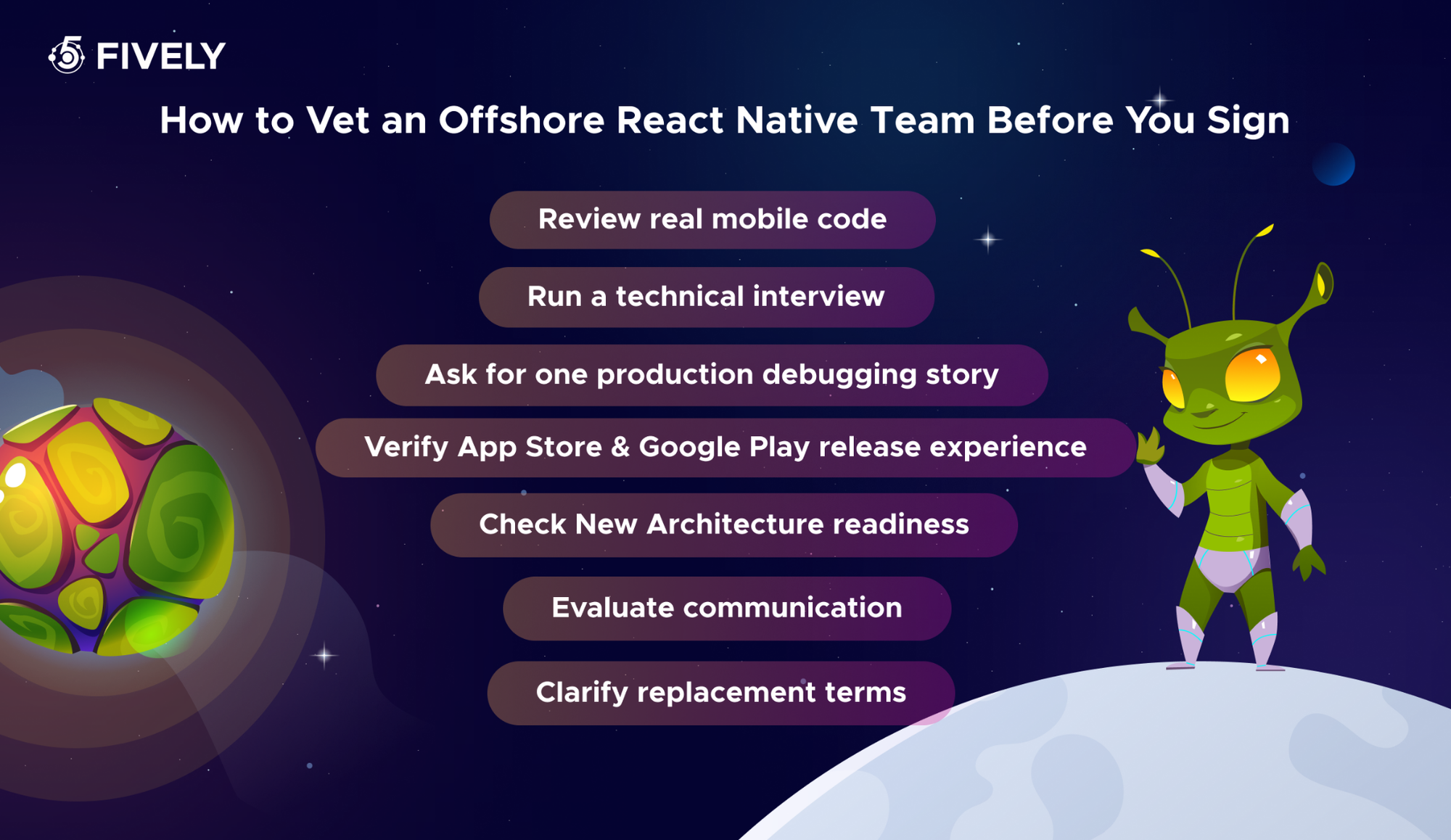
- Review real mobile code, not a generic JavaScript test. Include component design, TypeScript, asynchronous work, error handling, platform-specific behavior, and testability.
- Run a technical interview with a senior React Native engineer who can challenge architecture decisions. If you do not have one internally, use an independent reviewer.
- Ask for one production debugging story. The most revealing answers involve a performance regression, native dependency, release failure, memory issue, or platform-specific bug.
- Verify App Store and Google Play release experience. Shipping is part of mobile engineering.
- Check New Architecture readiness and dependency choices. A vendor still centered on the Legacy Architecture in 2026 is a warning sign.
- Evaluate communication with the person who will actually join the project, not only the salesperson.
- Clarify replacement terms, notice periods, knowledge transfer, and who pays for ramp-up if a developer does not work out.
- Start with a bounded paid trial or first sprint when the project allows it. Evaluate code quality, predictability, communication, and ownership together.
Security, IP, and GDPR: What Regulated Clients Need to Know
Offshore delivery does not remove the client’s responsibility for data protection, intellectual property, or supplier risk. Regulated companies should make legal and security requirements part of vendor selection rather than paperwork added after the engineering team already has production access.
- IP assignment: the contract should state who owns source code, designs, documentation, inventions, and deliverables created during the engagement.
- NDA and confidentiality: define protected information, permitted disclosure, subcontractor obligations, and what happens when the engagement ends.
- GDPR: if an offshore team processes personal data for an EU/EEA business, define controller/processor roles, data-processing terms, access controls, retention, subprocessors, and lawful international transfer mechanisms where required.
- Least-privilege access: dedicated React Native engineers should receive only the environments, repositories, customer data, and production permissions needed for their work.
- Security operations: ask about MFA, device policies, secrets management, incident response, logging, secure mobile app development practices, and employee offboarding.
- Data residency: healthcare, finance, public-sector, or enterprise customers may impose additional regional hosting and access requirements.
For sensitive projects, legal counsel should validate the final contract and cross-border data-transfer setup. A development vendor can implement controls, but it should not be your only source of legal interpretation.
Industry-Specific Expertise
Finally, React Native engineering is easier to evaluate when the vendor can show mobile work under real domain constraints. For example, Fively’s public portfolio includes React Native projects in healthcare, cybersecurity, IoT, travel/parking, and CRM-related workflows.
HealthTech
What React Native work tends to require: Sensitive data, reliable workflows, role-based access, device-friendly UX
Relevant Fively example: AviMedical — a medical resource management application for a chain of practices in Germany
 Services Account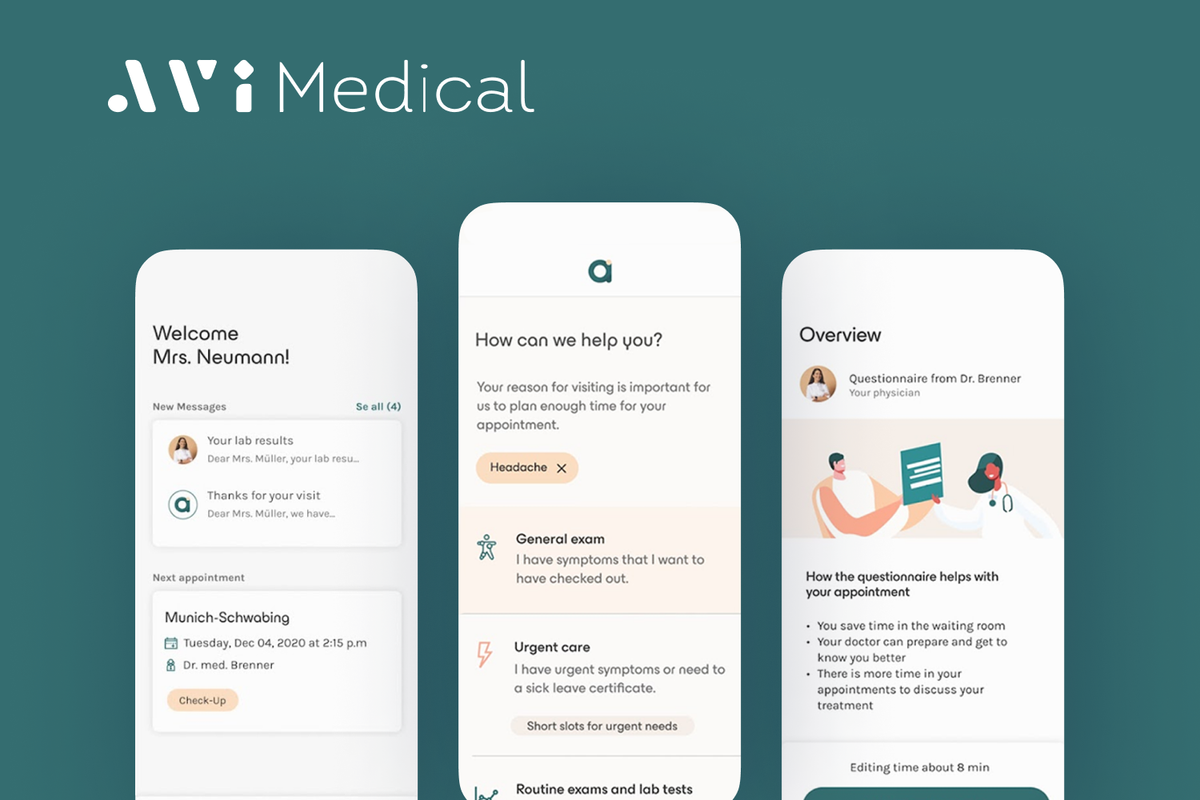
Cybersecurity
What React Native work tends to require: Secure authentication, identity flows, careful permissions
Relevant Fively example: Identity-access management automation using a React Native tech
 Services Account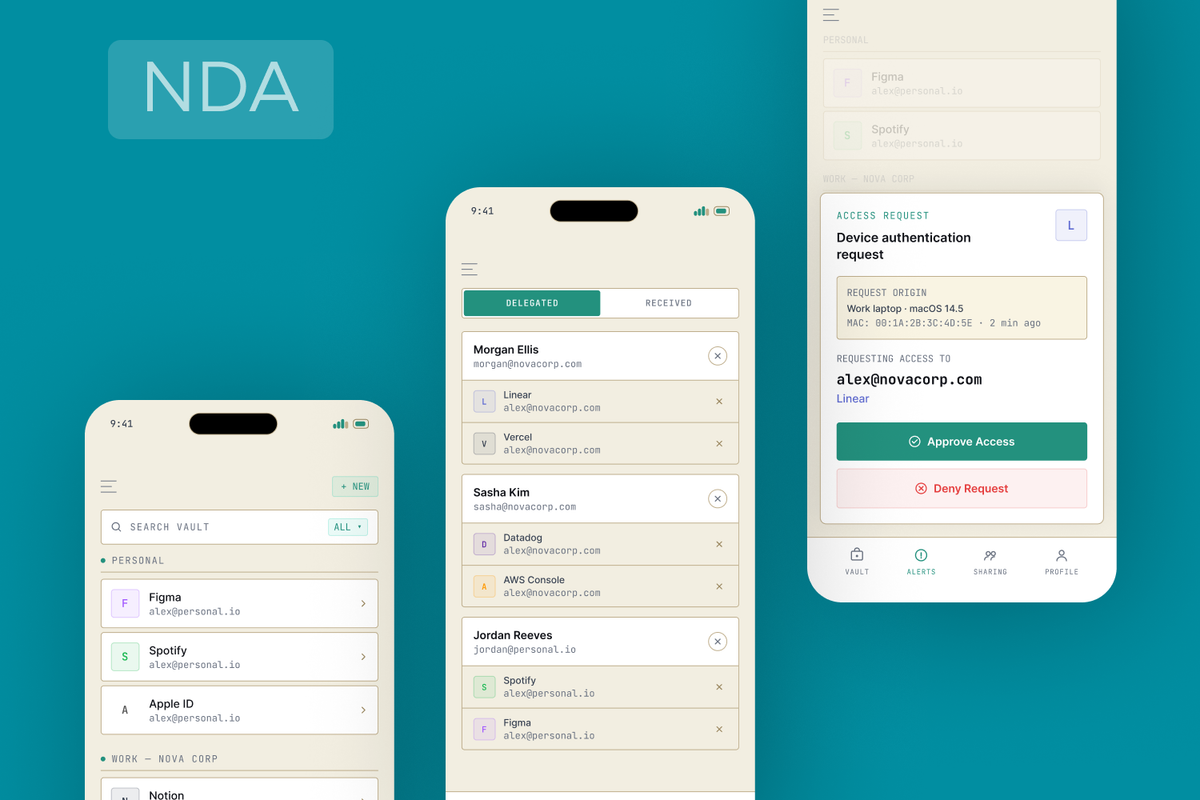
IoT
What React Native work tends to require: Native device connectivity, background behavior, state synchronization
Relevant Fively example: 3D printer remote control mobile application
 Services Account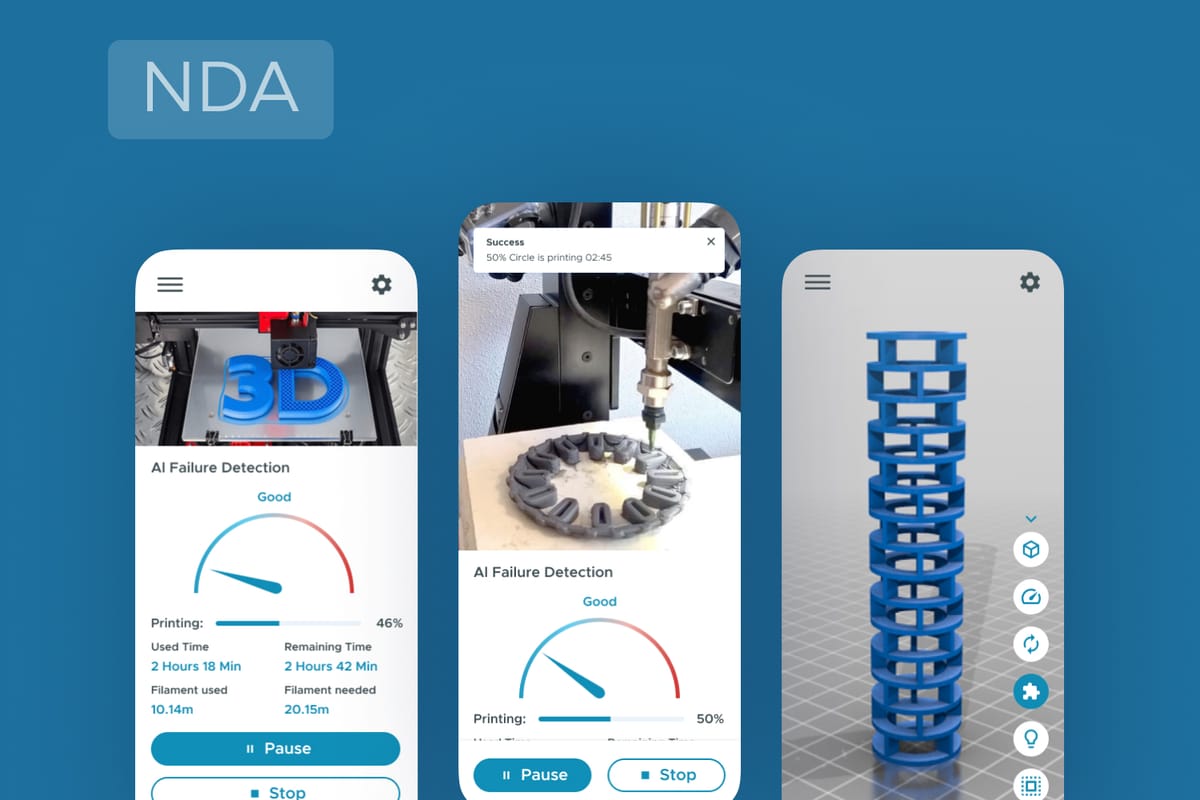
Travelling
What React Native work tends to require: Location-aware flows, booking, payments, real-time status
Relevant Fively example: Parking app — a modern booking application for Scandinavian airports
 Services Account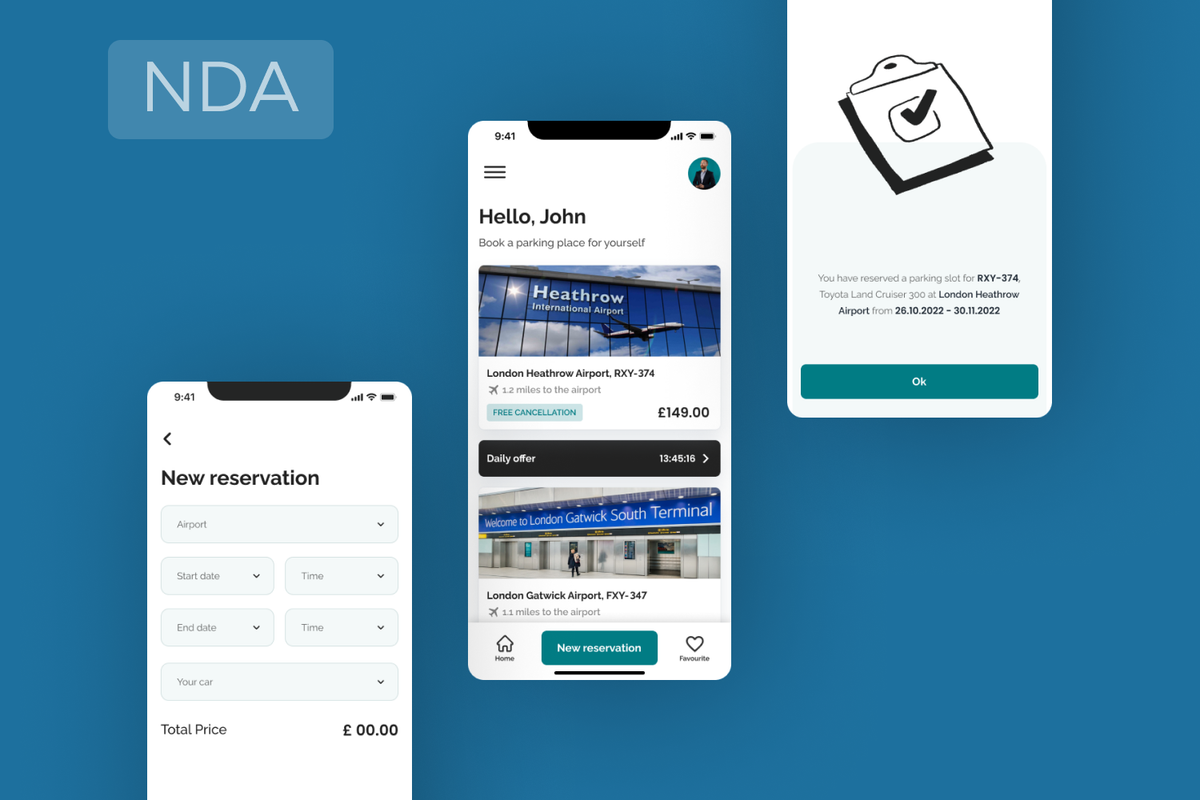
Entertainment
What React Native work tends to require: Mobile workflows, field access, integrations
Relevant Fively example: Volt — CRM customization services for the company, that electrifies dozens of widely-known music festivals all across Europe.
 Services Account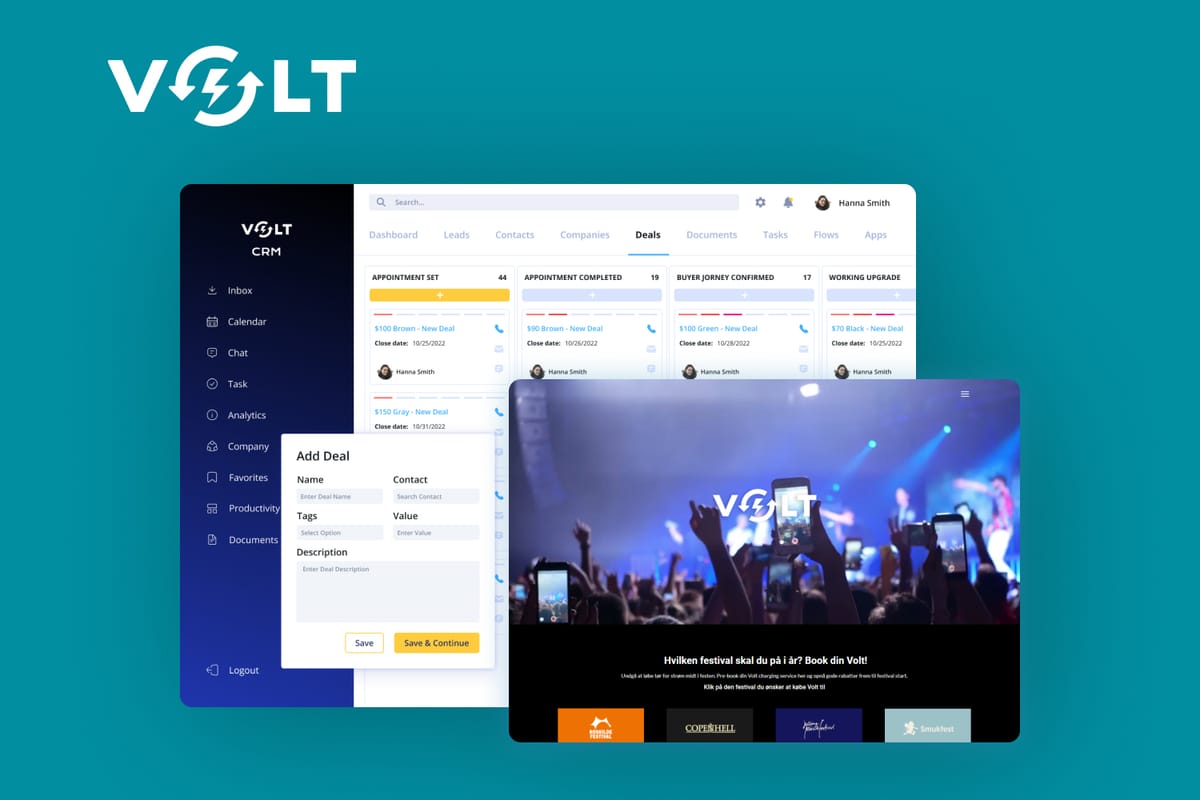
How Fively Delivers Offshore Software Development
Fively is a full-cycle software development company operating internationally, with a public portfolio that includes React Native projects across HealthTech, cybersecurity, IoT, mobility, and business software. For offshore development, the engagement can be structured around either delivery ownership or targeted engineering capacity.
Full-Cycle Development vs. Team Augmentation
For a new mobile product, full-cycle delivery can remove the need to separately assemble a mobile architect, React Native engineers, QA, PM, and release expertise. For an existing app, augmentation is often more efficient: a senior React Native engineer can join the current sprint cadence, work inside the existing repository, and help with feature delivery, performance, migration, or native integrations.
Summing up, offshore development works best when it is treated as an engineering model, not a rate-shopping exercise.
The best team is not the one with the cheapest JavaScript developer, but the one that can ship and operate a native mobile product across iOS and Android, work inside your delivery model, and handle the parts of React Native that stop being “just React” (native modules, performance, releases, devices, architecture migrations, and platform-specific failures).
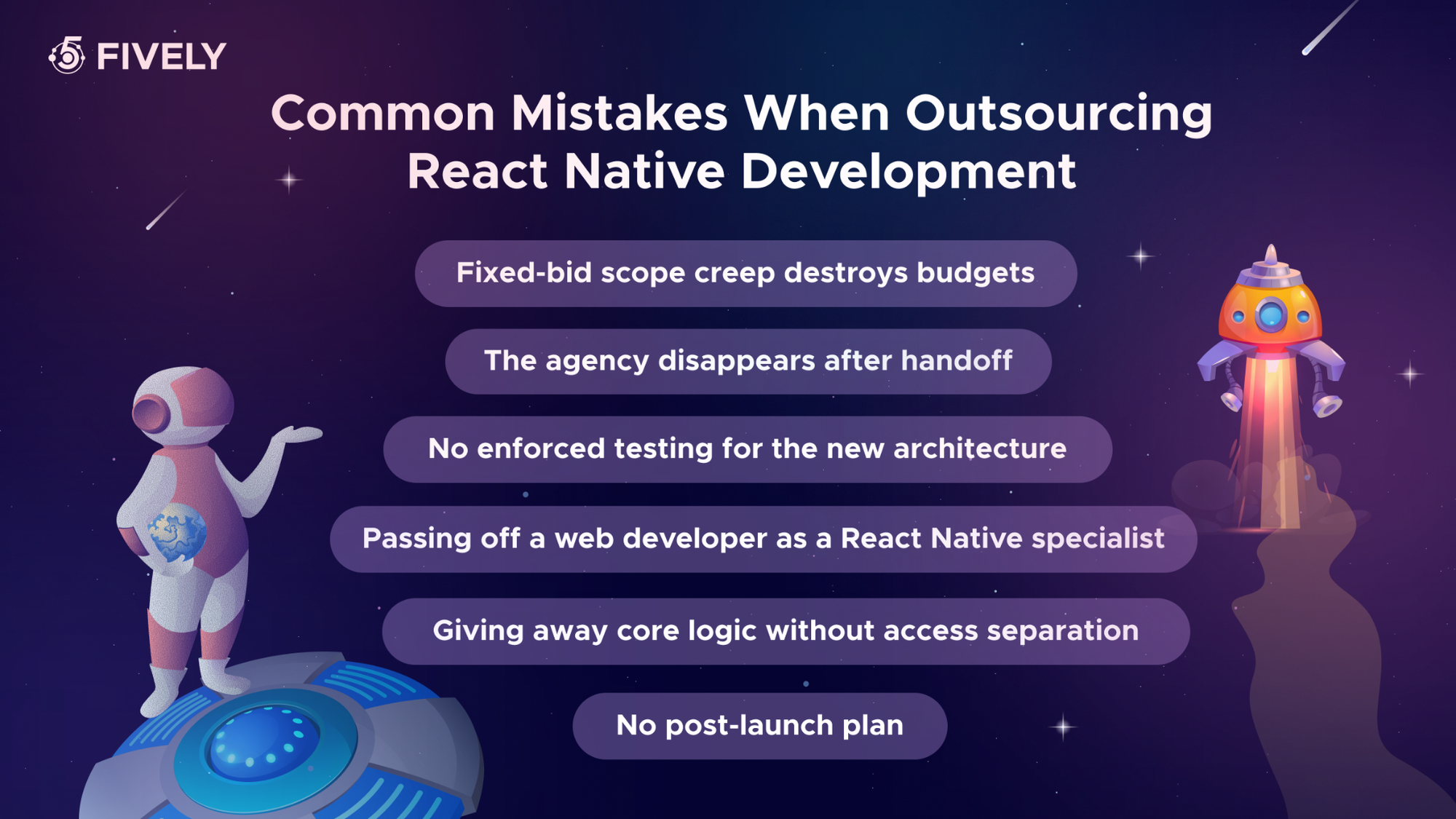
Common Mistakes When Outsourcing React Native Development
For most buyers, the decision sequence is simple: choose the ownership model first, choose the region second, then vet the actual engineers against your product’s technical risks. But the most expensive outsourcing failures usually come from a mismatch between the commercial model and the technical reality of mobile app development.
Fixed-Bid Scope Creep Destroys Budgets
A fixed price can work for a tightly specified migration or feature package, but React Native products often reveal unknowns in native SDKs, legacy dependencies, store requirements, and device behavior. If every discovery becomes a change request, the “predictable” budget turns into negotiation overhead. Use fixed scope where uncertainty is low; use Time & Material or milestone-based discovery where technical unknowns are material.
The Agency Disappears After Handoff
Store submission is not the end of a mobile product. iOS and Android updates, SDK deprecations, dependency changes, crash spikes, certificate renewals, and store-policy changes continue after launch. Ask who owns the first weeks after release, what support SLA exists, and whether the engineers who built the app remain available for critical fixes.
No Enforced Testing for the New Architecture
React Native’s New Architecture is no longer optional in current releases. A team that only checks whether the app compiles can miss behavioral regressions, incompatible libraries, performance changes, and native integration problems. Migration work should include regression coverage, representative devices, release builds, and explicit validation of critical flows.
Passing Off a Web Developer as a React Native Specialist
React and React Native share concepts, but mobile production adds platform APIs, build tooling, native dependencies, signing, store release processes, and device-specific performance. A web engineer can transition successfully, but the vendor should be transparent about the person’s actual mobile track record. For a complex project, ask specifically about Swift/Kotlin exposure, native modules, release ownership, and debugging on physical devices.
No Post-Launch Plan
A fixed-bid project that ends at store submission can leave the client owning every crash, OS update, and dependency failure without the context of the original team. Define warranty, maintenance, monitoring, incident response, upgrade cadence, and knowledge transfer before launch rather than negotiating them during the first production incident.
Giving Away Core Logic Without Access Separation
Offshore engineers may need deep repository and infrastructure access, but they rarely need unrestricted access to everything. Separate environments, use least privilege, protect production data, rotate credentials, log sensitive actions, and keep ownership of cloud, source-control, store, and analytics accounts with the client organization.
Why Hire Offshore React Native Developers at Fively
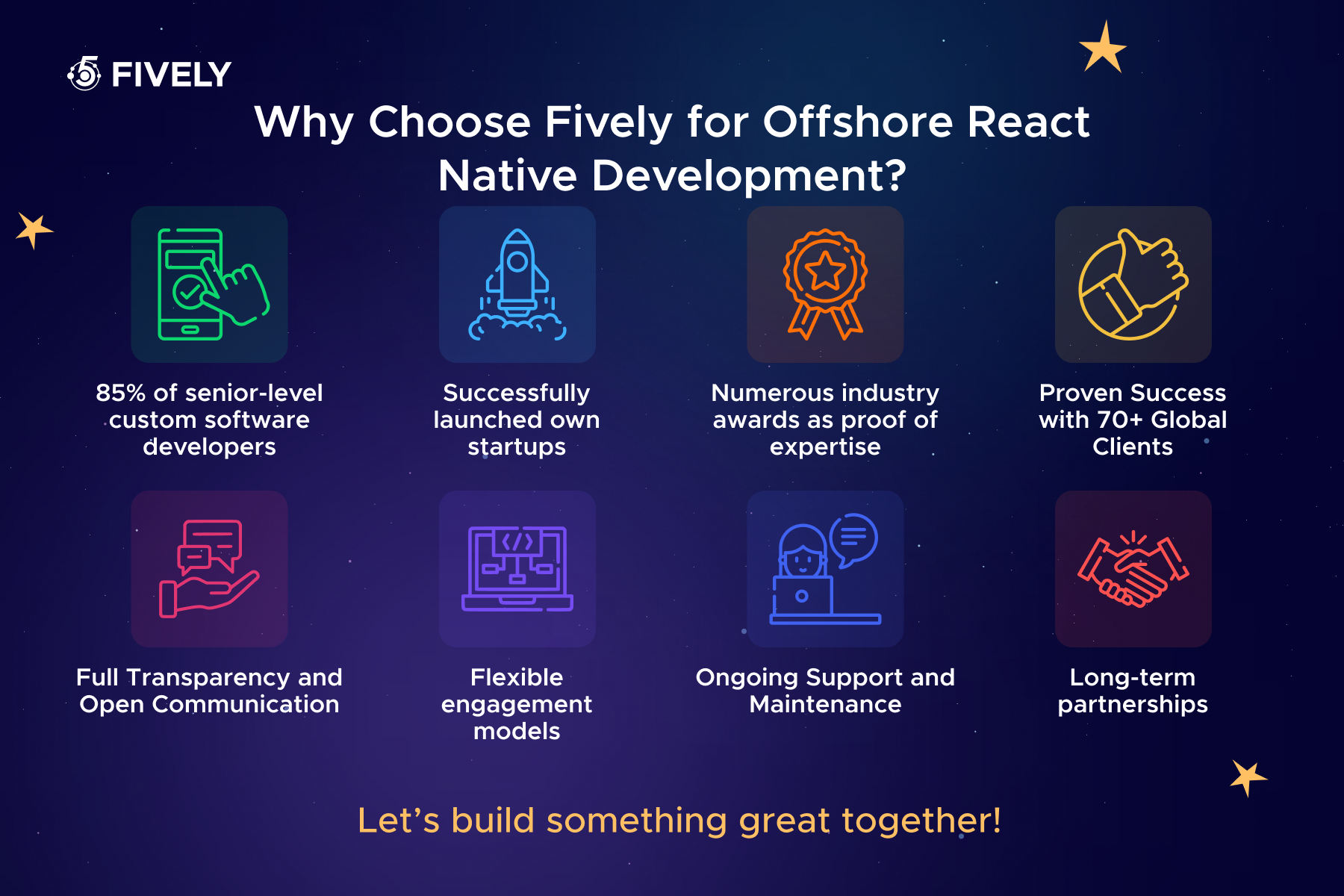
Fively combines the two things offshore mobile projects often separate: access to individual engineering talent and responsibility for complete product delivery.
That lets clients choose the operating model around their internal maturity instead of forcing every project into the same outsourcing package.
The company’s public portfolio includes React Native work in HealthTech, cybersecurity, IoT, mobility, and CRM-related products. Those projects are useful evidence of how we provide excellent security, smooth device behavior, and smart operational workflows in various domains.
For an established product organization, Fively can provide team augmentation: selected engineers work inside the client’s sprint cadence, repository, communication channels, and technical leadership. For a company that needs broader ownership, the full-cycle model can include architecture, React Native engineering, QA, delivery management, and release coordination. In both cases, the useful question is not “How many developers can you send?” but “Which delivery responsibility should remain with us, and which should the offshore partner own?”
Conclusion
The cheapest offshore quote and the safest offshore hire are rarely the same team. React Native makes cross-platform delivery efficient, but production mobile engineering still demands iOS and Android knowledge, modern architecture, testing, release automation, security, and long-term maintenance.
Match the engagement model to your internal engineering capacity, choose a region based on overlap and economics, and then vet the actual developers against the risks in your app. When those pieces line up, offshore development can reduce hiring friction and development costs without turning technical quality into the trade-off.
 Services Account
Need Help With A Project?
Drop us a line, let’s arrange a discussion
Frequently Asked Questions
React development normally refers to web apps built with React, while React Native refers to native mobile apps for iOS and Android built with React Native. The technologies share React concepts and JavaScript/TypeScript, but React Native engineers also need mobile platform knowledge, native SDK integration, app signing, store releases, device testing, and mobile performance skills.
A practical planning range is about $20–$40/hour for junior engineers, $35–$65/hour for mid-level developers, $50–$90/hour for senior React Native engineers, and $70–$120+/hour for leads or specialists with deep native expertise. Geography, vendor model, domain, and project complexity can move the rate significantly. Compare total delivery cost rather than hourly rate alone.
Ask for a production example and make the team explain the architecture decisions. For New Architecture work, ask about Fabric, TurboModules, dependency compatibility, migration issues, and the React Native versions they have shipped. For Expo, ask how they decide between framework-managed capabilities and custom native code, and how they handle routing, builds, EAS/CI, native plugins, and release workflows.
It can be, provided the delivery setup meets the same security and compliance requirements you would apply to an internal or local vendor. That includes contractual IP and confidentiality terms, GDPR or other applicable data-processing controls, least-privilege access, secure devices, MFA, auditability, controlled production access, and appropriate data residency. Regulated projects should involve qualified legal and security review.
Choose staff augmentation when you already have product and engineering leadership and mainly need additional React Native capacity or a specific specialist. Choose full-cycle development when you need a partner to own a larger part of discovery, architecture, engineering, QA, project delivery, and release. The wrong model creates management gaps even when the engineers themselves are strong.
For a common mid-level or senior profile, a vendor with an active talent pipeline may be able to present candidates within days and start onboarding in roughly one to several weeks. Highly specialized roles — for example, React Native plus deep Swift/Kotlin, Bluetooth, video, payments, or regulated-domain experience — can take longer. Ask vendors to distinguish candidate presentation time from the actual start date.


