
Custom Software Development Cost in 2026: Pricing, Factors, and Estimates

• 19 min
I'm a content specialist at Fively keen on writing fresh articles that can help out business and tech specialists. I love to conduct research, hold interviews, and spotlight sophisticated tech issues.
Explore custom software development cost in 2026, pricing by complexity and software type, key budget factors, hidden expenses, and practical ways to reduce total spend.
Custom software development cost can range from tens of thousands of dollars for a focused MVP to several hundred thousand dollars for a complex enterprise platform. Architecture, business logic, integrations, security, expected traffic, team structure, and post-launch operations all shape the final software development project price.
A realistic estimate starts with clear business goals, users, platforms, data requirements, integrations, and deadlines. The more uncertainty that remains, the wider the initial range will be. This guide explains custom software development pricing in 2026, the cost of each SDLC stage, major budget factors, and the hidden expenses included in total cost of ownership.
Important: All project costs, hourly rates, timelines, and percentages in this article are approximate planning ranges. The final estimate depends on the requirements, risks, delivery model, and software development company you choose.
Summary
- A basic MVP commonly costs $25,000–$60,000, while a standard business application often falls between $60,000 and $150,000.
- Complex SaaS products, marketplaces, and data-heavy platforms may cost $150,000–$400,000+.
- Enterprise and high-load systems typically start around $400,000 and can exceed $1 million when they involve strict compliance, legacy modernization, advanced security, or large-scale infrastructure.
- Software engineering is usually the largest part of the initial development budget, but discovery, design, QA, security, deployment, and DevOps are also necessary cost components.
- The initial build is only part of the total cost. Cloud hosting, monitoring, licenses, maintenance, audits, training, and further product development continue after launch.
Custom Software Development Price in 2026
For most commercial projects, the average cost of building custom software is somewhere between $25,000 and $500,000. This is a wide range because “custom software” may describe a focused internal tool, a mobile application, a subscription-based SaaS product, a marketplace, an AI-enabled platform, or a global enterprise system.
A rough estimate can be useful for early budgeting, but it should not be treated as a fixed quote. Two applications that look similar to end users can require very different investments behind the interface. One may use standard authentication and a simple database, while the other needs complex permissions, real-time synchronization, data migration, audit logs, high availability, and integrations with several legacy systems.
The following tables provide practical starting points for estimating custom software.
Cost by Software Project Complexity
Complexity grows faster than the visible feature count. Adding one reporting screen may be inexpensive if the required data already exists in a clean format. The same screen may become a major workstream if the team must build a data pipeline, reconcile several databases, implement role-based access, and guarantee near-real-time updates.
Cost by Software Type
These ranges can overlap because the software type alone does not determine the budget. A lightweight CRM for a small team may cost less than a mobile app with complex offline synchronization. A B2B SaaS product may begin as an MVP and later become an enterprise platform with advanced compliance and infrastructure needs.
Software Development Cost Breakdown by SDLC Stage
Custom software app development pricing becomes easier to understand when the project is divided into stages. Each stage produces a specific outcome and reduces a different type of risk. Skipping one stage rarely removes the work entirely; it often moves the cost later, when changes are more expensive.
The percentages are not universal. A design-led consumer product may allocate more to UX/UI, while a regulated enterprise system may spend more on security testing, documentation, and infrastructure. Maintenance and further product development process are ongoing costs and are not included in the initial-build percentages above.
Discovery and Product Planning
Discovery turns a business idea into an estimable product plan. The team clarifies users, goals, workflows, functional requirements, constraints, success metrics, and launch scope. Work may include stakeholder interviews, user journey mapping, feature prioritization, technical research, current-system review, and risk assessment.
The output provides the basis for scope, architecture, timeline, and cost estimation. It also exposes unclear requirements and technical risks before they create expensive rework. A focused MVP may need a short discovery, while enterprise software or legacy modernization can require several weeks of analysis by software developers.
UX/UI Design and Software Architecture
The design phase combines product experience with technical design. UX/UI designers create user flows, wireframes, prototypes, responsive layouts, visual styles, and reusable components. Cost depends on the number of workflows and devices, research depth, accessibility, and visual customization.
Software architects define modules, APIs, data structures, security boundaries, integrations, infrastructure, and scaling strategy. They choose suitable databases, cloud services, messaging, caching, and deployment patterns. Coordinating both areas reduces ambiguity: a simple-looking interface may require complex business logic, while a strong architecture still needs a usable product experience.
Software Engineering
Software engineering is usually the largest part of the project cost because it converts plans and designs into a working product. The exact split depends on the solution, but common workstreams include:
- frontend development for web or mobile interfaces;
- backend development for server-side logic;
- database design and implementation;
- API development;
- third-party and internal system integrations;
- business logic and workflow automation;
- authentication, authorization, and role management;
- code review and refactoring;
- technical documentation;
- development and staging environments;
- continuous integration setup.
Engineering cost depends on difficulty as well as feature count. Standard forms and CRUD workflows are predictable; real-time collaboration, complex calculations, custom search, offline synchronization, high-volume processing, and unusual integrations require more senior expertise and testing. Reusable components, managed cloud services, automated checks, containerized environments, and CI/CD can reduce repetitive work and release risk when their setup is justified by the product roadmap.
Quality Assurance and Security Testing
Quality assurance verifies the product across realistic devices, browsers, roles, data states, integrations, edge cases, and failure scenarios. Automated tests are valuable for stable, business-critical workflows that will be checked during every release.
Security testing may include dependency scanning, access-control tests, secure configuration review, threat modeling, penetration testing, and verification of encryption or logging. QA and security commonly account for 10–20% of the initial development budget. Cutting this stage may reduce the pre-launch invoice, but production bugs, data exposure, and emergency fixes are usually more expensive.
Deployment and DevOps Setup
Deployment moves the product into a stable production environment. DevOps work may include cloud configuration, infrastructure as code, CI/CD, secrets management, monitoring, logging, backups, recovery procedures, and release automation.
A small internal app may use a simple managed platform. Customer-facing SaaS needs separate environments, observability, backups, and rollback procedures, while high-load or regulated software may require redundancy, network isolation, disaster recovery, and audit logs. Initial deployment and DevOps setup often represent 5–10% of the build cost, followed by recurring operational expenses.
Maintenance and Further Product Development
Maintenance and further product development should be budgeted separately. Software maintenance covers bug fixes, security patches, dependency updates, monitoring, compatibility work, and external API changes. A common planning range is 15–25% of the initial development cost per year, though business-critical platforms may require more.
Further product development adds integrations, roles, analytics, automation, AI features, new platforms, or market-specific functionality. Maintenance protects the existing investment; roadmap development funds new business value.
What Factors Affect Custom Software Development Cost?
The SDLC breakdown explains where the money goes. The following factors explain why the same stage may cost more or less from one project to another.
Project Scope and Feature Complexity
Project scope defines what the team must deliver. It includes user roles, workflows, screens, integrations, platforms, administrative tools, reports, notifications, and operational requirements. Every feature creates design, engineering, testing, and maintenance work.
Feature complexity matters as much as feature count. A standard password reset is relatively predictable. A pricing engine with region-specific rules, approval chains, exceptions, and auditability is not. Features involving real-time updates, financial calculations, recommendation logic, complex search, document generation, or large data volumes typically require more senior engineering and more QA.
Clear priorities control cost. Separating must-have workflows from improvements and experiments allows the team to launch a smaller testable version and invest further based on evidence.
Target Platforms
Supporting one responsive web application is usually less expensive than building separate web, iOS, and Android products. Each platform introduces implementation, testing, release, and maintenance work.
For mobile development, native applications provide deeper platform control but often require separate iOS and Android workstreams. Cross-platform frameworks share more code, although device-specific features still need separate testing. Desktop apps, browser extensions, smart devices, and offline environments add further requirements. The best approach depends on actual user needs, not only the lowest initial price.
Software Architecture, Performance, and Scalability
An application built for a small internal team has different technical requirements from a platform expected to support thousands of simultaneous users. Scalability can require load balancing, caching, database replication or sharding, asynchronous processing, content delivery networks, observability, and distributed services.
Performance targets also affect custom software development pricing. Fast search across millions of records, real-time dashboards, media processing, low-latency transactions, and large file operations demand additional architecture and optimization work.
Premature microservices can create unnecessary complexity, while ignoring predictable growth can force major refactoring. Architecture should match realistic traffic and reliability goals, with a clear path for scaling when demand is proven.
 Services Account
UI/UX Design Requirements
Design cost depends on the level of customization and the number of user journeys.
A minimal design may use standard components, simple layouts, and a small set of screens. A polished product requires custom styling, responsive behavior, refined navigation, multiple states, onboarding, and usability testing. A full design system adds reusable components, design tokens, accessibility rules, documentation, and governance for future teams.
Consumer products, marketplaces, and complex dashboards often need more iteration because UX affects conversion and retention. Internal software may use simpler visuals but still needs clear workflows; poor usability increases training, support, and process errors.
Integrations and Data Migration
Integrations connect the new software with payment systems, CRMs, ERPs, identity providers, analytics tools, communication platforms, or proprietary services. Well-documented, stable APIs are easier to work with. Older or poorly documented systems may require custom adapters, data reconciliation, additional monitoring, and manual fallback processes.
Data migration involves extracting information from existing systems, cleaning it, mapping fields, transforming formats, validating results, and moving it safely. The cost grows when data is inconsistent, duplicated, incomplete, distributed across several sources, or still changing during development.
Migration may also require parallel operation, reconciliation reports, rollback procedures, and safe decommissioning of the legacy system.
Security and Regulatory Compliance
Security and compliance are not the same thing. Compliance defines the rules and evidence a business must provide. Security engineering implements the technical and operational controls that protect systems and data.
Security work may include threat modeling, encryption, identity and access management, audit logs, secure coding practices, vulnerability scanning, penetration testing, incident response planning, and backup protection. Compliance can add formal documentation, data retention rules, consent management, vendor assessments, access reviews, and external audits.
Regulated industries require specialized expertise. Including security and compliance in the architecture from the beginning is usually cheaper than retrofitting them after development.
 Services Account
Technology Stack, Cloud, and AI Infrastructure
The technology stack affects developer availability, delivery speed, hosting, maintainability, and licensing. Mature frameworks with strong ecosystems can reduce custom development work. Rare, outdated, or highly specialized technologies may require more expensive engineers and longer onboarding.
Cloud services accelerate storage, authentication, messaging, monitoring, analytics, and machine learning, but they add recurring usage fees and vendor dependency. The team should compare custom development with long-term service cost and limitations.
AI-enabled solutions add data preparation, model selection, retrieval infrastructure, evaluation, guardrails, monitoring, and inference usage. AI can accelerate some tasks, but it does not replace architecture, domain logic, security, testing, or human review.
Team Composition and Seniority
A complete software development team may include a product manager or business analyst, project manager, UX/UI designer, frontend developer, backend developer, mobile developer, QA engineer, DevOps engineer, data engineer, security specialist, and solution architect.
Not every role is needed full-time. An MVP may use a compact cross-functional team, while enterprise projects require more architecture, QA, DevOps, coordination, and domain expertise. Senior engineers cost more per hour but resolve ambiguity, identify risks, and prevent expensive mistakes. The lowest blended rate does not necessarily produce the lowest total cost.
Development Team Location
Location influences hourly rates, but it also affects communication, hiring speed, time-zone overlap, legal arrangements, and access to specialized skills.
These are broad market ranges. Senior architects, security engineers, and AI specialists may cost much more than generalists. Vendor maturity, communication, product ownership, and delivery discipline can matter more than geography alone.
Timeline and Delivery Urgency
A shorter deadline usually increases cost because the software development company must allocate more people, add parallel workstreams, or prioritize the project over other commitments. Coordination overhead also grows as the team becomes larger.
Discovery, architecture, security review, migration rehearsals, and acceptance testing cannot always be compressed safely. Adding developers late may even slow delivery through onboarding and coordination. For a fixed deadline, reduce or phase scope before reducing quality; a smaller reliable release is cheaper than a rushed product followed by emergency fixes.
How the Development Approach Changes the Price
The same software scope can have different financial implications depending on who builds it, how the team is organized, and how commercial risk is distributed.
In-House Team vs Development Company
An in-house team is strategic when software is central to the business and there is continuous work. Its true cost includes recruitment, benefits, management, tools, training, turnover, and underused specialists. A development company packages much of this overhead into its rate and can assemble a cross-functional team quickly. Compare both options over several years, not only the first release.
Staff Augmentation vs Dedicated Development Team
Staff augmentation fits clients with strong technical leadership who need extra capacity or a specialist. A dedicated team fits continuous product development that needs a stable delivery unit rather than separate individuals.
Fixed Price vs Time and Material
Fixed price does not remove uncertainty: incomplete requirements lead to a contingency or later change requests. Time and material exposes actual effort and supports agile development, but requires transparent reporting, backlog priorities, and regular budget reviews.
How to Choose the Right Model for Your Project
Choose the model based on uncertainty, internal capability, and expected product lifetime:
- Use fixed price when the scope, acceptance criteria, and dependencies are clear and unlikely to change.
- Use time and material when the team must learn from users, test technical assumptions, or adapt priorities during delivery.
- Use staff augmentation when you already have product and engineering leadership but need additional capacity or a specific skill.
- Use a dedicated team when you need a stable cross-functional unit for several releases or an ongoing product roadmap.
- Build in-house when engineering is a permanent core capability, and you can support recruitment, management, and retention over the long term.
A common hybrid is fixed-price discovery, time-and-material development, and a smaller dedicated team for post-launch work.
 Services Account
Hidden Costs of Software Development
The initial development estimate does not represent the full cost of owning software. A realistic development budget should include the following ongoing and less visible expenses:
- Cloud hosting, monitoring, and backups. Compute, databases, storage, bandwidth, logs, alerting, backup retention, and disaster recovery create monthly costs that grow with usage and reliability requirements.
- Third-party APIs, licenses, and vendor lock-in. Payment services, maps, messaging, identity, analytics, AI models, and enterprise tools may charge per user, transaction, request, or data volume. Pricing changes can affect unit economics.
- Data migration and legacy system decommissioning. Migration includes cleaning and validation, while decommissioning may require parallel operation, archive access, compliance checks, and process changes.
- Security, compliance, and external audits. Penetration tests, certifications, legal reviews, vendor assessments, and recurring audits may be necessary before enterprise customers or regulated markets accept the product.
- Documentation, training, and product adoption. Internal platforms need user guides, administrator documentation, onboarding sessions, support, and change management. A technically successful system can still fail if people do not adopt it.
- Technical debt and major refactoring. Shortcuts, outdated dependencies, rushed architecture, and changing requirements can create future rework. Technical debt should be tracked and addressed deliberately.
- Maintenance vs further product development. Maintenance preserves existing functionality; new features expand it. Combining both in one vague support budget makes planning difficult.
- Contingency reserve. Complex projects should include a risk buffer for unknown integration behavior, data quality problems, requirement changes, or external dependencies.
A simple total cost of ownership model is:
TCO = initial development + infrastructure + licenses + maintenance + support + compliance + training + planned enhancements + contingency.
Calculate this over at least three years when comparing custom software solutions with an off-the-shelf product or an internal development team.
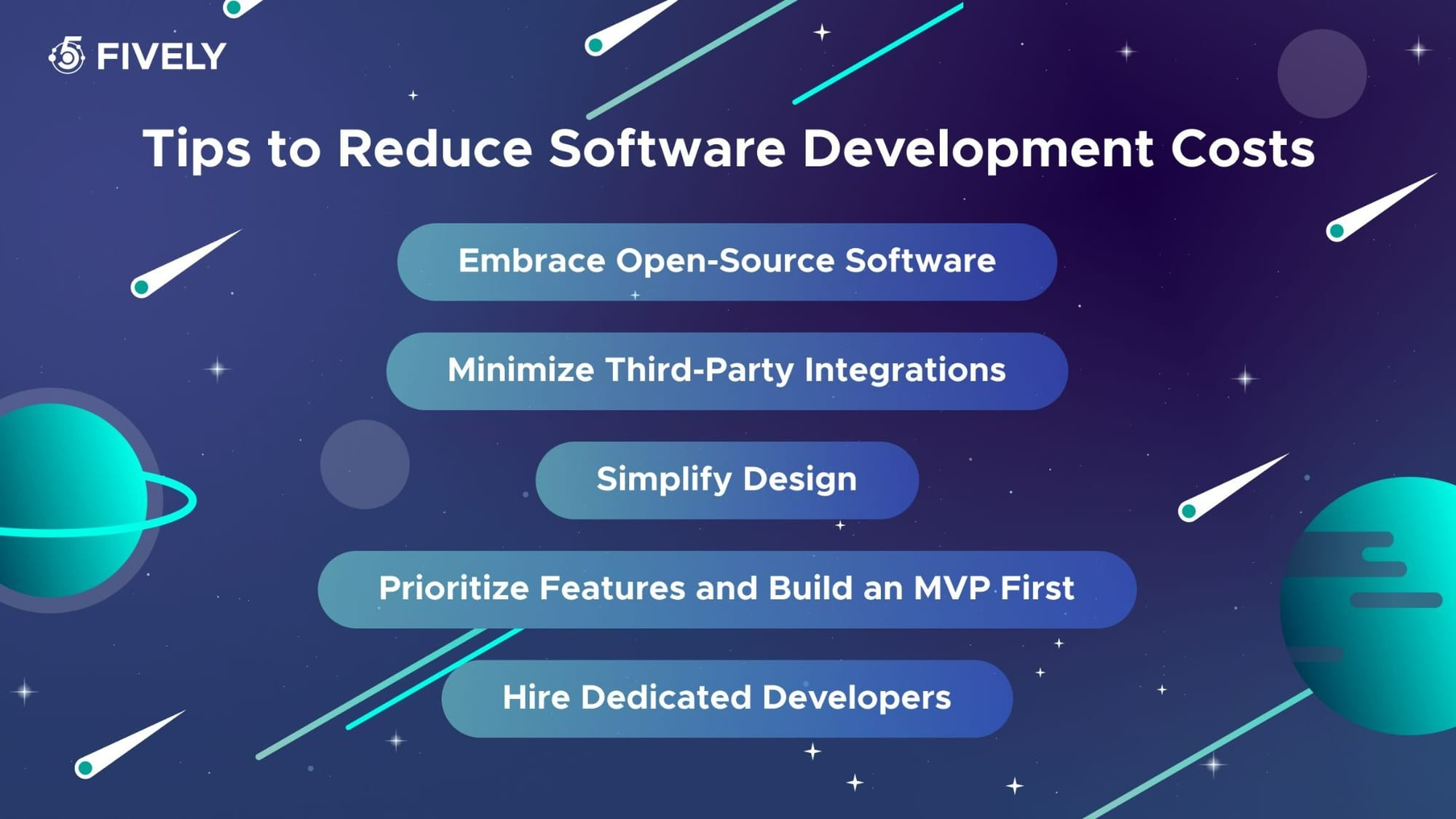
Tips to Reduce Software Development Costs
Reducing development cost should mean removing waste and uncertainty—not cutting the activities that protect quality.
Prioritize Features and Build an MVP First
Define the smallest version that solves one important problem for a clear user group. An MVP should include a complete core workflow, not a collection of unfinished features. Launching a focused version reduces initial development time and creates real feedback before the company invests in secondary functionality.
Classify features as must-have, should-have, or later, then evaluate them by business value, user need, effort, and risk. Expand the roadmap based on adoption and measurable results.
Validate Requirements and Technical Risks During Discovery
Discovery reduces cost by finding problems before code is written. Validate unclear workflows with prototypes, confirm integration access, inspect sample data, test critical APIs, and research high-risk technical assumptions.
Use a short proof of concept for AI accuracy, unusual hardware, high-performance processing, or undocumented legacy systems. Testing feasibility early is cheaper than discovering halfway through development that the approach cannot meet the requirement.
Embrace Open-Source Software Solutions
Open-source frameworks, libraries, databases, and infrastructure tools can reduce licensing and custom implementation work. Mature ecosystems also make it easier to hire developers and reuse established patterns.
Review licenses, maintenance activity, security history, and community support. An abandoned or commercially incompatible library can cost more than it saves.
Minimize Third-Party Integrations
Third-party services can accelerate development, but each one adds dependency, subscription cost, failure modes, and maintenance. Prioritize integrations that are essential to the core workflow and evaluate whether a simpler manual process is acceptable during the MVP stage.
Review API documentation, rate limits, sandbox access, pricing, data ownership, export options, and service commitments before integrating to avoid unexpected lock-in and scaling costs.
Simplify Design
Use a consistent component library, standard interaction patterns, and a limited set of responsive layouts. Custom animation and unusual navigation should be reserved for areas where they improve comprehension, conversion, or brand value.
Simplifying design does not mean ignoring usability. Clear information architecture, accessible controls, and tested user flows reduce engineering and support effort, while a stable design system speeds future features.
Control Scope Changes and Deliver Incrementally
Scope creep occurs when new features or requirements are added without adjusting the budget and timeline. Establish a visible backlog and a change process that records the expected value, effort, risk, and schedule impact of each request.
Incremental releases create decision points where stakeholders can review progress, user behavior, and priorities before low-value ideas consume months of work.
Automate Testing and Delivery Where It Reduces Rework
Automated unit, integration, and end-to-end tests are valuable for stable workflows that must be verified repeatedly. CI/CD pipelines can automatically run checks, build the application, and deploy approved changes to controlled environments.
Automation should target repetitive, high-risk processes. A prototype may need little automation, while a frequently released subscription product benefits from regression tests and reliable deployments.
Custom Software Development Cost Estimation at Fively
At Fively, we connect business requirements with the technical work needed to deliver them. A transparent estimate explains the scope, team, timeline, assumptions, risks, and major cost components behind the price.
Our estimation process usually includes four steps:
- Discovery call. We discuss the product idea, business goals, target users, current systems, expected functionality, constraints, and desired timeline.
- Analysis. Product and technical specialists review workflows, integrations, data, architecture options, security requirements, team needs, and delivery risks.
- Estimation. Within approximately 5–7 business days, we prepare a project estimate with the proposed scope, timeline, team composition, and technical approach. Complex enterprise projects may require a separate paid discovery stage before a detailed estimate is possible.
- Next steps. We review the estimate with the client, explain the major cost components, clarify assumptions, and select the most suitable engagement model.
This approach shows what the client is paying for and which decisions change the budget. If the scope exceeds available investment, we can define an MVP, phase integrations, simplify non-critical workflows, or spread development across several releases.
Fively provides custom software development services from discovery and UX/UI design to engineering, QA, cloud infrastructure, and long-term development. Share your requirements to receive an estimate based on your project rather than a generic average.
 Services Account
Need Help With A Project?
Drop us a line, let’s arrange a discussion
Frequently Asked Questions
Custom software development typically costs from $25,000 for a focused MVP to $500,000+ for a complex commercial platform. Enterprise, high-load, regulated, and major modernization projects can exceed $1 million. Scope, architecture, platforms, team, integrations, security, migration, and timeline determine the final figure.
The main cost components are discovery and planning, UX/UI design, software architecture, frontend and backend engineering, database and API development, integrations, QA, security testing, deployment, and DevOps. The total also depends on project complexity, target platforms, team seniority and location, delivery urgency, and the selected pricing model.
Yes. Start with a focused MVP, validate requirements during discovery, use proven open-source solutions, simplify design, limit non-essential integrations, control scope changes, and deliver incrementally. Cost reduction should remove low-value work and uncertainty rather than testing, security, or architecture activities that prevent expensive failures.
A basic MVP may take 2–4 months, a standard business application 4–8 months, and a complex SaaS platform 8–14 months. Enterprise and modernization programs often take 12–24 months or longer and are delivered in phases. Dependencies, feedback speed, compliance, and migration affect the schedule.
There is no single cheapest model for every project. Fixed price is cost-effective for a stable, clearly documented scope. Time and material is usually better for evolving products because priorities can change without repeated contract renegotiation. Staff augmentation works when the client already has technical leadership, while a dedicated team is effective for long-term product development requiring stable capacity.
A common planning range for software maintenance is 15–25% of the initial development cost per year. The budget covers bug fixes, security patches, dependency updates, monitoring, compatibility work, and operational support. Cloud hosting, third-party licenses, customer support, compliance audits, and new feature development may be charged separately and should be included in the total cost of ownership.


