
Node.js vs Python: Which Backend Wins in 2026?

• 18 min
AI enthusiast and senior full-stack developer with a product mindset. I turn complex requirements into state-of-the-art solutions and connect engineering decisions with real user and business needs.
We compare Node.js vs Python on performance, concurrency, ecosystem, security, AI readiness and cost. Get benchmarks, 2026 data and a decision framework for picking a backend.
Choosing between Node.js and Python is rarely about which technology is better. Both run some of the largest systems on the internet. Both will still be here when your product is.
Quick Comparison: Node.js vs Python for Backend Development
The useful question is narrower: which one fits the workload you are building, the team you can hire, and the budget you can sustain? This nodejs vs python comparison answers it with numbers rather than adjectives, and every figure below is dated and attributed. Start with the short version.
Usage percentages come from the 2025 Stack Overflow Developer Survey, which gathered over 49,000 responses from 177 countries. Those rows only mean something once you know what each name actually refers to, because the two are not the same kind of thing.
Node.js and Python at a Glance
What Node.js Is
Node.js is not a language. It is a runtime that executes JavaScript with Google’s V8 engine and adds what a browser does not provide: file system access, networking, processes and streams.
Ryan Dahl released it in 2009 on a specific thesis, that servers spend most of their life waiting for input and output rather than computing, so one thread driving an event loop can serve enormous numbers of connections.
That thesis shaped everything else. Node.js pairs V8 with libuv, the C library providing the event loop and a background thread pool. The language you write is JavaScript, and increasingly TypeScript: 43.6% of surveyed developers used it in 2025, against 66% for JavaScript itself. As of September 2026 the supported lines are v24.21.0 LTS and v26.10.0 Current, and production systems should run LTS.
 Services Account
What Python Is
Python comes from the opposite direction. Released in 1991, it was designed for readability, and web development was never its only purpose, which is why Django sits alongside NumPy and PyTorch in the same package index.
CPython has also moved fast lately. Python 3.11 ran an average 25% faster than 3.10 on the pyperformance suite, and Python 3.14, released 7 October 2025, made free-threaded builds officially supported and ships an experimental JIT. Modern Python backends are asynchronous: FastAPI or Starlette on servers like Uvicorn or Granian, not the synchronous WSGI model behind Python’s old reputation for slowness.
Two different origin stories, and they converge on one question: how does each runtime actually execute work? That is where the comparison starts.
Node.js vs Python: Detailed Comparison
Ten criteria which differences between Node.js and Python, each with the evidence and a verdict you can argue with, because the reasoning is visible.
1. Performance and Speed
Raw language benchmarks are the number everyone quotes and the least useful one here. V8 is a JIT-compiling engine shaped by two decades of browser competition; CPython is an interpreter whose JIT is still experimental. On tight numeric loops V8 wins, and that is not news.
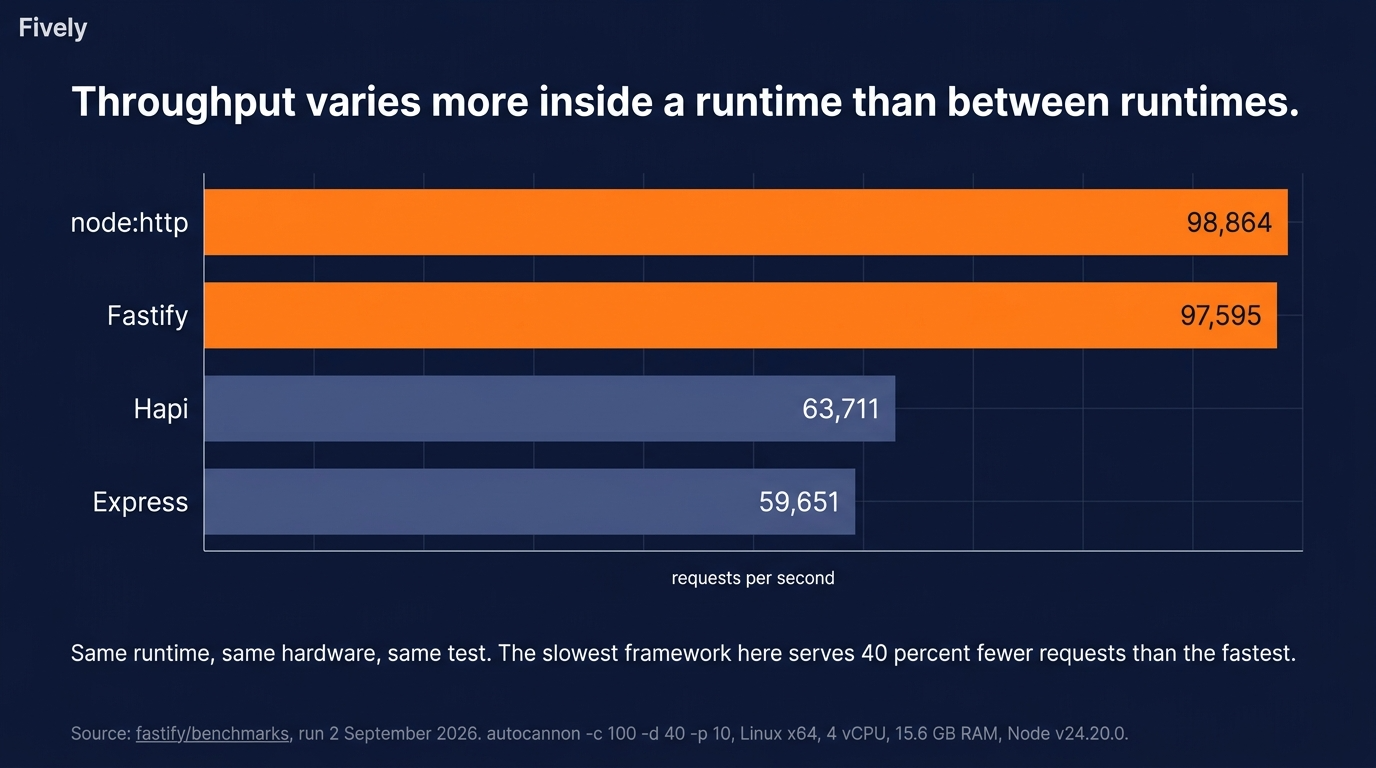
What matters for a backend is throughput under concurrent I/O, and the most instructive data is Node.js against itself. The Fastify project re-runs a benchmark of two dozen Node.js frameworks on identical hardware. On 2 September 2026, bare node:http handled 98,864 requests per second, Fastify 97,595 and Express 59,651. Picking Express over Fastify costs roughly 39% of throughput in the same runtime, more than many runtime-level differences people argue about. The same holds in Python: Django on a synchronous worker and Starlette on Granian do not perform alike.
Verdict: Node.js for raw request throughput and CPU-bound JavaScript. Python closes most of the practical gap with modern ASGI servers and C-backed libraries. Framework choice inside each runtime moves your numbers more than the runtime label does.
2. Scalability
Throughput on one machine is only half the question. The other half is what happens when one machine stops being enough.
Node.js scales horizontally by reflex. One process handles thousands of concurrent connections because they are all waiting; when one is not enough, you run several behind a load balancer or fork one per core. Statelessness is the natural design, which suits container orchestration.
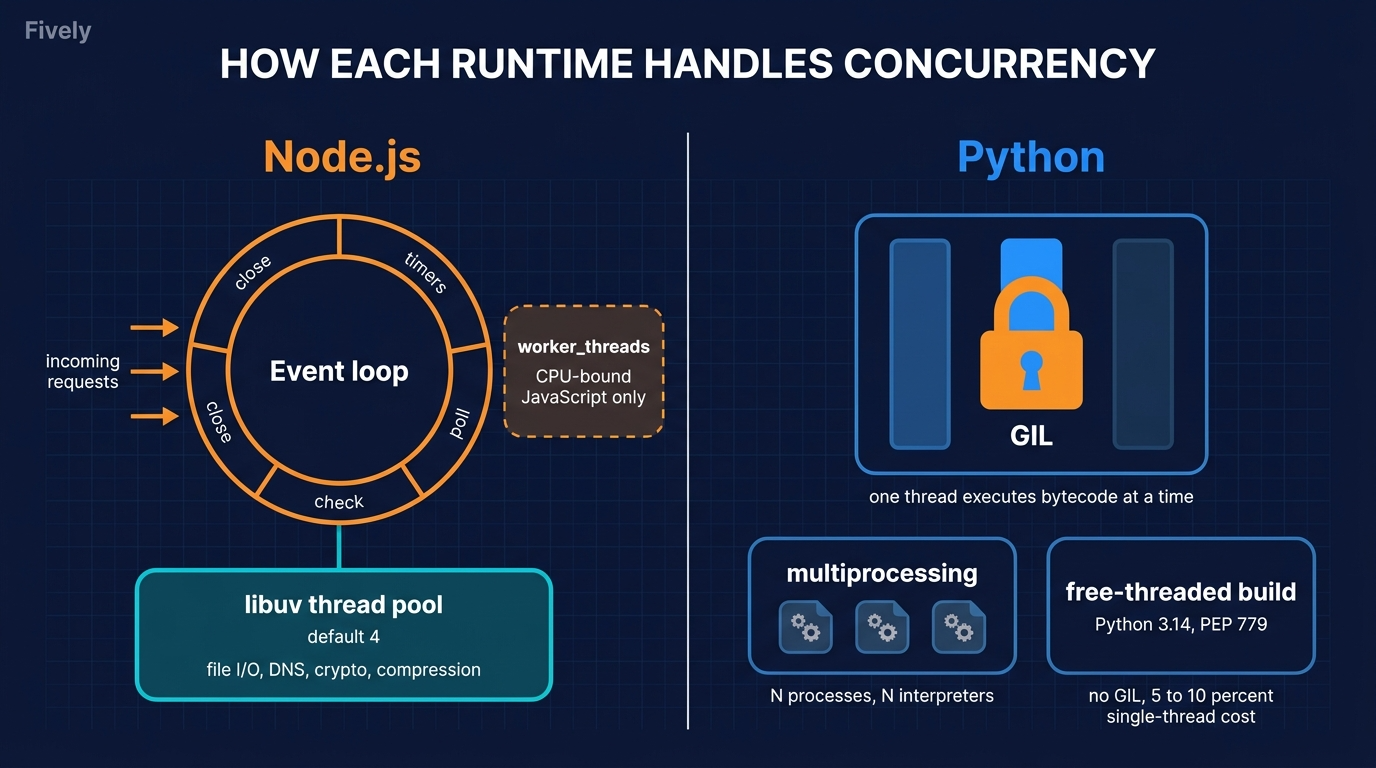
Python scales the same way with one catch. Because of the Global Interpreter Lock in standard builds, one process does not use multiple cores for Python bytecode, so the usual answer is several worker processes, each carrying its own interpreter and memory. Free-threaded builds remove that constraint, and PEP 779 records the price honestly: roughly 10% single-threaded penalty, about 3% on macOS, and 15 to 20% more memory.
Verdict: Both scale to large systems by adding processes and machines. Node.js gets more concurrency per gigabyte of RAM for I/O-heavy work. Python’s free-threaded builds narrow a gap that used to be structural.
3. Architecture and Concurrency Model
Both scaling stories trace back to the same root, so it is worth looking at directly. This section explains most of the others.
Node.js runs your JavaScript on one thread turning an event loop, handing anything that involves waiting to the operating system or to libuv’s thread pool. The official guidance is blunt about the consequence: if the loop spends too long at any point, “all current and new clients will not get a turn”. The escape hatch is worker_threads, which the docs describe as “useful for performing CPU-intensive JavaScript operations” and of little help for I/O.
Python offers several models in one language. asyncio is an event loop in the same spirit, which the standard library calls “often a perfect fit for IO-bound and high-level structured network code”. Threads help with I/O despite the GIL, multiprocessing gives true parallelism at a memory cost, and free-threaded builds add a fourth option.
The real difference is defaults. In Node.js asynchronous is the only way things happen, so the fast path is automatic and the blocking mistake is catastrophic. In Python you choose, so the fast path is a decision your team must get right and the blocking mistake is merely slow.
Verdict: Node.js if you want one concurrency model that is correct by default for network services. Python if your workload mixes I/O with real computation and you want to pick per component.
 Services Account
4. Learning Curve
That difference in defaults also shapes how long a team takes to become productive.
Python is widely taught first for a reason. The syntax is close to pseudocode and a competent engineer from another language can read unfamiliar Python on day one. For teams that include analysts or scientists who write code without being software engineers, that is decisive.
JavaScript is easy to start and harder to master: the language is small, but the event loop, promises, module systems and usually TypeScript come with it. The reward is one language across browser, server and tooling. Note the asymmetry: a front-end developer picks up Node.js quickly, while a Python developer moving to Node.js learns a language and a concurrency model at once.
Verdict: Python for the gentler curve and mixed-discipline teams. Node.js if your team already writes JavaScript on the front end, where the effective curve is close to zero.
5. Libraries, Frameworks and Ecosystem
How fast a team moves also depends on what they can reach for rather than build.
Raw counts mislead, but the shape of each ecosystem is informative. On 29 September 2026 npm held about 4.44 million packages against roughly 904,000 projects on PyPI. That says less about capability than about culture: npm normalised the tiny single-purpose package, Python prefers larger batteries-included libraries.
Downloads show where each community sits. In the thirty days to 27 September 2026, Express recorded about 493 million npm downloads and Fastify 48.4 million; on PyPI, FastAPI recorded about 358 million, Flask 130 million and Django 40.6 million. These counts include CI traffic, so compare within a registry rather than across: FastAPI has clearly overtaken the older Python frameworks.
The genuine divergence is outside web frameworks. Python’s index holds a scientific stack with no npm equivalent: pandas at about 525 million monthly downloads, scikit-learn at 184 million, PyTorch at 60 million. Node.js has the deeper front-end and real-time tooling.
Verdict: Python for anything touching data, science or models. Node.js for web, real-time and shared front-end tooling. Both are complete for ordinary CRUD backends.
 Services Account
6. Error Handling and Debugging
A large ecosystem means most of your codebase is code you did not write, which is when debugging starts to matter.
Python’s error handling is conventional and pleasant. Exceptions propagate, tracebacks are readable, and a stack trace usually points at the failing line without ceremony.
Node.js is harder in one specific way: asynchrony fragments the stack, so an error in an unawaited promise can surface far from its origin. Unhandled rejections remain a common production failure, though TypeScript catches a category of them at compile time. Python has its own trap: a blocking call inside an async handler destroys throughput silently, without raising anything.
Verdict: Python for straightforward debugging out of the box. Node.js is workable, and TypeScript closes much of the gap, but async error handling needs explicit conventions.
7. Security
Code you did not write also carries risk you did not choose, and in 2025 that risk became concrete.
Neither runtime is inherently insecure, but both have an attackable supply chain. On 14 September 2025 a self-replicating worm called Shai-Hulud spread through npm via compromised maintainer accounts and malicious post-install scripts. GitHub removed more than 500 packages and announced on 22 September 2025 that publishing would require mandatory 2FA, seven-day granular tokens or trusted publishing.
PyPI has had its own typosquatting and account-takeover incidents. The structural difference is depth: npm dependency trees run deeper, so an application trusts more maintainers, and install scripts hand an attacker code execution at install time.
Verdict: A draw on language security, a real difference in supply chain exposure. Lock files, provenance checks, dependency scanning and a policy on install scripts matter more than which runtime you picked.
 Services Account
8. Community Support and Talent Pool
Supply chain exposure scales with community size, and so does your ability to hire.
Both communities are enormous, so hiring turns on specifics rather than totals. JavaScript remains the most used language among surveyed developers at 66%, with Python at 57.9%; among professional developers the gap widens slightly, 68.8% against 54.8%.
The meaningful figure is the shape of the pool. The JavaScript pool is larger and front-end weighted, so filtering for genuine backend and distributed systems experience takes work. The Python pool splits between web engineers and data or ML practitioners, and those are different hires: a strong PyTorch engineer may never have deployed a web service.
Verdict: A draw on community strength. Node.js offers a larger raw pool; Python offers a clearer split between web and data specialisms, which helps when you know which you need.
9. Popularity in 2026: What the Data Actually Shows
Pool size raises the obvious question of which is actually winning. Popularity arguments usually cite whichever index favours the writer, so here are two independent sources measuring different things.
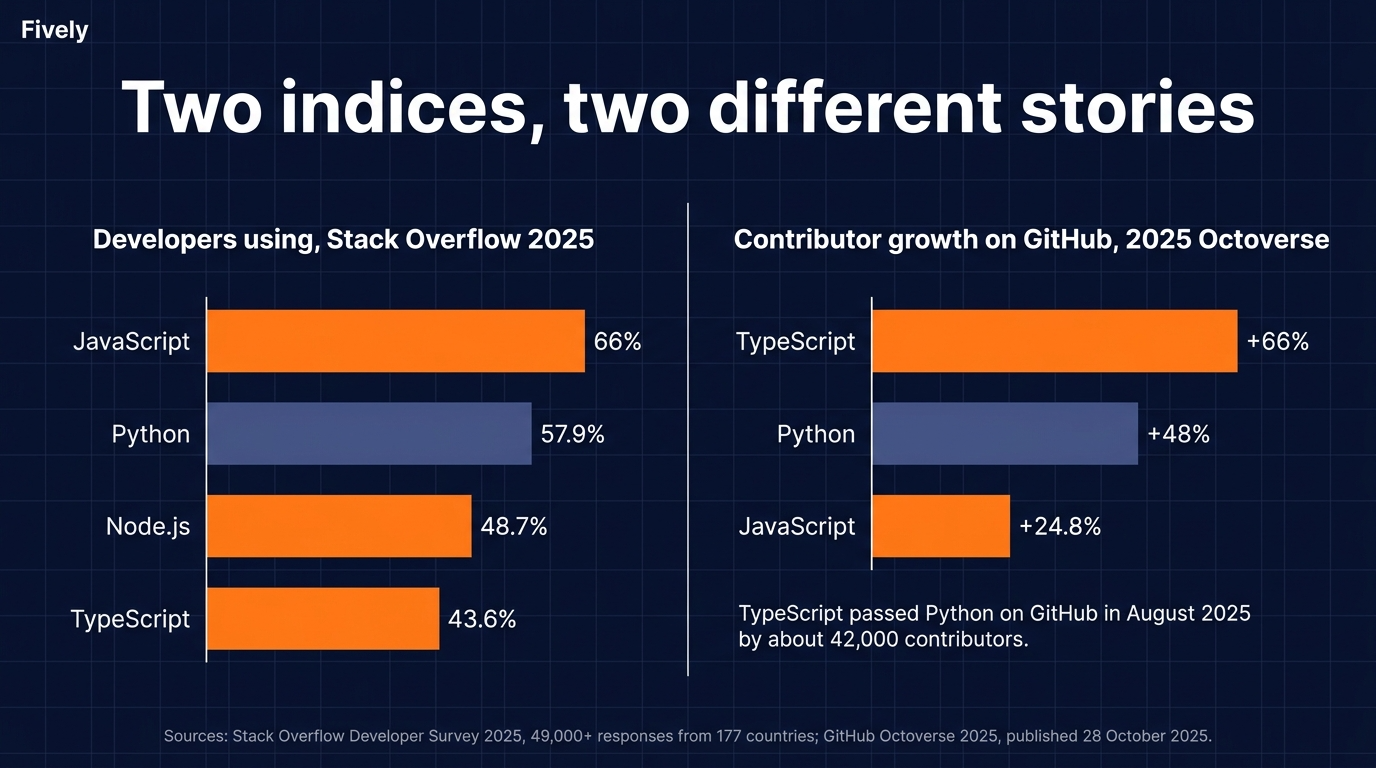
The 2025 Stack Overflow Developer Survey puts JavaScript at 66% usage, Python at 57.9% and TypeScript at 43.6%. Node.js leads the web technology category at 48.7%, while on the Python side FastAPI (14.8%) has now passed both Flask (14.4%) and Django (12.6%).
GitHub’s Octoverse 2025, published 28 October 2025, counts contributors instead and tells a different story. TypeScript became the most used language on GitHub in August 2025, passing Python by roughly 42,000 contributors, which the report calls the biggest language shift in more than a decade.
Read together, they say something more useful than “X is winning”: the JavaScript world is consolidating on TypeScript, while Python’s growth comes from people arriving through data and AI.
Verdict: A draw, and not something to choose a backend on. Popularity affects hiring and library maintenance, both healthy for both stacks.
10. AI and Machine Learning Readiness
Python’s growth curve has a specific driver, and for many readers it is the whole reason they are comparing these two stacks. The answer depends on whether you are building models or using them.
If you are training, fine-tuning or evaluating models, Python is not merely ahead: it is the environment the field is written in. PyTorch recorded about 60 million PyPI downloads in the thirty days to late September 2026, Hugging Face Transformers 92.7 million, scikit-learn 184 million. Doing this work in Node.js means rebuilding an ecosystem for no benefit.
If you are building an application that calls models through an API, the picture inverts. Streaming tokens, holding websocket sessions and staying responsive under load is exactly what Node.js was designed for, and the tooling has caught up: the Vercel AI SDK recorded about 92 million npm downloads over the same window. The OpenAI SDK shows the split cleanly, with roughly 284 million PyPI downloads against 145 million on npm.
At Fively we build both halves, from AI chatbots and retrieval-augmented generation systems on the application side to machine learning development on the model side.
Verdict: Python for building and training models. Node.js is often the better host for a product that consumes them. Many AI products need both.
Can You Use Node.js and Python Together in One Project?
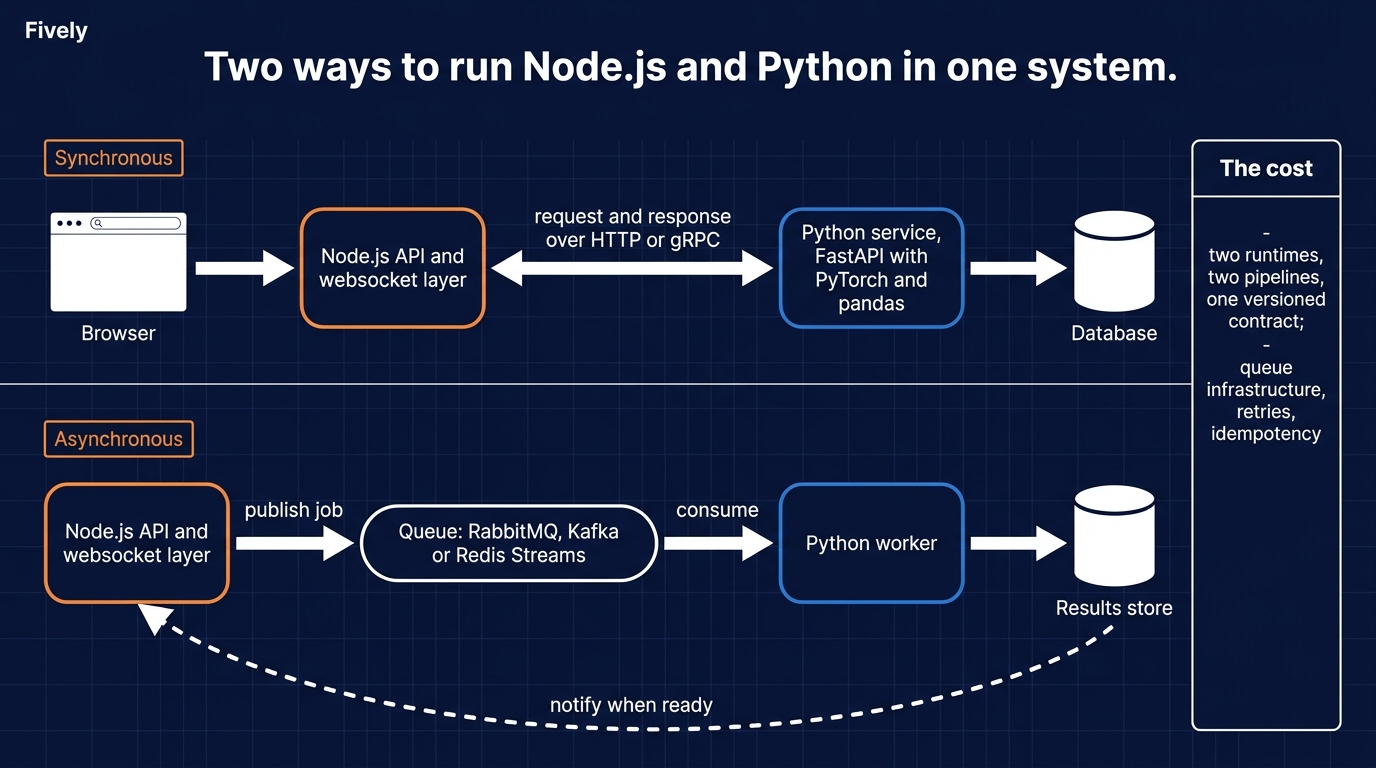
That last verdict is why a growing number of teams stop choosing. For a certain class of product, running both is the correct answer rather than a compromise, and two patterns cover most real deployments.
Pattern 1: Node.js API Layer + Python ML/Data Microservice
Node.js owns the edge: the public API, websocket connections, streaming and session state. Anything computational, such as model inference, batch scoring or data transformation, lives in a separate Python service behind FastAPI or Flask, which Node.js calls over HTTP or gRPC.
Each side does what it is good at. The cost is real: two runtimes, two dependency sets, two deployment pipelines, and an API contract between them that must be versioned like an external one. Skip that discipline and you get two services that can only be released together, which is the worst of both designs.
Pattern 2: Event Queue Bridging Both Runtimes
When the work does not need an immediate answer, the synchronous call becomes unnecessary coupling. Replace it with a queue: RabbitMQ, Kafka or Redis Streams. Node.js publishes a job and returns; a Python worker consumes it at its own pace and the user is notified when the result lands.
This suits report generation, document processing and model training runs, and lets you scale the expensive half separately. The price is infrastructure somebody must operate, plus retries, idempotency and ordering to get right.
When Polyglot Architecture Is Worth the Complexity
Both patterns cost something, so the question becomes when that cost is justified. Run both when at least two of these are true:
- The product genuinely needs real-time behaviour and heavy computation. A fintech platform with a live dashboard and a risk-scoring model is the canonical example.
- You already employ people strong in both stacks. Without that, support costs roughly double.
- The service boundaries are clear before you start. If you cannot draw the line on a whiteboard, the split will follow team politics rather than architecture.
- The two halves have different scaling profiles, so separating them actually pays.
Do not run both for an MVP with one or two engineers. Two CI pipelines, two dependency sets and two runtimes to patch will cost more time than the performance you gained.
Decision Framework: Which Backend Fits Your Project
If polyglot is the exception, the table below is the rule.
The second row matters most. For a first release, the stack your team can ship confidently beats the stack that benchmarks marginally better. Our guide to choosing a web app tech stack covers the surrounding decisions.
What It Costs to Build and Staff a Node.js or Python Team in 2026
Every row in that table assumes you can staff the choice, which brings us to money. Rates for the two stacks are close enough that cost should rarely decide it: region and seniority move the number far more than the language does.
Typical Hourly Rates by Region
These planning ranges come from our software development cost guide and apply to both stacks. Budget for two premiums. Senior Node.js engineers with real distributed systems experience cost more than the general JavaScript pool, because that pool is front-end weighted. Python ML engineers sit in a different market from Python web developers, often 20 to 40% above a backend rate in the same region, so an AI product is not simply “a Python project” financially.
Typical Team Composition for Each Stack
Team shape changes the total more than the hourly rate does:
- MVP: one full-stack developer plus a part-time designer. One Node.js developer covering both ends is often the cheapest viable team.
- Growing product: two or three backend engineers, a DevOps engineer and a QA engineer. The stack now affects hiring speed more than hourly cost.
- AI product: a backend engineer, a Python ML engineer and often a Node.js developer for the real-time interface.
A missing role is the usual reason projects stall between prototype and release. Fively provides Node.js development and Python development engineers who join an existing team rather than replacing it, and our guide to in-house versus outsourced teams compares the models in more depth.
Node.js vs Python: Which One Should You Choose?
With the architecture, the data and the budget on the table, the decision compresses into two short lists.
Use Node.js If…
- Your product is real-time: chat, live dashboards, collaborative editing, streaming.
- You expect many concurrent connections that spend most of their time waiting.
- Your front end is already JavaScript or TypeScript and you want one language and one toolchain across the stack.
- You are building on top of existing AI models and need token streaming.
- Your first team is small and you want one person covering both ends of the product.
- You are building microservices where cheap horizontal scaling matters.
Use Python If…
- Data is the product: analytics, reporting, ETL pipelines, scientific workloads.
- You are training or fine-tuning machine learning models, or expect to within a year.
- Your team includes people who write code without being software engineers.
- You want a batteries-included framework with admin, ORM and security defaults, which means Django.
- Automation, scripting and internal tooling are a significant part of the work.
- Readability for a rotating team matters more than peak request throughput.
If both lists describe part of your product, that is not indecision. It is the polyglot case above, and it deserves a real decision rather than a forced single answer.
 Services Account
Conclusion
Node.js and Python are correct answers to different questions. Node.js wins for real-time, high-concurrency and streaming products, especially when the front end is already JavaScript. Python wins when data, models or scientific computation sit at the centre. And the gaps are closing from both sides: ASGI and free-threading for Python, model-consumption SDKs for Node.js.
Fively builds production systems on both, including the hybrid architectures above. Bring us the requirements for your product and we will tell you how we would build it, and why.
 Services Account
Need Help With A Project?
Drop us a line, let’s arrange a discussion
Frequently Asked Questions
Node.js is faster for most web workloads, thanks to V8’s JIT compiler and the non-blocking event loop. The gap narrows with modern ASGI frameworks such as FastAPI on Uvicorn or Granian. Framework choice matters as much as runtime: in Fastify’s September 2026 benchmark, Express served about 39% fewer requests per second than Fastify on the same hardware.
Neither is better in general. Python wins when the backend is mostly data processing, machine learning, automation or scientific computation, or when you want Django’s included admin and security defaults. Node.js wins for real-time features, high concurrency and teams already writing JavaScript. For an ordinary CRUD API, both serve you well and your team’s existing skills should decide.
Yes, and it is common in AI products. The usual pattern is a Node.js API and websocket layer in front of a Python service handling models or data, communicating over HTTP, gRPC or a queue such as Kafka. It is worth the complexity when the product needs both real-time behaviour and heavy computation, and when you have people who know both stacks. For a small MVP, one runtime is almost always better.
Rates are broadly similar and depend far more on region and seniority: roughly $25–60 per hour in Asia, $35–75 in Latin America, $40–80 in Eastern Europe, $70–150 in Western Europe and $100–200+ in North America. Senior distributed-systems Node.js engineers and Python ML engineers both command a premium over the general market.
Whichever your team can ship fastest. With no strong preference and a standard web app, Node.js with TypeScript lets one developer cover both ends, the cheapest viable team. If the product’s value depends on data or machine learning from day one, start with Python.


