
10 Questions to Ask Before Vibe Coding an App

• 8 min
AI enthusiast and senior full-stack developer with a product mindset. I turn complex requirements into state-of-the-art solutions and connect engineering decisions with real user and business needs.
You have an idea and a tool that promises a working app by the weekend. It will probably deliver one. The catch is that AI builders are very good at building exactly what you describe, including the wrong thing, beautifully.
Vibe coding has moved the hard part of app development earlier: writing the code is now the cheap step; deciding what to build, what data it touches and who will keep it alive is where projects succeed or quietly die.
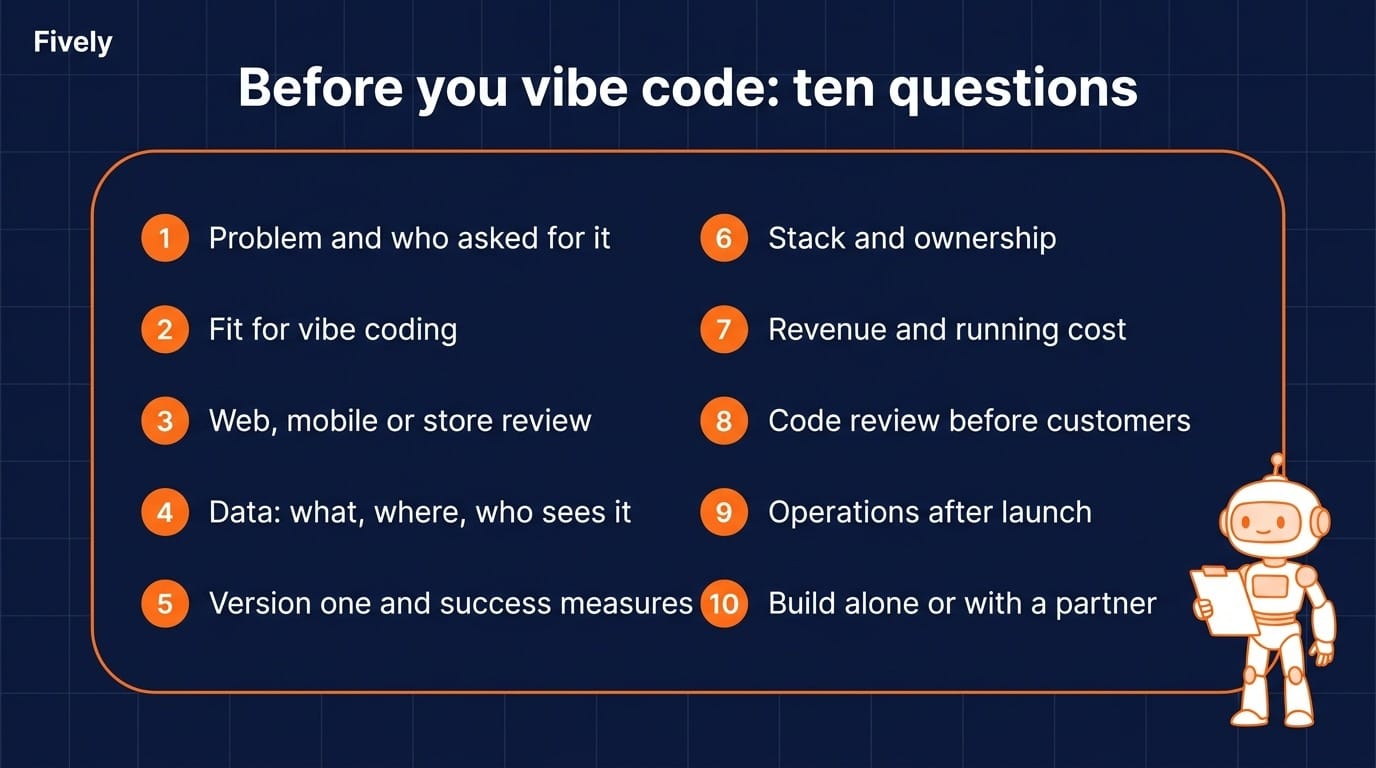
These 10 questions are the vibe coding checklist you can run before any such project, and they work just as well for non-technical founders building alone. Answer them before you start vibe coding and the weekend produces a prototype worth investing in rather than a demo you’ll rebuild.
1. What problem does this app solve, and who has asked for it?
The oldest question in product work matters more when building is easy, because nothing stops you building something nobody wants. Before opening a tool, name one specific person the app helps, describe their pain without mentioning your app, and say what they do about it today. Then look at whoever already serves them: what those products do well, and what your first version does differently.
Red flag: the answer starts with the technology. “An AI-powered platform that…” is a description of a build, not a problem.
2. Is this idea a good fit for vibe coding?
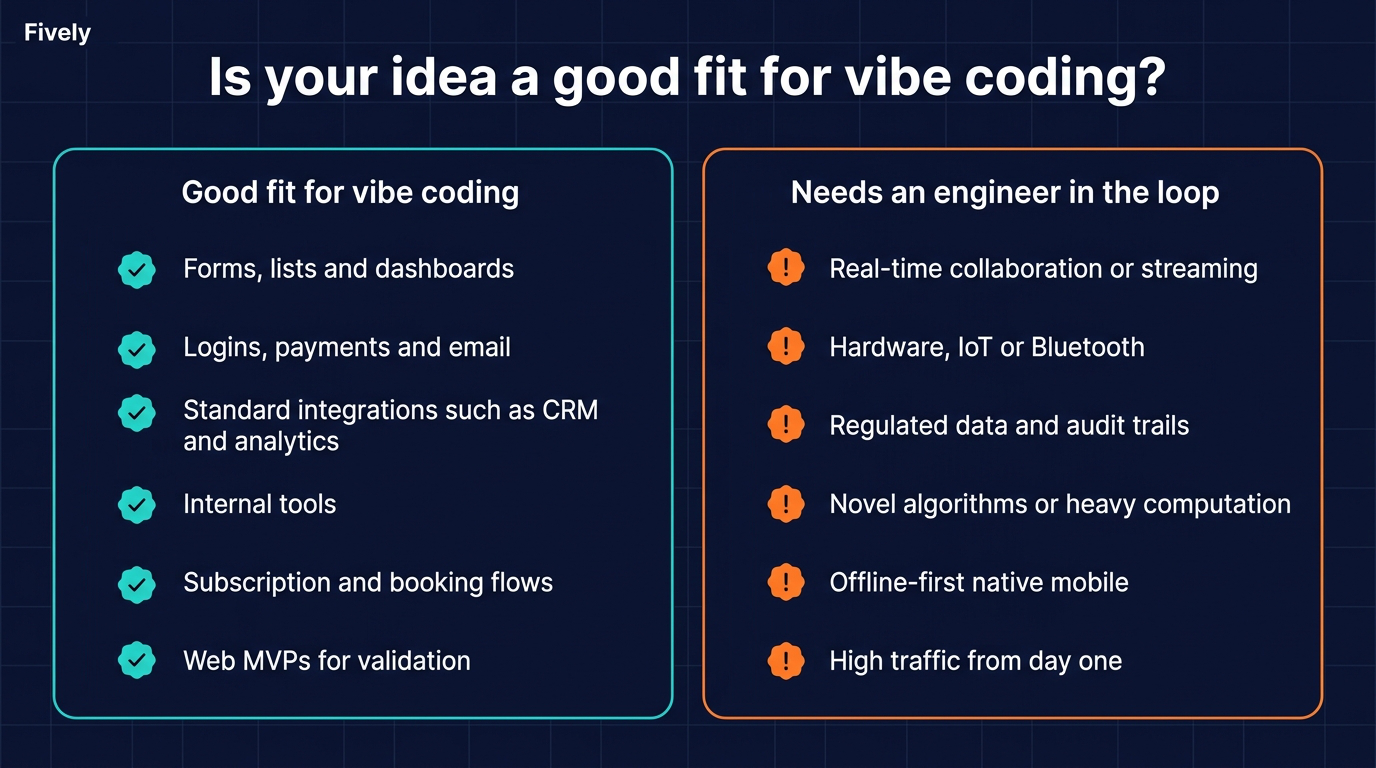
Not every app is. AI builders excel at web products assembled from familiar parts: forms, lists, dashboards, logins, payments, email, a CRM integration. That covers most B2B SaaS ideas, customer portals and internal tools. They struggle, without an experienced engineer in the loop, when the core of the product is a novel algorithm, real-time collaboration, hardware or Bluetooth, or a regulated workflow that needs an audit trail.
Good answer: “It’s a forms-and-payments web product with a dashboard.” If your idea sits in the second group, that doesn’t rule out AI-assisted development; it rules out doing it alone. For a platform-only alternative, see our review of the best no-code AI tools.
3. Web, mobile or both, and does it need to pass App Store review?
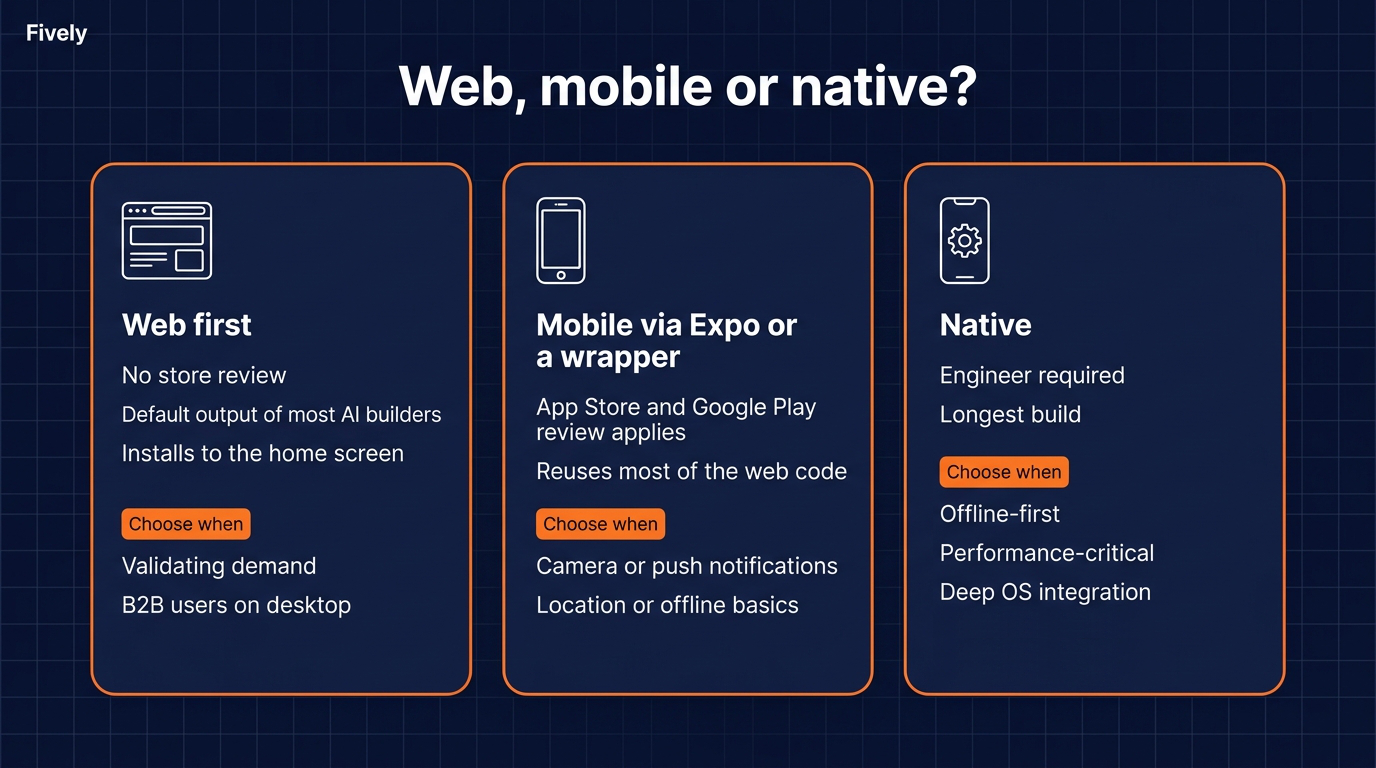
Most AI builders produce web apps by default. A native mobile app means a mobile framework such as Expo or a wrapper around your web app, and then a store review. That review is a real gate in 2026: after new App Store submissions rose 84% in a single quarter, developers reported review delays of a week to a month against the usual day or two, and Apple has been enforcing its rule against apps that change their own behaviour after approval.
Good answer: web first, unless the product needs the camera, push notifications or offline use from day one. A web app can live on a phone’s home screen and be validated with real users long before you commit to the stores. When mobile is essential, our guide to the best tech stack for mobile apps covers the options.
4. What data will it hold, where will it live, and who can see it?
This is the question AI tools answer for you if you don’t, and they answer it badly. In May 2026 security firm RedAccess examined 5,000 apps built with Lovable, Replit, Base44 and Netlify and found them with virtually no authentication; 40% exposed sensitive data, from medical records to corporate documents. The platforms’ response was that configuration is the creator’s responsibility. They’re right, which is the point.
Write down what personal or payment data the app stores, which service holds it, in which region, and who can read it. For UK and European customers, choose a European region and know who your data processor is. A region is not compliance, but it’s the first thing a customer’s lawyer will ask.
Red flag: “The tool handles that.”
 Services Account
5. What is in version one, what is left out, and how will you know it worked?
A vibe coding MVP punishes vague scope faster than a classical one, because the tool builds whatever you describe and the eighth feature quietly breaks the first. Write a one-page note: the two or three journeys the first version must support, an explicit list of what it does not do, and three measures that will tell you it worked, such as activation, task completion and repeat use within two weeks.
Good answer: a written scope shorter than this article, agreed by whoever is paying. Our guide to MVP development for startups goes deeper on choosing the first release.
6. What will it run on, and who chose that stack?
Every AI builder with a fixed default generates React. v0 produces Next.js only; Lovable and Bolt.new default to React frameworks; add a Postgres service such as Supabase, Stripe for payments and Vercel for hosting and you have the typical vibe-coded product. That’s a sound stack, but notice that the tool chose it, not you. Know the layers, and make sure the repository, the hosting account, the database and the domain are in your company’s name from the first day.
Red flag: nobody on your side can say where the code lives. For the full comparison of React and Next.js with the alternatives, read our guide to the best tech stack for vibe coding.
7. How will it make money, and what will it cost to run?
Decide the model first: subscription, usage, one-off, or free with a paid tier. Then budget in three parts. The prototype is the cheap one: a tool subscription and a few days of a product person’s time. Preparing for paying customers is the one providers underquote: real authentication, billing with VAT and invoicing, tests, monitoring, a security check. Running and evolving the product is the recurring line: hosting that grows with traffic, AI tool spend, and every change after launch.
Good answer: three numbers, in your currency, with the middle one larger than the first. Our software development cost guide explains the drivers.
8. Who reviews the code before real customers touch it?
The most common vibe coding mistakes to avoid are not prompting errors but missing checks. AI-generated code fails in predictable places: secret keys left where the browser can read them, server actions that never check who is calling, database policies left open to make the demo work, packages two years out of date, and no tests or monitoring at all. IBM’s security team reported in June 2026 that AI-generated pull requests carry 2.74 times more security issues than human-written ones.
Good answer: a named human reviewer plus automated secret and dependency scans before the first customer, and again before every release. Our AI prompts for code review show what a structured review covers.
 Valentin Parshikov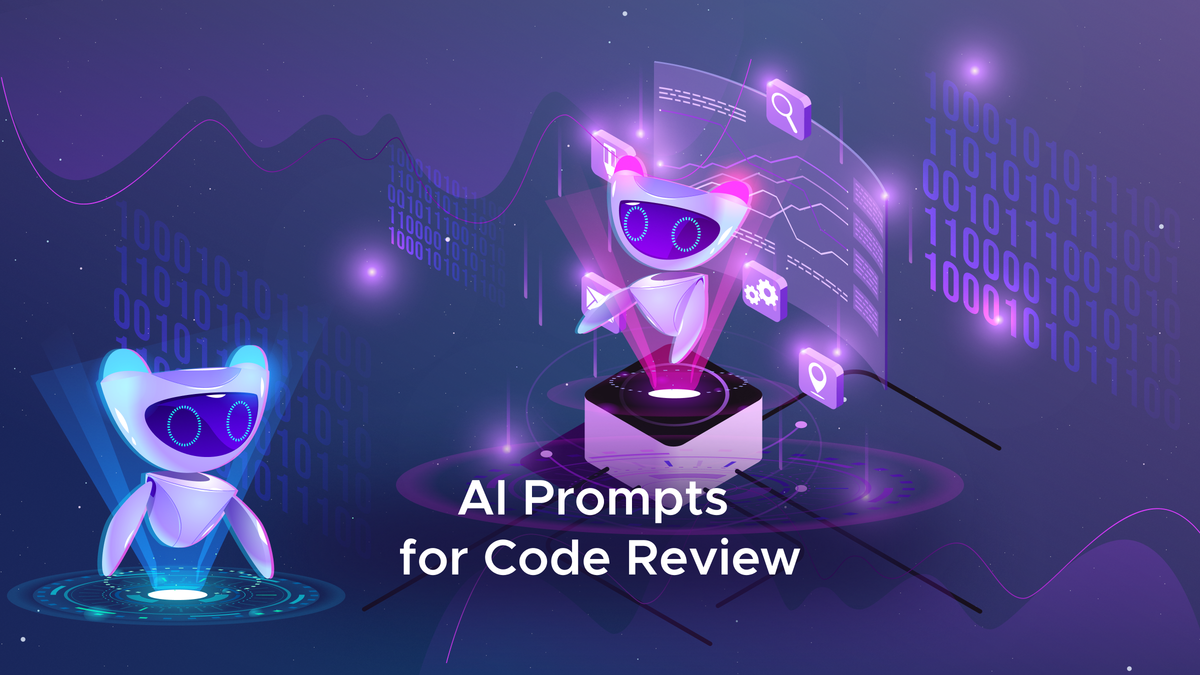
9. Who keeps it running after launch?
AI tools produce features, not operations. Someone has to notice when signup breaks at 2 a.m., apply security updates, answer support and ship the next ten changes without breaking the first ten. If that someone is you, budget the hours. If it’s a partner, put it in the contract. Our comparison of in-house versus outsourced teams helps weigh the options.
Red flag: the plan ends at “publish”.
10. Should you build it yourself, or with a partner?
The vibe coding vs hiring a developer debate has a simple answer from the nine questions above: build it yourself to validate, and bring in a partner when real customers, real money or real data arrive, or when questions 4, 8 and 9 have no owner. A good partner adds scoping, architecture, review of every generated change, a security check before launch and a handover you can take elsewhere. Our list of top vibe coding agencies shows how established teams work, and the stack guide includes the eight questions to ask any of them.
Good answer: “We’ll validate alone, then scope the real build with someone accountable for the code.”
Plan Your App With Fively
If the 10 questions left gaps around data, review or what happens after launch, that’s the normal outcome, and it’s where we come in. Fively delivers vibe coding projects with the parts AI tools leave out: scoping, architecture, expert review of generated code, security checks before launch and support afterwards. Bring an idea or an existing prototype and we’ll tell you what stands between it and paying customers. Ley’s fly!
 Services Account
Need Help With A Project?
Drop us a line, let’s arrange a discussion
Frequently Asked Questions
For a web product built from standard parts, such as B2B SaaS, a customer portal or an internal tool, yes, and it’s the fastest way to validate demand. For products whose core is a novel algorithm, real-time or hardware features, or regulated data, use AI-assisted development with an engineer accountable for the result.
Vibe code it yourself to test whether anyone wants it. Bring in a developer or a partner when paying customers, personal data or integrations arrive, because that’s when review, security and operations start to matter more than build speed.
Yes, if it’s built as a real mobile app rather than a wrapped web page and meets Apple’s guidelines, including the rule against changing behaviour after review. Expect longer review times than in previous years and plan a web version first if you can.


