
How to Hire Offshore Node.js Developers in 2026: Rates, Frameworks, and Delivery Models

• 17 min
I'm a content specialist at Fively keen on writing fresh articles that can help out business and tech specialists. I love to conduct research, hold interviews, and spotlight sophisticated tech issues.
Hiring offshore Node.js developers can solve two problems at once: a limited local hiring pool and a backend roadmap that cannot wait three months for recruiting. But the model only works when the role is defined more precisely than “we need a Node.js developer.” A NestJS engineer migrating a regulated monolith to Kafka-based microservices is a different hire from an Express developer building a straightforward REST API, and both are different from an engineer running AI streaming, queues, and real-time workloads.
This guide focuses on that distinction: it covers where offshore Node.js development makes sense, what these engineers build, realistic 2026 rate bands, framework fit, and the operating metrics that tell you whether the engagement is actually creating leverage. Let’s go!
Key Takeaways
- Offshore Node.js rates in 2026 commonly fall around $20-$100+ per hour depending on region, seniority, vendor model, and specialization; senior Poland/CEE profiles often sit higher than India or Southeast Asia, while still below comparable US vendor rates.
- Framework fit matters. “Node.js” is a runtime, not a complete job description. NestJS, Express, Fastify, serverless/edge patterns, queues, databases, and cloud experience should match the architecture you actually run.
- Rate is not total cost. Recruiting time, ramp-up, replacements, management, QA, DevOps, and knowledge loss can erase the advantage of a cheap hourly quote.
- Offshore works best when the work is modular enough to onboard, engineering ownership is clear, and the company can maintain a predictable communication window. It is a poor fix for an undefined product or a team with no one able to review backend decisions.
- Production readiness should be tested explicitly: graceful shutdown, health checks, structured logs, tracing, secrets, dependency security, input validation, backpressure, and failure behavior are separate skills from passing a coding exercise.
- Privacy and IP need contract language, not marketing promises. Fively can work under NDA and structures delivery around controlled access, documented ownership, and client-specific security requirements.
What Offshore Developers Actually Are
An offshore Node.js developer is a backend or full-stack software engineer who works from a country outside the client’s primary labor market and uses Node.js to build server-side applications.
The geography changes the employment and collaboration model; it does not change the engineering standard. A good offshore engineer should be able to work inside the same repository, CI/CD process, issue tracker, architecture rules, security controls, and review standards as an in-house engineer.
In 2026, production Node.js usually means TypeScript plus a broader backend stack: APIs, PostgreSQL or MongoDB, Redis, queues, cloud infrastructure, observability, authentication, third-party integrations, and often microservices. Node.js 24 is an active LTS line in September 2026, while Node.js 26 is Current, so version policy and dependency maintenance are part of the role as well.
Offshore vs. Nearshore vs. Onshore
The labels are relative: Poland is nearshore for Germany but offshore for a US company. Latin America is often nearshore for North America. Use the categories below to think about overlap, legal structure, and cost rather than as a proxy for quality.
Four Ways to Hire Node.js Developers
Let’s look at the top 4 ways of hiring devs and how they compare:
Node.js is Built for Some Teams, Not for Everybody
Offshore development is an operating model, not a cure for every delivery problem. It creates leverage when the organization can define ownership and absorb a remote engineer into a functioning process. It amplifies confusion when the product, architecture, and decision rights are already unclear. The table below shows it clearly:
What Offshore Node.js Developers Build
In general, Node.js is especially effective for I/O-heavy services that coordinate many concurrent connections and external systems.
The official Node.js guidance emphasizes keeping work on the Event Loop small and offloading expensive computation rather than blocking request handling. That makes the runtime a natural fit for APIs, real-time systems, integrations, and event-driven services when the architecture respects those constraints.
Plus to that, Node.js is often used when it comes to:
- API and backend development: REST, GraphQL, authentication, authorization, webhooks, payment and SaaS integrations;
- Microservices and modernization: decomposing monoliths, introducing service boundaries, Kafka/RabbitMQ messaging, independent deployment, and backward-compatible migrations;
- Real-time systems: WebSockets, notifications, collaboration features, live dashboards, streaming data, and event processing;
- E-commerce and marketplace backends: catalog, checkout, inventory synchronization, order workflows, integrations, and background jobs;
- SaaS platforms: multi-tenant APIs, billing logic, permissions, audit trails, reporting, and integration layers;
- AI and LLM backends: streaming responses over SSE/WebSockets, provider integrations, RAG orchestration, vector stores, token/rate controls, and job queues such as BullMQ for asynchronous inference workflows;
- Cloud and serverless services: AWS/Azure/GCP integrations, containers, Kubernetes, serverless functions, observability, and CI/CD;
- Data-intensive integration services: ETL-style workflows, third-party API normalization, caching, queues, and synchronization between systems.
 Services Account
How Fively Builds Offshore Node.js Teams
We use Node.js and NestJS in both focused staff augmentation and full-cycle delivery. One current example is the modernization of an Electronic Flight Bag platform. Fively engineers reverse-engineered legacy .NET 8.0 business logic and rebuilt six functions as independent NestJS microservices, using Kafka for event-driven communication and MongoDB for the new services. The migration was designed to coexist with the live legacy backend so components could be replaced gradually without disrupting production.
 Services Account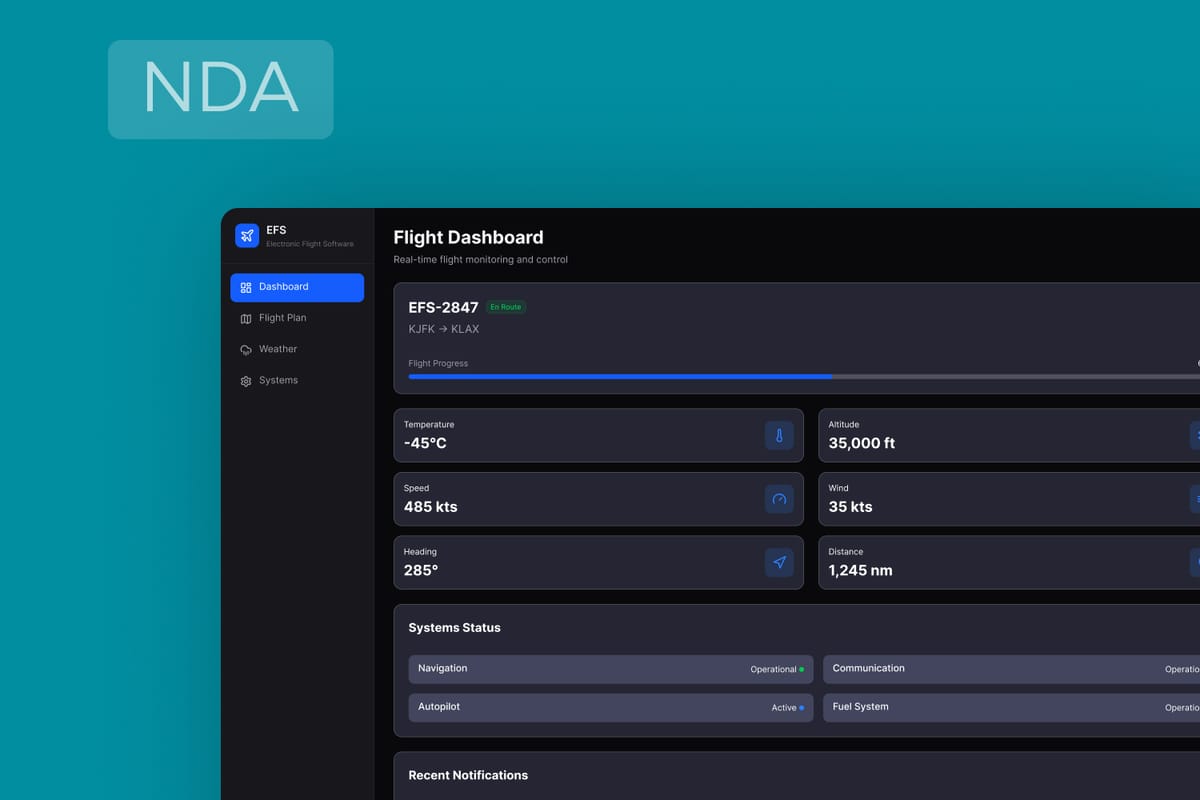
Fively also uses NestJS in SaaS and automation products, including Search Tuner, where a NestJS/PostgreSQL backend supports real-time synchronization between a browser extension, dashboard, and database, and Avo, where NestJS formed part of a scalable HR automation stack.
 Services Account
Offshore Developers Rates in 2026
Rate tables should be treated as planning bands, not salary truth. Vendor invoices, direct salaries, contractor rates, seniority definitions, and specializations differ substantially. The 2026 market sources we reviewed place senior US engineering rates well above Poland, Latin America, India, and Southeast Asia; specialized cloud, distributed-systems, fintech, or AI experience can push any region toward the top of its band.
These ranges synthesize 2026 offshore/backend rate guides rather than presenting a single vendor’s price list. For example, current market guides put Poland around $45-$65/hour for backend work and $55-$75+ for senior engineering, India around $22-$55 for mid/senior Node.js profiles, and Latin America broadly between the two depending on country and seniority.
What Drives the Rate Up or Down
- Specialization depth. A general API developer costs less than a senior engineer who can own Kafka, distributed tracing, Kubernetes, high-throughput services, or complex database performance.
- Domain experience. Fintech, healthcare, cybersecurity, aviation, and other regulated or high-consequence systems often justify a premium because domain mistakes are expensive.
- Seniority. Seniority should mean production ownership and judgment, not years on a CV. Strong seniors reduce architecture churn, review load, and incident risk.
- Engagement length. Stable full-time commitments can price differently from short, urgent, part-time work.
- Geography and overlap. Markets with high demand, strong English, EU proximity, or US-hour overlap may command higher rates.
- Cooperation model. A freelancer rate excludes much of what a managed vendor rate may include: sourcing, HR, replacement support, delivery management, and account continuity.
Rate Is Not Cost: What a Node.js Hire Really Costs You
A $25/hour engineer who needs repeated replacement, heavy supervision, and months of context rebuilding can cost more than a $55/hour engineer who becomes productive quickly and stays. The useful comparison is total cost of capacity, not the number printed beside “hourly rate.”
Do not treat the timing rows as guarantees. Ask each vendor to put candidate-presentation, start-date, replacement, and handover commitments in writing.
Which Node.js Framework Are You Actually Hiring For?
“Node.js” alone is too broad for a useful backend job description. The runtime tells you where JavaScript executes; the framework and architecture tell you how the service is structured, tested, deployed, and maintained. Define the environment before screening candidates.
Elysia is primarily associated with Bun rather than Node.js, so it should not be used as a generic “Node.js framework” requirement. If an edge or alternative-runtime stack is part of the architecture, name the runtime explicitly.
How to Vet an Offshore Node.js Developer
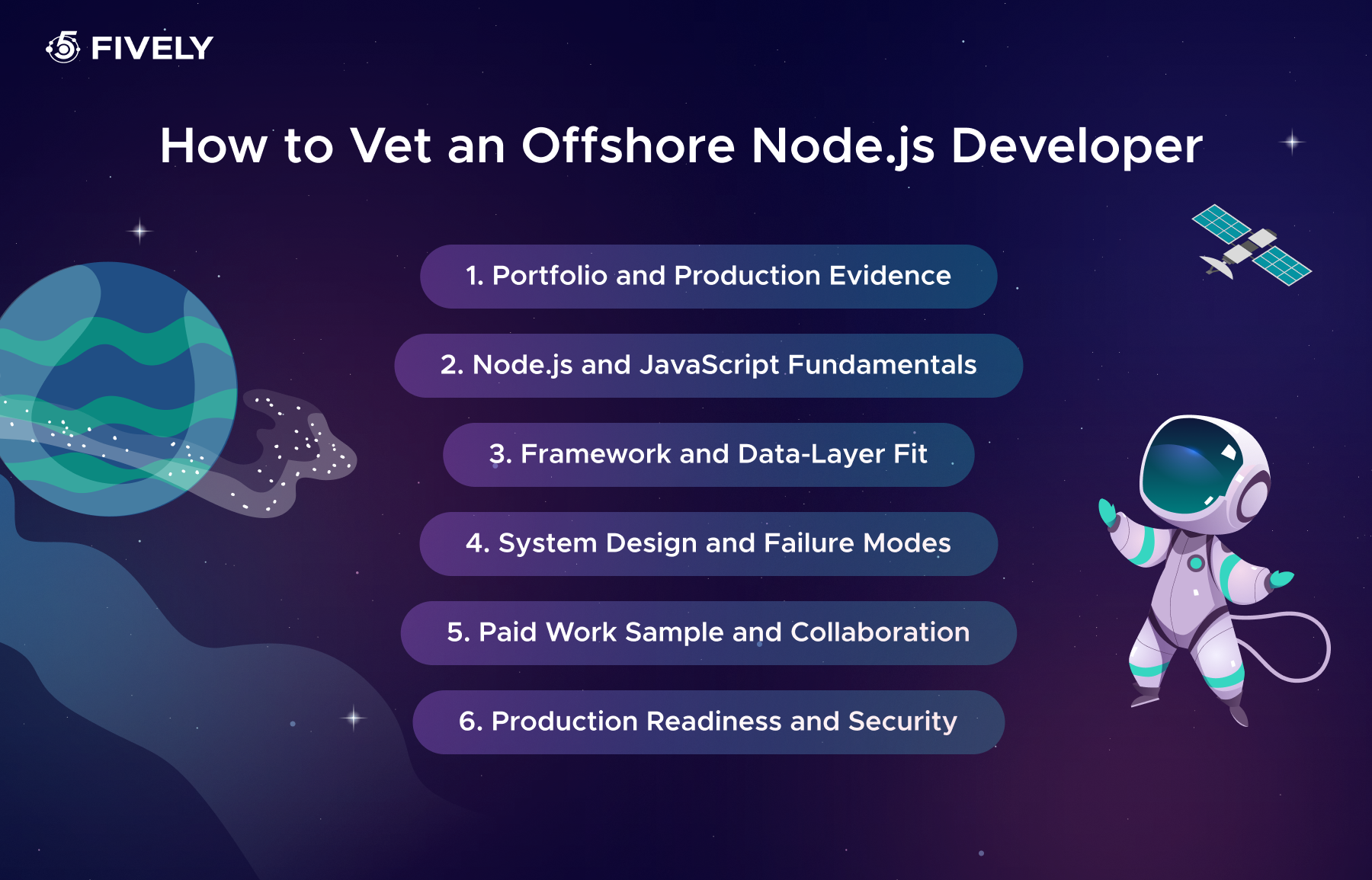
A strong hiring funnel moves from evidence to architecture to production behavior. The goal is not to maximize interview difficulty; it is to expose whether the engineer can safely own the kind of backend work you are actually outsourcing.
Stage 1: Portfolio and Production Evidence
Ask for two systems the candidate personally worked on and make them separate their contribution from the team’s. Look for scale, failure modes, framework choice, database decisions, deployment environment, and what changed after production feedback. “Built REST APIs with Node.js” is not enough evidence for a senior role.
Stage 2: Node.js and JavaScript Fundamentals
Test the event loop, promises and microtasks, streams, error propagation, memory behavior, asynchronous I/O, worker threads/child processes, and TypeScript. Avoid trivia that never appears in production. A useful candidate can explain why CPU-heavy work blocks throughput and how they would move it away from the request path.
Stage 3: Framework and Data-Layer Fit
Use the framework you actually run. For NestJS, ask the engineer to design modules, dependency boundaries, validation, guards, testing, and a microservice interaction. For Express/Fastify, look for explicit structure rather than “the framework lets us do anything.” Include database transactions, indexes, migrations, caching, and concurrency in the exercise.
Stage 4: System Design and Failure Modes
Give the candidate a realistic service: orders, notifications, payments, document processing, or an LLM-backed workflow. Increase traffic, make a dependency slow, duplicate a message, or drop a database connection. Strong engineers reason about queues, timeouts, retries, idempotency, backpressure, rate limits, circuit breaking, and observability rather than only drawing boxes.
Stage 5: Paid Work Sample and Collaboration
A bounded paid task can reveal more than another interview. Use a small feature or service that resembles the real codebase, then review the PR, tests, commit quality, assumptions, questions, and response to feedback. For offshore hiring, communication quality is part of engineering quality because unclear assumptions travel further across time zones.
Stage 6: Production Readiness and Security
Finally, test whether the candidate thinks beyond code review. Ask how a Node.js service handles SIGTERM and graceful shutdown without dropping in-flight requests; how liveness and readiness checks work; how logs carry request or trace IDs; and how OpenTelemetry traces cross service boundaries. Verify that secrets stay outside the repository, dependencies are audited, inputs are validated, payload sizes are limited, and external API failures have explicit timeout and retry behavior.
Discuss npm supply-chain risk, least-privilege credentials, and how the service behaves when a queue, database, or provider becomes unavailable. A backend that passes tests locally and a backend that survives a 3 a.m. production incident require overlapping but different skills. Senior candidates should be able to explain both.
Top Interview Questions to Hire Offshore Node.js Developers
First, it’s good to ask some basic questions on Node.js:
- What is npm, and what role does it play in a Node.js project? Explain how npm is used to install and manage packages, how package.json and lockfiles fit into dependency management, and what you would check before introducing a new third-party package into production.
- Why is Node.js commonly described as single-threaded? Explain what actually runs on the main JavaScript thread, how the event loop enables concurrency, and where the offshore developers worker pool or worker threads come into the picture.
- What are modules in Node.js, and how do they help structure an application? Compare CommonJS and ECMAScript modules at a practical level, including import/export syntax, interoperability, and the considerations involved when choosing or migrating between them.
- How is Node.js different from Angular? Clarify the role of Node.js as a JavaScript runtime commonly used for server-side offshore development and Angular as a frontend application framework, and explain how the two can be used together in one product.
- What is the difference between fs.readFile() and fs.createReadStream()? Discuss memory usage, buffering, large-file handling, and the situations in which loading an entire file is preferable to processing it as a stream.
- What types of API functions does Node.js expose? Explain the difference between synchronous and asynchronous APIs, and within asynchronous code, discuss callback-, Promise-, and async/await-based patterns and when blocking synchronous operations become risky on a server.
- What is middleware in Node.js applications? Explain how middleware participates in the request-response lifecycle and give practical examples such as authentication, validation, logging, error handling, rate limiting, or request transformation.
Then, you can go on with more specific ones:
- What is the Reactor Pattern in Node.js? Explain how an event demultiplexer, event loop, callbacks/handlers, and non-blocking I/O work together to let Node.js handle many concurrent I/O operations efficiently.
- How do you prevent callback hell in a Node.js codebase? Discuss decomposition into small functions, Promises, async/await, centralized error handling, and cases where queues, streams, or event-driven patterns may produce cleaner control flow.
- Walk me through the event loop at a practical level. Where do timers, I/O callbacks, promise microtasks, and setImmediate fit into your mental model?
- You have a CPU-bound task blocking request handling. What options do you have, and when would you choose worker threads, a separate service, or a queue?
- How do you handle backpressure when a Node.js stream writes to a slow consumer?
- What breaks first when this service grows from 100 to 5,000 requests per second, and how would you find out before production?
- How do you shut down a Node.js process without dropping in-flight requests or abandoning jobs?
- Where do secrets live in your deployment, and who can read them?
- How do you decide between a message queue/event bus and a direct HTTP call between services?
- What is your policy for Node.js LTS upgrades and npm dependency/security audits?
- In NestJS, how would you keep modules from becoming tightly coupled as the system grows?
- Show me a production bug you caused or owned. What was the root cause, and what did you change in the system or process afterwards?
Contracts, IP and Compliance: A Checklist Before You Sign
The contract should describe the operating reality of the engagement, not only the invoice. For regulated or data-sensitive work, involve qualified counsel; the checklist below is a buyer’s engineering and commercial starting point, not legal advice.
- MSA with a named delivery scope, not a staffing invoice. Define services, responsibilities, acceptance/working model, confidentiality, security obligations, and what is outside scope. For augmentation, identify that delivery direction remains with the client.
- NDA covering subcontractors, not just the vendor. Confidentiality should flow down to anyone who can access your repositories, systems, designs, or customer information.
- IP assignment valid in the developer’s jurisdiction. Do not rely on a website promise that “your IP is protected.” Copyright ownership rules differ by jurisdiction and worker status, so the agreement should expressly transfer or license the necessary rights from the people/entities creating the work.
- DPA plus transfer mechanism when required. If personal data is processed, document controller/processor roles, subprocessors, security, retention, and cross-border transfer rules. A Poland-based team can keep processing inside the EEA when systems and access are structured that way, but do not assume geography alone eliminates every transfer or GDPR obligation.
- Named replacement SLA. Agree before signing how quickly a replacement candidate must be presented, whether handover overlaps are billable, and who owns knowledge transfer if an engineer leaves.
- Notice period and knowledge-transfer obligations. Specify documentation, open PRs, runbooks, credentials/access return, and handover expectations at exit.
- Access control. Name which repositories, environments, customer datasets, production systems, and cloud accounts offshore engineers may access; apply least privilege and audit sensitive actions.
- Non-solicit in both directions. If included, keep it proportionate and review enforceability with counsel in the relevant jurisdictions rather than copying a boilerplate clause.
Six Metrics That Tell You If It’s Working
You do not need a special “offshore productivity dashboard.” Use delivery and reliability signals that would matter for any engineer, then compare trends after onboarding.
If none of these can be measured, the core problem may be the delivery process rather than the offshore model. Geography cannot fix an organization that has no definition of done, no deployment visibility, and no ownership boundaries.
Seven Mistakes and Challenges of Offshore Node.js Development
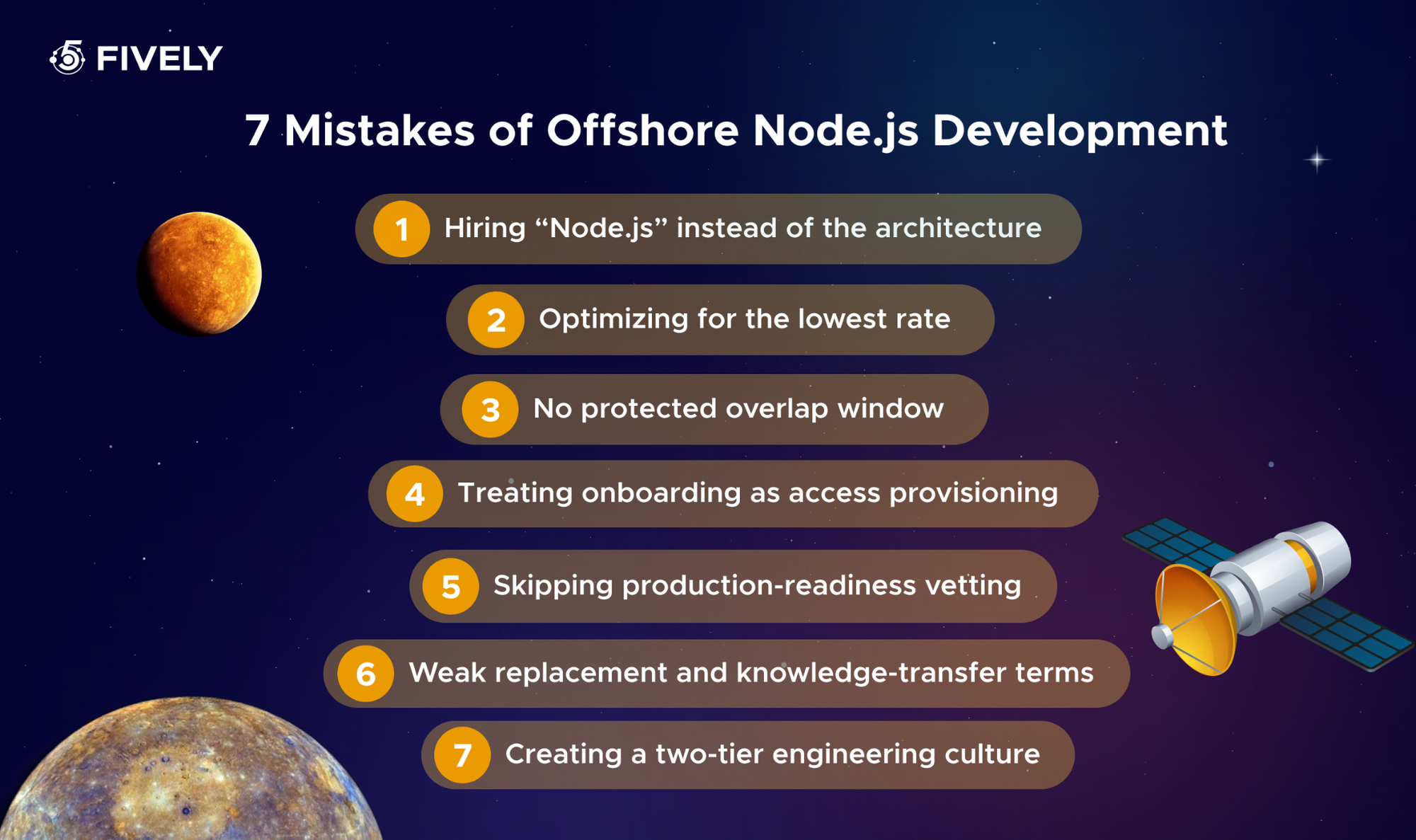
- Hiring “Node.js” instead of the architecture: A generic JavaScript screen can miss the NestJS, Kafka, database, cloud, or real-time skills the project actually needs.
- Optimizing for the lowest rate: Cheap capacity becomes expensive when senior engineers spend their week rewriting it.
- No protected overlap window: Async work is powerful, but planning, architecture, reviews, and incidents still need predictable shared hours.
- Treating onboarding as access provisioning: A repository login is not context. Provide architecture, local setup, domain rules, owners, release flow, and first scoped tasks.
- Skipping production-readiness vetting: A candidate can write clean endpoints and still have no experience with shutdown, observability, queues, security, or incidents.
- Weak replacement and knowledge-transfer terms: People leave. The risk is manageable when the contract defines replacement and handover before it happens.
- Creating a two-tier engineering culture: Offshore engineers who receive only tickets and no product context cannot exercise senior judgment. Include them in relevant architecture and product decisions.
Final Takeaway
If you want to hire top offshore Node.js developers, it is most valuable when it expands access to the right backend expertise, not merely cheaper JavaScript labor. Define the framework and architecture, choose the cooperation model that matches your internal leadership, compare total cost rather than rate, and test production ownership as deliberately as coding ability. The common standard is the same: highly skilled developers should be able to build, operate, debug, and evolve the backend they touch - from API design and databases to microservices, observability, security, and production incidents.
At Fively, we can both embed Node.js engineers into an existing team or take responsibility for a broader delivery scope. Feel free to contact us if you need offshore software development, and we will be happy to turn your idea to life!
 Services Account
Need Help With A Project?
Drop us a line, let’s arrange a discussion
Frequently Asked Questions
A practical vendor-rate range is roughly $20-$100+ per hour globally. India and Southeast Asia usually occupy the lower bands, Latin America and CEE the middle-to-upper offshore development teams, and senior US engineers substantially higher. NestJS architecture, Kafka, cloud/DevOps, security, regulated domains, and distributed-systems experience can add a premium.
Candidate sourcing can take days to several weeks through a vendor, but productive onboarding depends on your codebase. A documented service with working tests and a clear first task can produce a meaningful PR quickly; a legacy system with tribal knowledge can take weeks. Ask vendors to separate “candidate presented,” “start date,” and “productive in codebase.”
Often partly or fully, depending on region and agreed schedule. Latin America offers strong US overlap; Poland/CEE offers full CET overlap and partial US East overlap; India and Southeast Asia usually require a deliberately scheduled overlap window. Put required hours in the engagement terms rather than assuming them.
Screen them in NestJS. Ask about modules, dependency injection, guards, interceptors, pipes/validation, testing, microservice transports, and architecture boundaries, then use a NestJS-based work sample or code review. Do not infer framework depth from generic Node.js experience.
That should be answered before the contract is signed. A managed vendor should define a replacement process, target timeline, handover expectations, and commercial treatment of transition time. Marketplace hiring typically leaves the client to restart sourcing and onboarding independently.


