
Best Tech Stack for Vibe Coding: A Guide for Product Leaders

• 20 min
AI enthusiast and senior full-stack developer with a product mindset. I turn complex requirements into state-of-the-art solutions and connect engineering decisions with real user and business needs.
Your team has a prototype. It was built in a few days with an AI tool, it looks convincing, and the first people who saw it asked when they could use it. Now comes the harder decision: what should the real product be built on, so that paying customers can rely on it and your team can keep changing it for years?
With vibe coding, the question is also how well AI tools generate, check, and fix code on that stack, because a framework the models know deeply produces fewer surprises, cheaper changes, and a larger pool of people who can take the work over. A framework they know poorly produces the opposite, however elegant it looks in a demo.
So the question isn’t “which framework is best”; it’s which stack holds up when AI writes the code. This guide answers it the way a CTO would: five criteria for AI-assisted delivery, a fair comparison of six realistic options, and a recommendation that follows from the evidence.
Key takeaways
- A vibe coding stack is judged on different criteria from a classical one. How reliably AI tools generate and fix code on it now matters as much as the technology’s own merits, and the data on that is public.
- The interface framework is only one layer. Database, authentication, payments, hosting, and code review decide whether a vibe-coded MVP becomes a product. Budget for them from the start.
- AI-generated code fails in predictable places: exposed secrets, missing permission checks, outdated framework patterns. A widely used stack makes those failures easier to catch, but only a review process actually catches them.
What Makes a Stack Good for Vibe Coding? Top Five Criteria
Two definitions first:
Vibe coding is a way of building software where you describe what you want in plain language, and an AI tool writes most of the code, while people direct the work and check the result.
A tech stack is the set of technologies your product runs on: the framework that draws the interface, the database that stores customer data, the services that handle logins and payments, and the platform that hosts it all.
Put together, that is your vibe coding tech stack, and every layer of it will be touched by generated code. When AI writes the code, five criteria decide whether a stack helps or hurts. Each has a technical basis, but each maps to a business outcome you can hold a provider to:
1. How well AI tools generate it
Large language models write best on what they have seen most. Frameworks with years of documentation, tutorials, open-source projects, and answered questions give a model more correct patterns to draw on. That shows up as fewer broken first drafts, fewer invented APIs, and less time spent on corrections.
Adoption data is the closest public proxy for that footprint. In the 2025 Stack Overflow Developer Survey, React was used by 44.7% of 49,090 respondents, more than twice the share of any other interface framework, and Next.js on its own matched Angular and Vue.
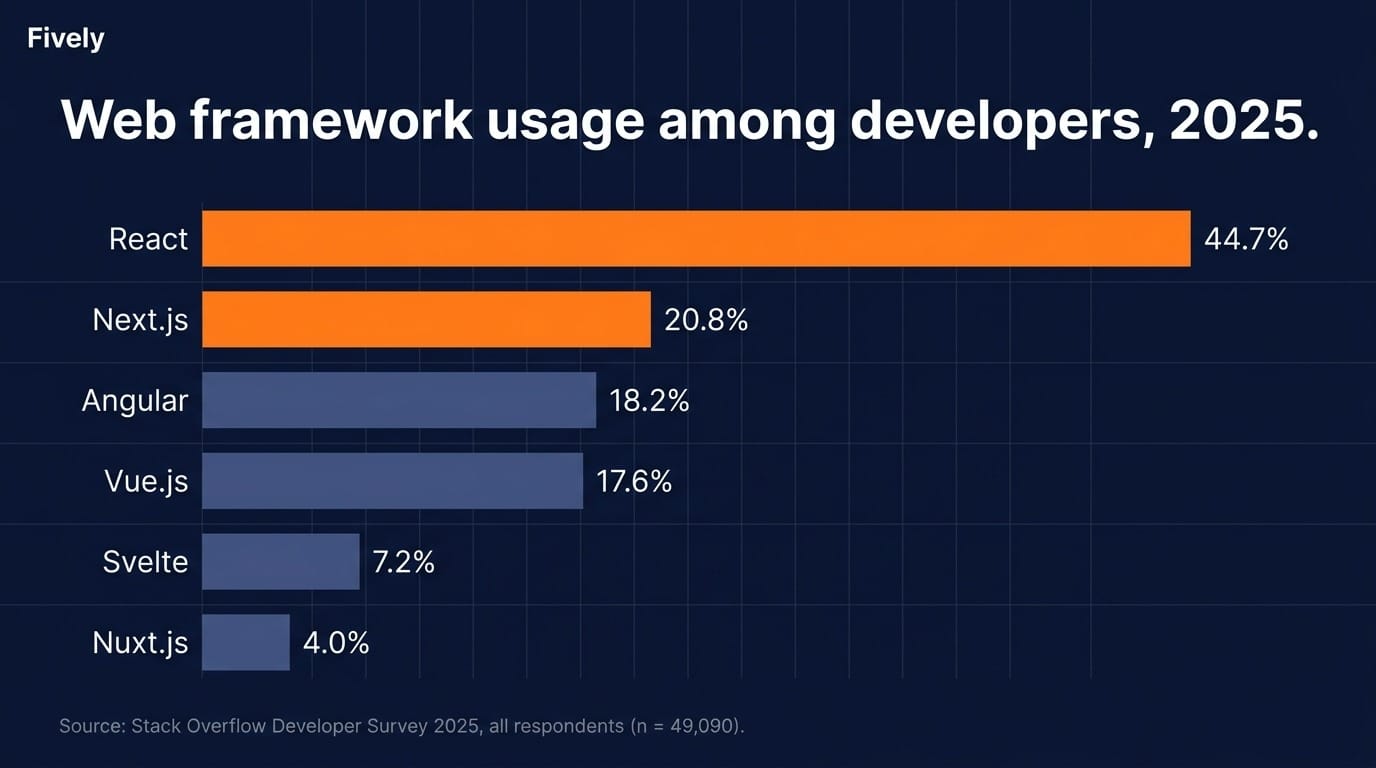
But popularity does not make generated code good: it makes good code more likely on the first attempt and cheaper to fix on the second.
We’ll return to it once more in the AI builders section.
2. How quickly you get customer feedback
A stack suited to vibe coding lets you put a change in front of a real user within hours. Technically, that means preview deployments for every change, instant reloading during development, and libraries of ready-made interface components. For you, it means the CPO can review a new onboarding flow on a private link before a single customer sees it.
3. What a change costs
Prototypes are cheap to build and expensive to change badly. Component-based frameworks, static typing with TypeScript, and automated tests keep changes local: adjusting the pricing page should not break the dashboard. Ask any provider how they will keep the tenth change as cheap as the first.
4. Who can own it and take it over
Your product should not depend on one agency or one AI tool. The stack should have a large talent market, a standard project structure that a new team recognises in a day, and no proprietary lock-in in the code itself. Ownership also means you hold the repository, the cloud accounts, and the domain, not your supplier.
5. How it grows
At a hundred users, almost anything works. At ten thousand, database design, caching, and hosting costs start to matter. But at a million, week-one architecture decisions become expensive. A good stack has a documented path through those stages and a market of engineers who have walked it.
Apply these five criteria to the market and one pair of technologies keeps coming up: React, a library for building interfaces from reusable components, and Next.js, the framework built on it that turns those components into a complete web application with routing, server rendering, and a deployment model. Choosing Next.js means choosing React; they are two layers of one decision, not rivals. The pair leads every adoption survey and, as the next section shows, it's what most AI builders produce when left to their own devices.
Why AI Tools Default to React and Next.js
Ask the leading AI app builders to create a product without specifying a technology, and every one with a fixed default reaches for React. Several reach for Next.js specifically. This is not a coincidence - it is the single strongest practical argument for the stack.
Note where the two most influential builders have gone: v0 and Lovable both moved past plain React to frameworks with server rendering, Next.js and TanStack Start respectively. The market that makes vibe coding possible has standardised on the React ecosystem.
Four reasons hold up to scrutiny:
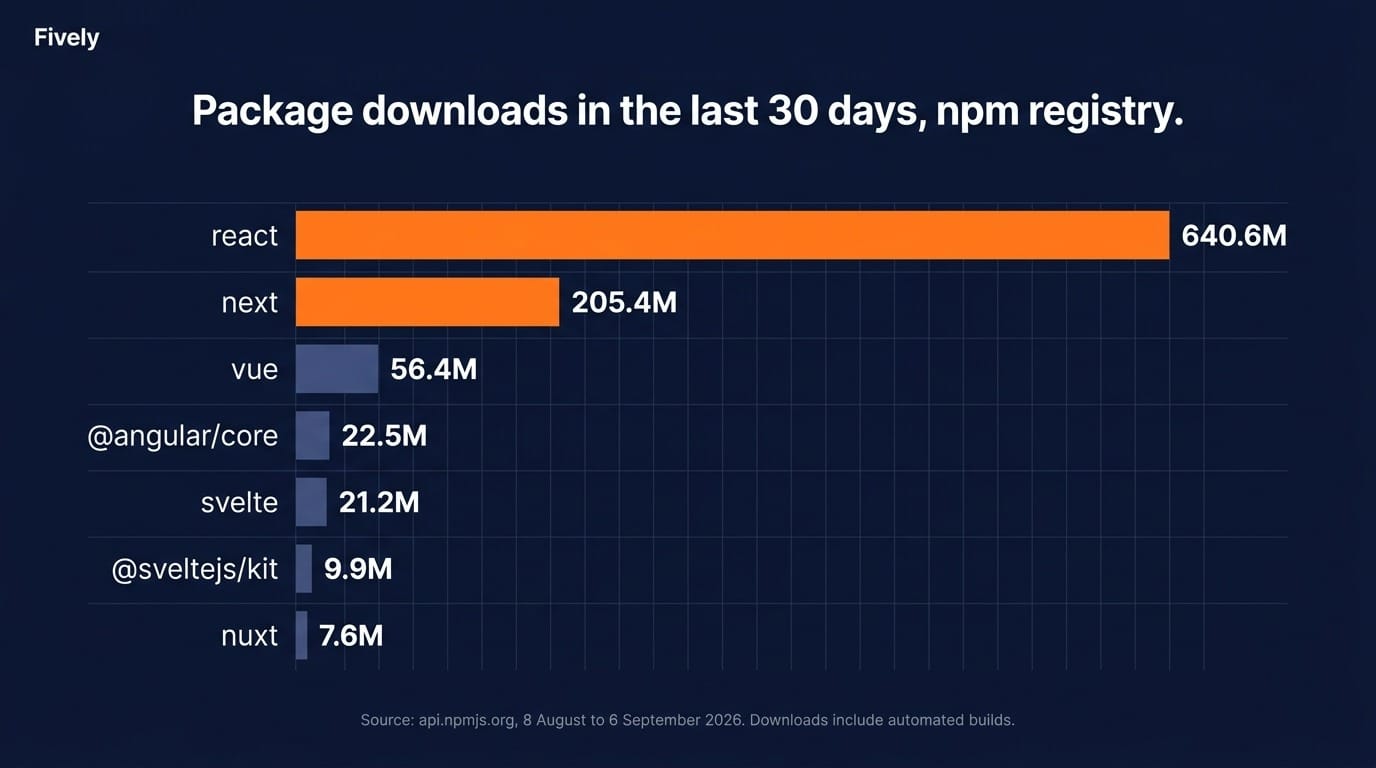
- Training data. React has been the most used interface library for roughly a decade. The volume of public code, documentation and discussion dwarfs any alternative, so models have simply seen more correct React than correct anything else. Download figures from the npm package registry make the gap concrete.
- One language across the whole product. With Next.js, the interface, the server logic and the database access can all be written in TypeScript. A model that only has to hold one language and one set of conventions in context makes fewer mistakes than one switching between, say, a Python back end and a JavaScript front end.
- The framework is adapting to agents. This is the newest and least appreciated reason. Next.js now ships its documentation inside the package itself and, since version 16.3, automatically generates an instruction file for AI agents when it detects one working in the project. Vercel’s own wording in that file is blunt: “This is NOT the Next.js you know. This version has breaking changes — APIs, conventions, and file structure may all differ from your training data.” The framework is actively correcting the models’ outdated habits, and Vercel publishes benchmark results showing agents perform better when they read the bundled docs. No other mainstream framework has gone this far.
- Models reproduce old patterns. That last point also exposes the main caveat: Next.js changed its project structure substantially between the older Pages Router and the current App Router, and React 19 retired several long-standing APIs. A model trained largely on earlier code will happily generate the old way unless the project tells it otherwise. Popularity gives you more correct examples; it also gives you more outdated ones. A delivery team that pins versions, keeps agent instructions current, and reviews generated code is not optional.
With the “why React” argument made, fairness demands the comparison. Where do the alternatives win?
 Services Account
How React and Next.js Compare With Other Stacks
Ask ten engineers for the best framework for vibe coding, and you’ll get at least four answers, each defensible for a particular product. The best frontend framework for vibe coding depends on what you’re building, and the honest way to choose is by criteria.
We scored six realistic options against the five criteria below. The scores are editorial judgements based on adoption data, the AI-builder defaults, framework documentation, and our delivery experience.
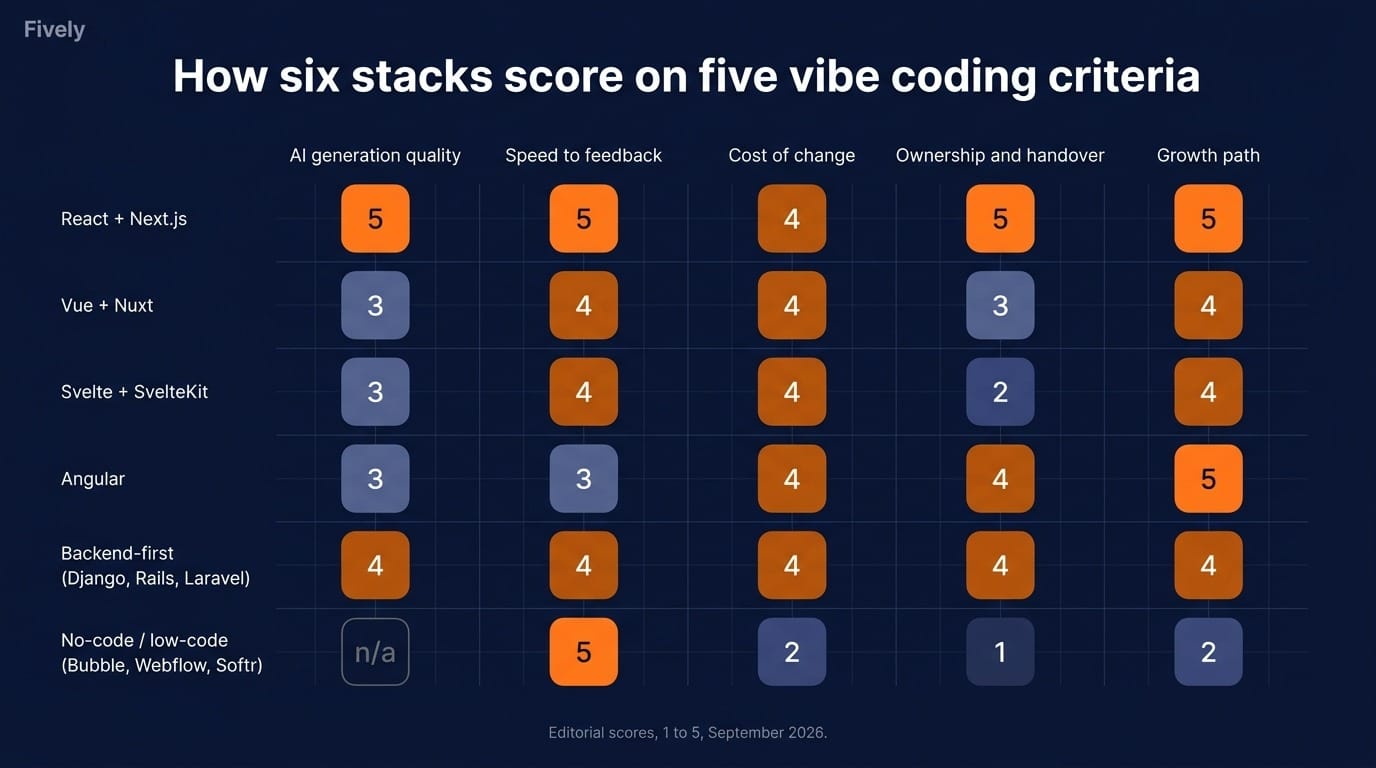
How to read the rows:
Vue and Nuxt are technically close to React and Next.js, Nuxt also offers server rendering and a comparable structure. The gap is in the ecosystem around AI: no major builder generates Vue by default, the training footprint is a fraction of React’s, and the UK and European hiring market for Vue is smaller. If your CTO already leads a Vue team, the gap narrows considerably. If you’re starting from nothing, it doesn’t.
Svelte and SvelteKit produce fast, lean applications and many engineers love working in them. Developer surveys consistently show high satisfaction, and in a straight Next.js vs SvelteKit comparison on performance SvelteKit often comes out ahead.
But models generate Svelte with less confidence, the component ecosystem is thinner, and finding a second team to take over is harder. It’s a fine choice when a strong engineer will stay with the product. It’s a risk when the founding developer might leave.
Angular brings structure that large organisations value: strict conventions, built-in tooling, long support cycles. For a fast MVP those same qualities add weight, and none of the AI builders default to it. Choose Angular when you’re extending an enterprise estate that already runs on it, not when you’re testing a new product.
Backend-first frameworks deserve more respect than the vibe coding conversation gives them. Ruby on Rails, Django and Laravel have decades of documentation, models generate them well, and for a product that is essentially forms and tables they are hard to beat.
The trade-off appears when customers expect a rich, app-like interface: you end up adding a JavaScript front end anyway, and now you maintain two stacks.
No-code and low-code platforms are the fastest route to a clickable test and the slowest route to a product you own. Bubble, Webflow and Softr will get a landing page or a simple workflow live in a day.
The ceiling arrives when you need custom logic, integrations the platform doesn’t offer, or an export of your application to run elsewhere. Starting on no-code is often right; the mistake is not planning the move off it.
Verdict by product type: What to Choose?
- Interactive SaaS, customer portal or marketplace: React and Next.js. It scores highest on the criterion vibe coding adds, AI generation quality, without giving anything up on ownership or growth. This is the product most readers of this guide are planning, and it is our recommendation.
- Content or marketing site: Next.js still works well, but so does a simpler static framework such as Astro, and for a brochure site a no-code builder may be the right call. Don’t over-engineer a site that mainly needs to load quickly and rank.
- Internal tool or data-heavy CRUD product: a backend-first framework or a low-code platform can be cheaper and perfectly adequate. Reserve React and Next.js for the products your customers touch.
The alternatives each win a specific case; none wins the general one. The rest of this guide assumes React and Next.js and shows what surrounds them, because the layers underneath decide whether the product survives contact with real users.
What the Rest of the Stack Looks Like
Vibe-coded products rarely fail because of the interface framework. They fail because customer data was exposed, logins broke, and the payment webhook silently stopped, or because the hosting bill tripled. The second layer of the stack is where those things live.
For the broader, non-AI view of these layers, see our guide to the best tech stack for web app development.
Two notes for UK and European buyers: first, ask early where customer data physically lives. Supabase, Neon and the major clouds all offer European regions, but the AI tool will not choose one for you; someone has to. Second, keep every account (hosting, database, payments, domain) in your company’s name. A supplier who insists on owning them is creating a dependency you’ll pay to unwind.
Knowing the layers is half the picture. The other half is knowing where AI-generated code tends to break them.
Technical Risks Specific to AI-Generated Code
AI-generated code has a distinctive failure profile. IBM’s security team put it plainly in June 2026: vibe coding security risks aren’t like ordinary security risks. They cite a December 2025 study in which AI-generated pull requests contained 2.74 times more security issues than human-authored ones, and a 2026 GitGuardian report finding that commits assisted by an AI coding agent exposed secrets more than twice as often as human-only commits. Academic work agrees: a December 2025 paper by Waseem and colleagues describes a “flow-debt trade-off”, where the speed of generation is paid for in architectural inconsistency, security gaps and maintenance overhead.
So is vibe coding production ready? The code can be. Whether it is depends on the process around it, because generated code accumulates technical debt at the speed it’s produced unless someone pays it down. None of this is an argument against vibe coding.
It’s an argument for knowing the five places to look if you want to prevent such breaches.
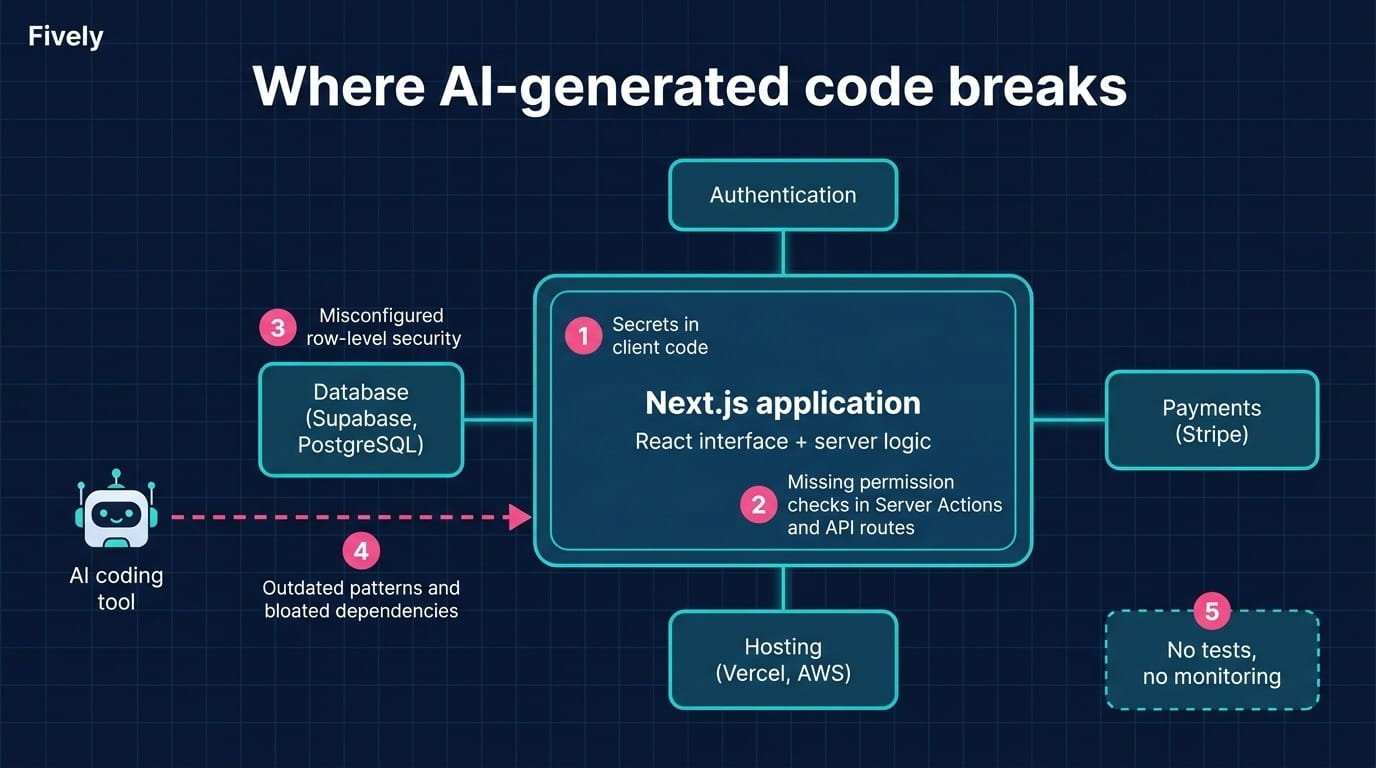
1. Secrets exposed in client code
A model, asked to connect to a payment or database service, places the secret key where the browser can read it. Anyone who views the page source now has your credentials, and the result is fraudulent charges, data theft and a painful disclosure to customers.
How it’s caught: automated secret scanning in the repository and a review rule that no server credential appears in interface code.
2. Missing permission checks on the server
Next.js lets the interface call server logic directly through Server Actions and API routes. Generated code often assumes the caller is who they say they are, so one user can read or edit another’s records by changing an identifier. In B2B, a customer seeing another customer’s data ends the contract.
How it’s caught: a written rule that every server action verifies the current user’s rights, plus tests that try to break it.
3. Misconfigured data access policies
Supabase and similar services protect data with row-level security policies. AI tools frequently generate permissive policies to make the demo work, and no one tightens them later, which leaves the database readable to anyone with the public key.
How it’s caught: a policy review before the first customer, and again before every new table.
4. Outdated patterns and bloated dependencies
The model reaches for a library or a framework convention that was current two years ago. The code works but carries known vulnerabilities, deprecated APIs and packages you don’t need, which means slower changes now and an expensive upgrade later. A related trap, which IBM calls “slopsquatting”, is a model recommending a package that doesn’t exist, which an attacker has since registered with malicious code.
How it’s caught: pinned versions, dependency scanning, and current agent instructions such as the ones Next.js now generates.
5. No tests, no monitoring
Without tests, the fifth change breaks the first feature and no one notices until a customer does. Without monitoring, no one notices even then, and the support inbox becomes your error log.
How it’s caught: a minimum test suite for critical journeys and error tracking wired in before launch.
A large ecosystem helps here in a practical way: the scanners, linters and testing tools for React and Next.js are mature and widely used, and there is a large pool of engineers who know what a bad pattern looks like. But tools don’t review code; people do. Our guide to AI prompts for code review shows what a structured review looks like in practice.
Each of these risks has a cost attached, either now or later. Let’s make the budget explicit.
 Services Account
What Vibe Coding Changes About Costs
The real cost of vibe coding is not the tool subscription: the prototype budget is the smallest of three, and most disappointment comes from treating it as the whole.
- Budget one: the prototype. An AI tool subscription, a few days of a product person’s time, perhaps a designer. This is genuinely cheap, and that’s the point: you buy the right to test an idea with real people before committing;
- Budget two: preparing for customers. This is where the work the prototype skipped comes due: review and restructuring of generated code, real authentication and data policies, billing with VAT and invoicing for UK and European customers, tests, monitoring, data regions. Depending on scope, this stage frequently costs more than the prototype by a wide margin, and it’s the stage most providers underquote;
- Budget three: running and evolving. Hosting that scales with usage, AI tool and token spend for continued development, a review process for every change, security updates, and the roadmap itself. This is a recurring line, not a one-off.
We have deliberately given no figures: rates differ widely across the UK and Europe, and any number quoted here would be wrong for your scope. Our guide to software development costs explains the drivers in detail.
We can say that a React and Next.js stack can make budget two more predictable, because the work follows patterns that many engineers recognise.
With costs visible, the sensible move is to spend them in stages, each with a decision at the end.
From Prototype to Product: A Staged Plan
Take a hypothetical UK startup building a client-onboarding tool for small accountancy practices, sold as a monthly subscription. The founder has a Lovable prototype. Here is how the investment sensibly unfolds.
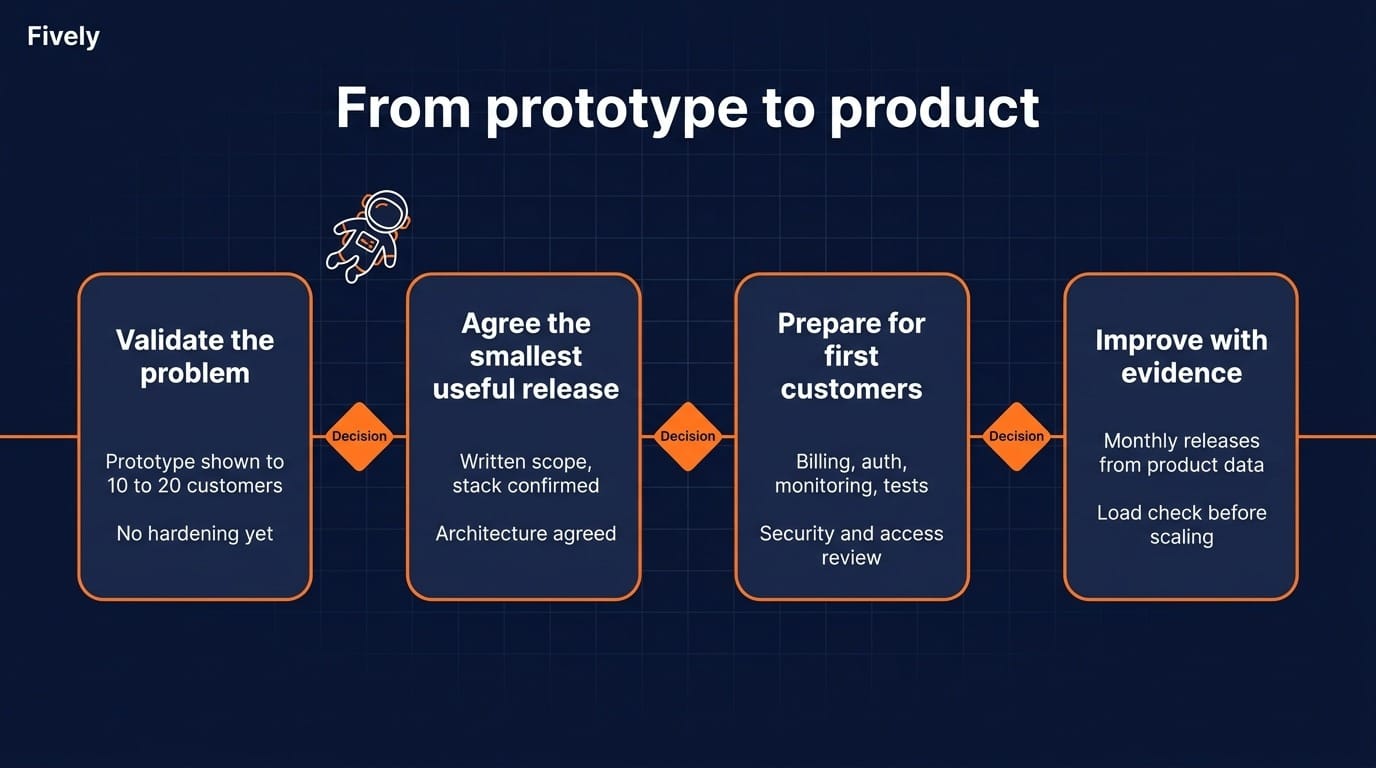
The technical checkpoints are where a stack proves its worth: in stage three, the team replaces the prototype’s permissive settings with real policies. In stage four, when a partnership brings a thousand practices in one week, the Next.js and Supabase combination has a documented scaling path and a wide market of engineers who have followed it.
For the delivery side of each stage, our guide to MVP development for startups goes deeper.
Finally, each stage needs an owner and a clear acceptance point. The questions below help you establish both before work begins.
Questions to Ask Your Development Partner
Whether you’re talking to an agency, a freelancer or your own new hire, these eight questions separate teams who understand vibe coding delivery from teams who have simply learned to prompt.
- Which versions of React and Next.js will we be on, and why? A good answer names current versions, explains how versions are pinned, and mentions how the AI tools are kept from generating outdated patterns.
- Where does our customer data live, and who can reach it? A good answer names the database service, the region, and the access policies, and describes when those policies are reviewed.
- How is generated code reviewed before it reaches customers? A good answer describes a process with named reviewers and automated checks, not “the AI tests itself”.
- Who owns the repository, the cloud accounts and the domain? The only good answer is “you do, from day one”.
- What exactly is in the first release, and what triggers a new estimate? A good answer is a written scope with explicit exclusions and a change process.
- What is checked before we go live? A good answer covers secrets, permissions, data policies, dependencies, tests on critical journeys and monitoring.
- If we changed suppliers next quarter, what would we receive? A good answer lists the repository, documentation, access to every account, and a handover session, and treats the question as normal.
- How will you show us progress? A good answer is a preview link for every change and a short review cadence, so the CPO sees the product, not a status report.
If a provider bristles at question four or seven, that tells you more than any portfolio. Our comparison of top vibe coding agencies shows how established teams answer these questions.
A focused product discussion can turn those answers into a first-release scope and an estimate. That’s where we come in.
 Services Account
Plan Your MVP With Fively
If you’re launching an interactive web product that you intend to own and grow, React and Next.js are the stack we’d propose, with Supabase or an equivalent Postgres service, Stripe and a hosting choice that respects where your customers’ data needs to live.
Fively delivers vibe coding projects with the parts the AI tools leave out: discovery and scoping, architecture decisions, expert review of every generated change, security checks before launch and support afterwards.
Our React and Next.js engineers have shipped web applications for clients across the UK, Europe and the US, and our code review service can help you out because AI-generated code needs experienced eyes.
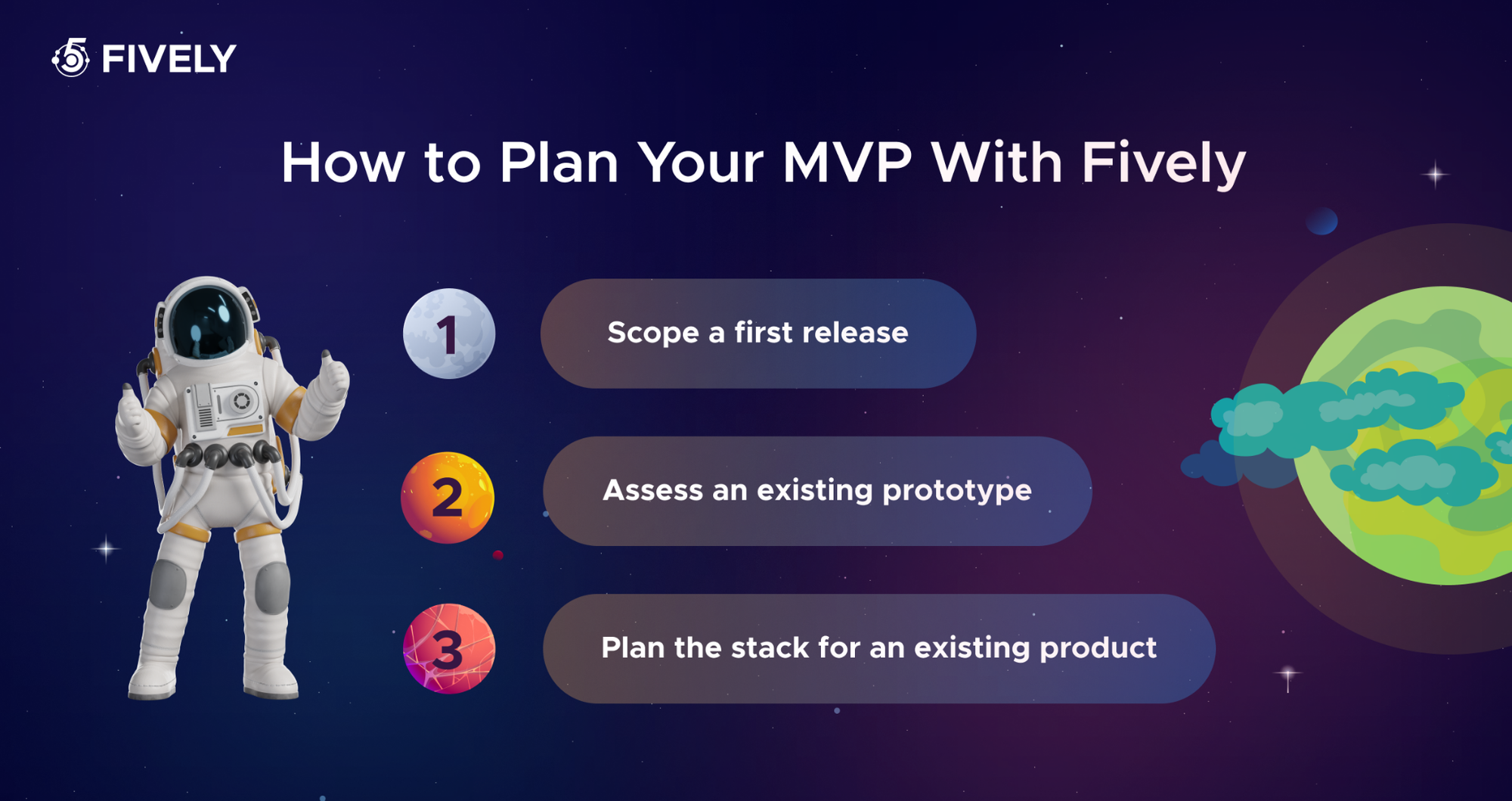
Three ways to start:
- Scope a first release. Bring the idea or the prototype; leave with a written scope and an estimate.
- Assess an existing prototype. We review what your AI tool built against the five risks above and tell you what stands between it and paying customers.
- Plan the stack for an existing product. If you’re deciding whether to add an AI-built module to a live system, we’ll map the options.
Whether you’re validating a first prototype or scaling an existing system, our team is ready to guide you from strategy and architecture through deployment and continuous improvement with security, compliance, and measurable impact built in from day one.
Have an idea worth shipping? Let’s talk!
 Palina Trokhautsava
Need Help With A Project?
Drop us a line, let’s arrange a discussion
Frequently Asked Questions
For an interactive web product such as B2B SaaS or a customer portal: React with Next.js, a managed PostgreSQL service such as Supabase, Stripe for payments and Vercel or a comparable host. It’s the stack AI tools generate most reliably and the one with the largest pool of engineers. For a simple validation experiment or a brochure site, a no-code builder may be the better first step.
Both are capable, and Nuxt and SvelteKit offer comparable features to Next.js. The best frontend framework for vibe coding, though, is the one AI tools generate most reliably: no major builder generates Vue or Svelte by default, models have seen far less of them, and the hiring market is smaller. If your team already knows them, that changes the calculation. Starting from zero, React and Next.js carry less risk.
Yes, and it’s often the right sequence: validate on no-code, rebuild on an owned stack once demand is proven. Treat it as a rebuild, not a migration, because no-code platforms rarely export usable application code. What carries over is your data, your understanding of the customer journey and the design decisions you’ve already tested.
It can be both, but neither happens by default. Production readiness comes from review, security checks and monitoring, not from the AI tool. Scaling depends on the layers under the interface: database design, hosting and caching. On React, Next.js and a managed Postgres service, that path is well documented and widely walked; the stack won’t limit you before your architecture decisions do.
Vibe coding for startups works best when product leadership and technical accountability are clearly separated. You need product judgement, not coding skills. You also need someone technically accountable for review, security and architecture, whether that’s a CTO, a fractional CTO or a delivery partner. The failure mode is assuming the AI tool fills that role. It doesn’t.
If it’s built on a standard stack, held in your own repository and accounts, and documented, yes. React and Next.js help because their project structure is widely recognised. What makes handover hard isn’t the stack but permissive security settings, missing tests and code no one has reviewed. Fix those and any competent team can pick it up.


