
React Native App Development Cost in 2026: What Should You Budget?

• 17 min
I'm a content specialist at Fively keen on writing fresh articles that can help out business and tech specialists. I love to conduct research, hold interviews, and spotlight sophisticated tech issues.
Discover realistic React Native app development cost, based on product complexity, backend architecture, design depth, integrations, AI features, and the structure of your team.
React Native app development cost in 2026 typically starts around $20,000–$40,000 for a lean production MVP and can exceed $200,000 for a complex enterprise mobile product. The final number depends far more on business logic, backend work, integrations, security, and product maturity than on the framework itself.
React Native can reduce duplicated iOS and Android engineering because one team can share much of the application code across both platforms. But “one codebase” does not mean “half the price.” A serious mobile app development still needs UX design, backend APIs, QA across devices and OS versions, release engineering, analytics, monitoring, security, and ongoing maintenance.
Key Takeaways
- Realistic 2026 planning ranges are roughly $20,000–$40,000 for a lean MVP, $40,000–$100,000 for a standard business app, $100,000–$200,000 for an advanced product, and $200,000+ for enterprise or highly regulated applications.
- React Native saves money primarily by reducing duplicated mobile engineering and maintenance across iOS and Android—not by eliminating backend, QA, design, or platform-specific work.
- Team location is one of the largest price variables. 2026 market guides commonly place US/Canada React Native rates around $90–$160+/hour for experienced engineers, Eastern Europe around $40–$90/hour, Latin America around $35–$90/hour, and South Asia around $20–$60/hour, depending on seniority and vendor model.
- Backend architecture can consume 25–40% of the total budget in data-heavy products. Real-time sync, multi-tenancy, complex permissions, payments, and integrations often cost more than the mobile screens themselves.
- FinTech and HealthTech applications cost more because security, auditability, data protection, compliance, and QA are product requirements rather than optional polish.
- AI features can add anything from a small API-integration increment to a major subsystem with retrieval, evaluation, observability, privacy controls, and variable inference costs.
- Annual maintenance commonly deserves a separate budget of roughly 15–20% of the initial build cost, with more for rapidly evolving or integration-heavy products.
- The best way to control React Native app cost is to validate a focused MVP, define the backend and integrations early, and buy the engagement model that matches your internal engineering capacity.
How Much Does React Native App Development Cost?
There is no useful single average for React Native development services because a six-screen internal tool and a regulated consumer fintech app are both “React Native apps.” A better estimate starts with complexity, then adjusts for region, team model, backend scope, and risk.
These are planning bands rather than quotes. A highly polished consumer MVP with custom animations and video can cost more than a visually plain enterprise workflow. Conversely, a larger app that relies on mature backend services and standard UI patterns can be cheaper than its screen count suggests.
What Really Drives React Native App Development Cost
App Complexity and Business Logic
Business logic is the biggest reason two apps with similar-looking interfaces receive radically different estimates. A booking screen that simply submits a form is cheap. A booking flow that checks availability in real time, applies location-specific pricing, handles refunds, supports multiple roles, and reconciles payments is not.
For budgeting, classify features by engineering risk rather than by how small they look in a design file. Authentication, permissions, subscriptions, background jobs, offline workflows, geolocation, media processing, native hardware access, and complex state synchronization can each introduce disproportionate effort.
Number of Screens & UI/UX Depth
Every screen creates design, implementation, state, accessibility, analytics, and QA work. A 6-screen MVP and a 25-screen product are not comparable even if they use the same backend. As a rough planning range, basic product design using a standard design system may add $3,000–$8,000, while a custom UI/UX system with extensive flows, motion, and branded interaction patterns can reach $10,000–$30,000+ depending on scope.
The important variable is not only screen count. A static settings screen is cheap; an interactive map, data visualization, camera workflow, or highly animated onboarding screen can cost several times more. Good UX work can also reduce development waste by resolving navigation and state problems before they reach code.
Backend Architecture & Data Model
Most serious React Native apps need more than a mobile frontend. They need authentication, a database, business rules, APIs, background processing, admin workflows, notifications, and integrations. In many projects, backend engineering represents roughly 25–40% of the total build budget.
Firebase, Supabase, AWS Amplify, or similar managed services can reduce initial engineering effort for the right product. They do not remove architecture decisions, and operating costs can grow with users, storage, bandwidth, real-time traffic, and serverless execution. A custom cloud architecture costs more upfront but may be appropriate when scale, compliance, data ownership, or integration requirements demand it.
Third-Party Integrations & APIs
Integrations look cheap in a feature list because the vendor has already built the API. In practice, your team still has to implement authentication, map data models, handle errors and rate limits, test edge cases, secure credentials, monitor failures, and update the integration when the provider changes.
The API license itself is a separate operating expense. For transaction-based services, model both the development cost and the per-user, per-message, per-transaction, or percentage fee at realistic scale.
Security & Compliance: GDPR, HIPAA, and PCI DSS
Security is not a single line item called “add encryption.” Apps that handle health, financial, identity, or payment data need secure authentication, authorization, API design, secrets management, logging, data minimization, secure storage, threat modeling, and a disciplined release process. Compliance can also require documentation, audit trails, data-processing controls, and vendor review.
As a planning heuristic, regulated requirements can add 15–25% or more to development process and QA effort, while an independent security assessment may cost roughly $2,000–$15,000+ depending on scope and depth. PCI DSS scope can often be reduced by using a mature payment provider instead of directly handling card data, but the app still needs secure integration and correct data boundaries.
Real-Time Features & Offline Sync
Chat, live location, collaborative updates, real-time dashboards, ride or delivery tracking, and device telemetry require persistent connections, event delivery, reconnection logic, ordering, and additional load testing. WebSockets, Firebase, or managed pub/sub services reduce infrastructure work but do not remove product complexity.
Offline-first behavior is similarly deceptive. Storing data locally is easy; deciding what happens when two devices edit the same record while offline is not. A focused offline capability may add roughly $3,000–$8,000, while complex synchronization and conflict resolution can become a much larger architecture effort.
AI Features
In 2026, AI features increasingly appear in ordinary mobile roadmaps: support assistants, recommendations, document extraction, image understanding, voice interfaces, semantic search, and agentic workflows. A simple integration with a hosted model can add roughly $5,000–$25,000. Production AI that requires RAG, evaluation, privacy controls, fallback logic, observability, or custom workflows can add $25,000–$100,000+ and create ongoing inference costs.
Do not estimate AI by counting screens. The expensive part is usually the system around the model: data preparation, retrieval, permissions, prompt/version management, evaluation datasets, guardrails, monitoring, and human escalation.
 Services Account
Where Your Budget Actually Goes: Cost by Development Phase
The percentages overlap by project because teams work iteratively rather than handing the product from one department to another in a perfect waterfall. Still, the table is useful for spotting suspicious proposals. If 90% of a quote is “development” and almost nothing is allocated to QA, release, or discovery, those costs have probably not disappeared—they are simply hidden.
React Native Cost by Industry & App Type
Why This Matters More for Regulated Industries: FinTech & HealthTech
Regulated products demonstrate why framework choice is only one part of the budget. Fively’s public portfolio includes Insly, an insurance platform used across more than 60 countries, and AviMedical, a German HealthTech project built with React Native. Insly required robust workflow automation, integrations, security, and collaboration with the client’s engineering team. AviMedical required a patient-facing mobile product integrated into a broader medical resource-management environment.
The AviMedical case is particularly relevant to React Native budgeting. Fively worked with the client’s in-house team for 12 months, using React Native to deliver iOS and Android applications. The public case study reports 10,000+ patient contacts through the mobile app and more than 40 app versions implemented, tested, and launched during the engagement. That is a useful reminder: regulated mobile cost is not just the first build. Repeated releases, testing, production reliability, and integration with a larger healthcare system are part of the product lifecycle.
React Native vs. Native vs. Flutter: Cost Comparison
React Native is usually cheaper than maintaining two fully separate native codebases because product logic, components, tests, and engineering capacity can be shared. It is not automatically cheaper for every app: products dominated by platform-specific native functionality may receive less benefit from cross-platform reuse.
React Native vs. Flutter is rarely a meaningful “which framework is cheaper” question in isolation. Both can support a shared mobile team. The lower-cost choice is usually the one your chosen team knows deeply, can staff reliably, and can maintain for years. React Native can be especially attractive to organizations that already use React and TypeScript, while Flutter can be compelling when the team has strong Dart/Flutter expertise and values its rendering model.
React Native itself continues to evolve. The official project made the New Architecture the only runtime option in 0.82; React Native 0.84 made Hermes V1 the default and continued removing Legacy Architecture code. In 2026, estimates for existing apps should therefore include dependency compatibility and upgrade work rather than assuming an old React Native codebase can remain frozen indefinitely.
Hidden & Ongoing Costs After Launch
App Store & Google Play Fees
Apple’s Developer Program costs $99 per year for standard App Store distribution. Google Play Console registration has historically used a $25 one-time registration fee. These numbers are tiny next to engineering cost, but store operations also include screenshots, metadata, privacy declarations, certificates, review responses, staged releases, and policy updates. Enterprise distribution and special programs can have different requirements and fees, so verify current platform terms before launch.
Cloud Hosting & Infrastructure
Infrastructure is highly workload-dependent. A B2B app with 2,000 users may cost less to operate than a media-heavy consumer app with 20,000. Model expected users, requests, storage, file transfer, AI usage, and background work rather than copying a generic “hosting = $200/month” assumption.
Security Audits
A professional security review is easy to cut from a launch budget because it does not create a visible feature. For apps handling sensitive user data, payments, identity, or regulated workflows, that is false economy. Budget roughly $2,000–$15,000+ for a scoped assessment, with deeper penetration testing, compliance evidence, or remediation increasing the total.
Third-Party Subscriptions & Analytics Tools
Twilio, SendGrid, Stripe, maps, identity providers, crash reporting, customer support, experimentation, Mixpanel, Amplitude, and other services can turn a cheap MVP into a meaningful monthly software development bill. A typical growing app might spend $100–$500/month across several services before transaction fees, while high-volume messaging, maps, analytics, or identity can push the number much higher.
Track third-party cost per active user or transaction from the start. Variable vendor pricing becomes dangerous when a feature is cheap to build but expensive every time a user touches it.
Annual Maintenance: Plan for 15–20% of Build Cost
A practical baseline is to reserve around 15–20% of the initial development investment per year for maintenance. A $100,000 app might therefore need $15,000–$20,000 annually for bug fixes, dependency upgrades, OS compatibility, security patches, monitoring, performance work, and minor improvements. Products with heavy native integrations, rapid feature growth, or strict compliance may need more.
How Development Team & Engagement Model Affect Price
Two proposals with the same hourly rate can have completely different total costs depending on who owns architecture, product coordination, QA, and release. Fively supports both full-cycle delivery and team augmentation, so the right model depends on what already exists inside the client organization.
Location also changes price. Current 2026 market guides broadly place experienced React Native engineers at roughly $90–$160+/hour in the US and Canada, $60–$130/hour in Western Europe, $40–$90/hour in Eastern Europe, $35–$90/hour in Latin America, and $20–$60/hour in South Asia. Treat these as directional bands: seniority, native iOS/Android depth, vendor margin, domain expertise, and communication expectations matter more than country labels alone.
What a Trustworthy React Native Estimate Should Include: Buyer Checklist
A credible proposal explains what will be built, what assumptions the price depends on, and what happens when reality differs from those assumptions. Before choosing a React Native app development company, ask for explicit answers to the following questions:
- Is the estimate broken down by discovery, design, mobile engineering, backend, integrations, QA, release, and post-launch support—or is it only a total based on screen count?
- Who owns the backend APIs, database schema, admin workflows, cloud accounts, source repositories, and technical documentation after launch?
- Which devices and OS versions are in the QA matrix? Does the scope include regression, accessibility, performance, release builds, and real-device testing?
- Who prepares App Store and Google Play releases, signing, certificates, privacy declarations, screenshots/metadata, staged rollout, and responses to store rejection?
- What is the plan for the first 90 days after launch? Is there a warranty, support SLA, crash monitoring, analytics review, and budget for urgent fixes?
- Which third-party services are assumed, and are their subscription/transaction costs included or excluded?
- What native modules or platform-specific code are expected? Has the team verified compatibility with the current React Native New Architecture?
- What security and compliance activities are included? Is an independent audit included, recommended, or explicitly excluded?
- How are change requests handled? Which assumptions would trigger re-estimation?
- Who owns the IP, designs, app-store accounts, analytics, infrastructure, and credentials if the vendor relationship ends?
- What maintenance and React Native upgrade cadence is recommended after release?
The goal is not to force every vendor into a fixed price. The goal is to make uncertainty visible. A transparent $120,000 estimate with assumptions can be safer than a $70,000 quote that quietly excludes backend, QA, store release, and post-launch work.
 Services Account
Real React Native Case Study: AviMedical
AviMedical is a useful example of why real React Native budgets should be tied to outcomes and delivery context rather than a generic “price per screen.” The client is a German healthcare provider with practices in Munich, Hamburg, and Berlin. Fively joined the existing engineering organization to build a patient-facing application from existing designs and integrate it with a broader medical resource-management platform.
Industry: HealthTech
Country: Germany
Timeline: 12 months
Team: 1–5 developers
Core mobile stack: React Native
Platforms: iOS and Android
Reported usage: 10,000+ patients contact GPs via the app
Delivery evidence: 40+ app versions implemented, tested, and launched
The cost lesson is straightforward: a regulated mobile product is not priced only by UI implementation. The team has to fit into an existing engineering environment, preserve reliability across repeated releases, test patient-facing workflows, integrate with a larger system, and maintain a consistent experience on both mobile platforms.
This is where React Native can create leverage: shared cross-platform engineering without pretending the surrounding product and compliance work disappears.
 Services Account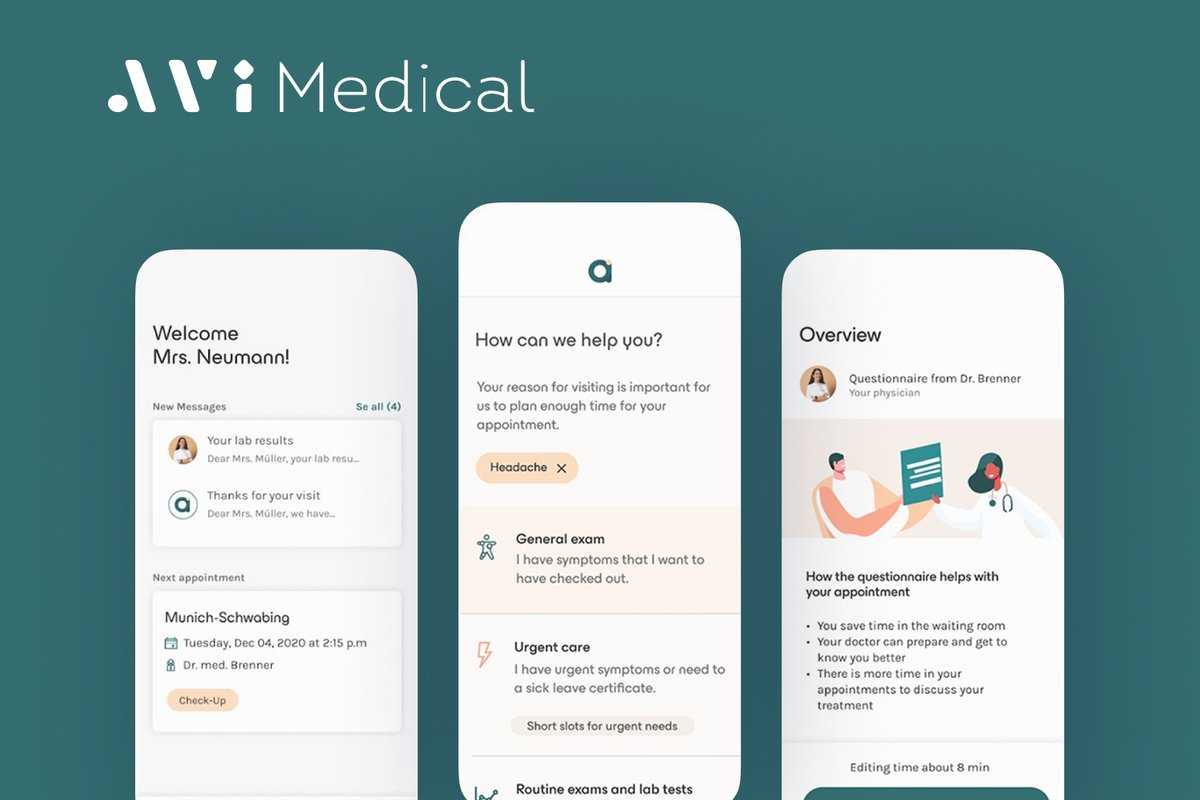
How to Keep Your React Native Budget Under Control
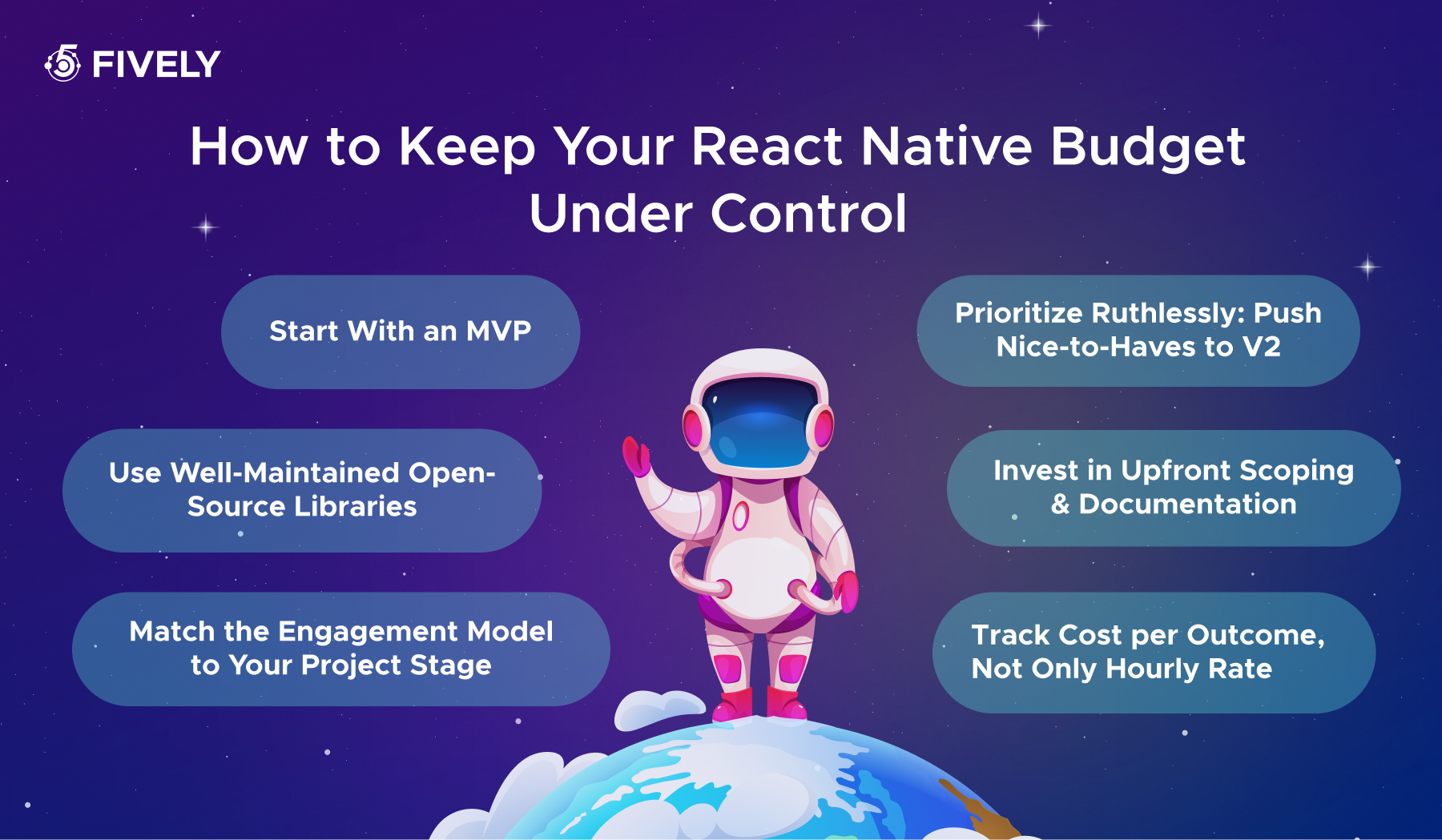
Start With an MVP
Build the smallest version that can validate the riskiest business assumption. An MVP often costs 40–60% less than attempting the complete roadmap in version one, but the bigger benefit is avoiding investment in features users never needed. Keep authentication, core workflow, analytics, and operational necessities; defer breadth.
Prioritize Ruthlessly — Push Nice-to-Haves to V2
Create three buckets: required for the core outcome, required for launch operations, and nice to have. The third bucket does not enter version one unless removing it breaks the value proposition. Every “small” feature adds implementation, QA, analytics, documentation, and future maintenance.
Use Well-Maintained Open-Source Libraries — Carefully
React Native has a mature ecosystem for navigation, state, forms, storage, UI, maps, and device capabilities. Reusing healthy libraries can save weeks. Check release activity, issue health, New Architecture compatibility, platform support, security posture, and whether the package is becoming a critical dependency. Saving two days today is not worth a migration crisis next year.
Invest in Upfront Scoping and Documentation
Discovery feels like overhead until a team discovers halfway through development that the backend cannot support offline sync or the chosen payment flow violates a store rule. Spending several thousand dollars on product flows, architecture, API assumptions, and a delivery plan can prevent tens of thousands in rework on a larger build.
Match the Engagement Model to Your Project Stage
If you already have a CTO, product manager, QA process, and backend team, augmentation can be the leaner option because you only buy missing React Native capacity. If you do not have those functions, full-cycle development is often cheaper in total because it closes ownership gaps instead of making founders coordinate five independent contractors.
Track Cost per Outcome, Not Only Hourly Rate
A $35/hour React Native developer who needs twice the hours and produces code that must be rewritten is not cheaper than a $65/hour engineer who ships the feature correctly. Track delivery predictability, escaped defects, rework, cycle time, and ownership. Rate optimization without output measurement is one of the easiest ways to blow a software budget.
How Fively Estimates Your React Native Project
A useful React Native estimate starts before anyone multiplies hours by a rate. Fively’s public process begins with discussing the product, choosing a viable stack and team size, and preparing a project estimation. For a mobile project, we recommend structuring the estimate around the following phases:
- Discovery: define users, business goals, core flows, constraints, integrations, compliance, and launch scope.
- Technical planning: decide React Native/Expo approach, backend architecture, data model, native dependencies, environments, and release strategy.
- UX/UI: map flows, design the system and screens, validate high-risk interactions before engineering.
- Engineering: build a React Native app, backend, admin workflows, integrations, analytics, and platform-specific code.
- QA and hardening: test the supported device/OS matrix, regressions, performance, security, accessibility, and failure states.
- Release: configure CI/CD, signing, store assets, privacy requirements, production monitoring, and staged rollout.
- Post-launch: observe crashes and analytics, fix launch issues, prioritize feedback, maintain dependencies, and plan the next release.
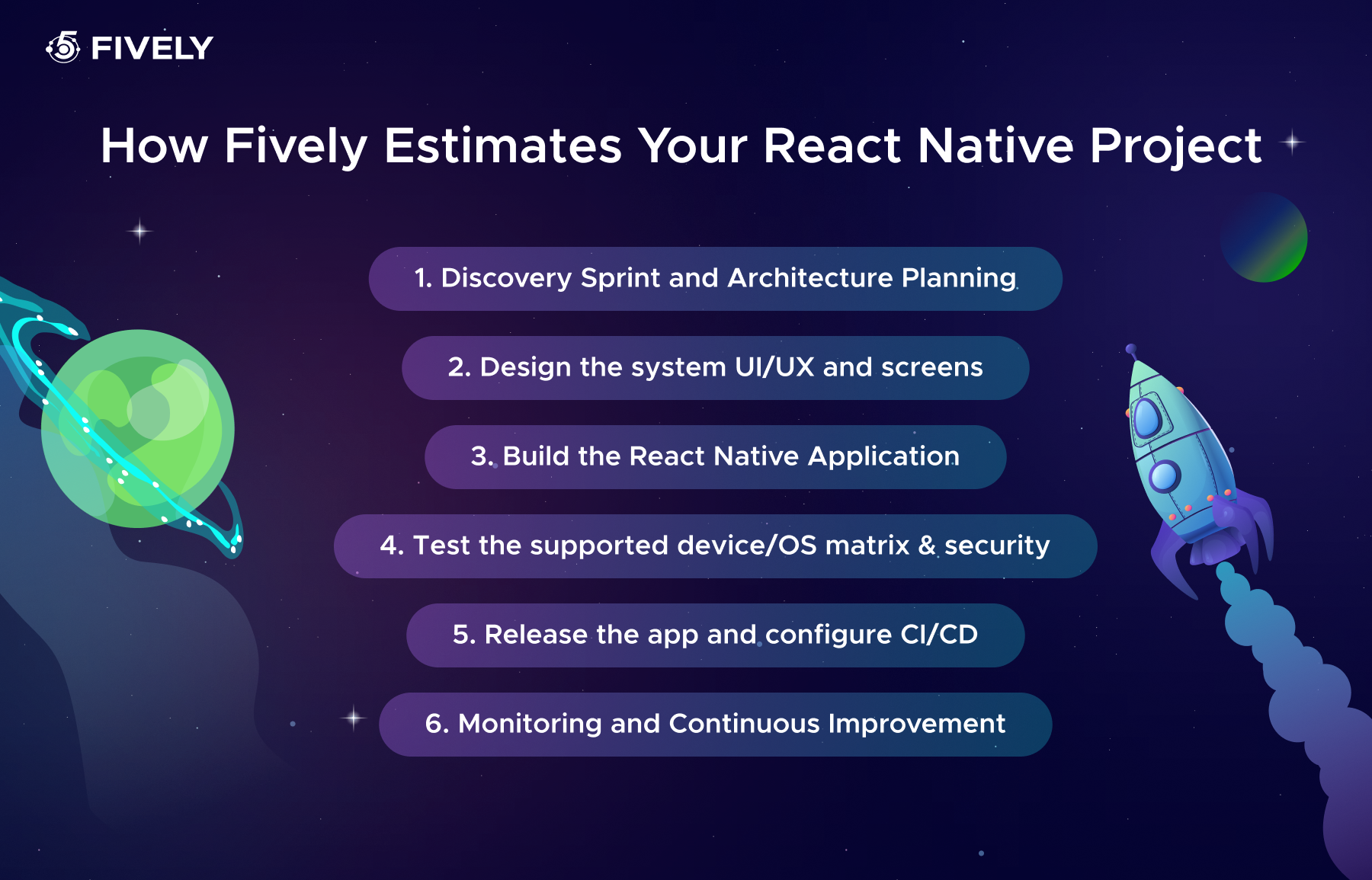
The output should be a range with assumptions, not a magic number. If a requirement is still unknown, such as the number of enterprise integrations or whether offline mode needs conflict resolution, the estimate should say what is known, what is provisional, and how that uncertainty affects the budget.
Conclusion
React Native app development cost in 2026 is best understood as a product budget, not a framework price. React Native can create meaningful savings by sharing engineering across iOS and Android, but the largest cost drivers remain the same ones that make any serious mobile product difficult: business logic, backend architecture, integrations, design, security, QA, and long-term operation.
For a realistic budget, start with complexity and business risk, then choose the team region and engagement model. Validate the MVP before expanding scope, make hidden operating costs visible, and demand an estimate that explains assumptions instead of hiding them behind a single number. That is how React Native becomes a cost advantage without turning product quality into the thing you sacrificed to get it.
 Services Account
Need Help With A Project?
Drop us a line, let’s arrange a discussion
Frequently Asked Questions
A lean production MVP commonly starts around $20,000–$40,000. Standard business applications often fall around $40,000–$100,000, advanced products around $100,000–$200,000, and enterprise or regulated apps can exceed $200,000–$500,000. Complexity, backend scope, integrations, design, security, team location, and engagement model determine the final price.
React Native is usually cheaper than maintaining separate iOS and Android codebases when a meaningful share of product logic and UI can be reused. Compared with Flutter, cost is usually similar at a high level; the better economic choice is often the framework your team can staff and maintain most effectively. Native development can be worth the higher cost when the product relies heavily on platform-specific capabilities or demands maximum native specialization.
Maintenance typically covers bug fixes, dependency and React Native upgrades, iOS/Android compatibility, security patches, monitoring, crash remediation, performance work, minor enhancements, and release support. A useful baseline is around 15–20% of the original build cost per year, although complex products can require more.
FinTech and HealthTech products usually cost more because security, privacy, auditability, compliance, permissions, data handling, and testing requirements are stricter. Integrations with payment, identity, insurance, EHR, or other regulated systems also increase backend and QA effort. The framework itself is not the expensive part; the risk controls around the product are.
Look for a phase-by-phase estimate, clear backend and integration scope, a device/OS QA matrix, store-release responsibility, security assumptions, third-party operating costs, IP ownership, change-request rules, and a post-launch plan. The proposal should also explain native dependencies and current React Native architecture compatibility instead of treating the app as a generic JavaScript project.


