
AI Agent Development Cost in 2026: Pricing, Factors, and Budgets

• 20 min
I'm a content specialist at Fively keen on writing fresh articles that can help out business and tech specialists. I love to conduct research, hold interviews, and spotlight sophisticated tech issues.
AI agents have moved from impressive demos to software that can read business data, choose an action, call tools, update systems, and continue a workflow without waiting for a human prompt. That extra agency is exactly why estimating an AI agent is harder than pricing a chatbot. You are not paying only for an LLM call. You are paying for the decision layer around the model: context, permissions, integrations, memory, evaluation, observability, security, fallbacks, and the controls that keep an automated action from becoming an automated incident.
For a buyer, the useful question is therefore not “How much does an AI agent cost?” in isolation. It is: what level of autonomy do we need, what systems can the agent touch, what happens when it is wrong, and what will it cost to operate safely at our expected volume? This guide answers those questions with planning ranges for 2026 and shows where the budget actually goes.
Quick Answer: AI Agent Development Cost at a Glance
A focused custom AI agent can start around $25,000–$60,000. A production workflow agent with RAG, several tools, approvals, monitoring, and business-system integrations commonly lands around $60,000–$180,000. Complex multi-agent or regulated enterprise programs can move into the $180,000–$500,000+ range, while broad transformation programs can exceed that. These are planning ranges, not quotes: data quality, autonomy, integrations, compliance, evaluation depth, and traffic can move the same “agent” idea into a very different budget.
Fively’s public AI agent development guidance puts a single task-specific agent in the low five figures, workflow-level agents with several integrations around $30,000–$80,000, and enterprise multi-agent systems around $80,000–$200,000+. The wider ranges in this article deliberately leave room for regulated environments, difficult legacy integration, high-volume operation, custom evaluation, and enterprise governance.
It may be also interesting: AI App Development Cost in 2026
AI Agent vs. AI Chatbot vs. AI App Development Cost: What’s the Difference?
A surprising amount of “AI agent” budgeting starts with a naming problem. A customer-support interface that answers from a knowledge base may be a chatbot or RAG assistant, not an autonomous agent. Conversely, a system that reads a claim, checks policy data, queries external services, decides what to do next, writes back to the core platform, and escalates exceptions is much closer to agentic software.
The practical rule is simple: if your system only needs to answer, summarize, classify, or draft, do not budget for multi-agent autonomy. If it needs to act across real systems, spend less time debating the AI model and more time designing permissions, state, failure recovery, and evaluation.
How Much Does Each Type of AI Agent Cost?
Reactive (Rule-Based) Agents: $15,000–$40,000
Reactive agents sit at the narrowest end of the spectrum. They use explicit rules, classifiers, structured prompts, or deterministic workflow logic to choose from a limited set of actions. Examples include ticket categorization, basic lead routing, HR self-service flows, and simple FAQ automation with escalation.
They are relatively inexpensive because the state space is small and the agent is not expected to invent long plans. The budget still needs room for integration, authentication, logging, edge cases, and a human fallback. A $15K prototype that only works against sample data is not the same deliverable as a $35K production service with permissions, analytics, deployment, and support.
Contextual / Model-Based Agents: $40,000–$100,000
These agents use an LLM plus conversation or task context to interpret requests and generate useful outputs. Typical use cases include onboarding assistants, internal knowledge helpers, document summarization, email drafting, customer-support response generation, contract-clause extraction, and lead qualification.
Cost increases because “good enough in a demo” is not a production acceptance criterion. Teams need prompt/version management, context assembly, structured outputs, refusal and fallback behavior, regression tests, analytics, and often a knowledge source. The more business-specific the language and decision criteria, the more evaluation data you need.
Multi-Tool / RAG Agents: $80,000–$250,000
This is where many valuable B2B agents live. The agent retrieves company knowledge, reasons over it, and uses tools: CRM, ticketing, finance APIs, search, databases, email, inventory systems, or internal services. Examples include research assistants, CRM automation, competitive-intelligence agents, financial-data retrieval, inventory workflows, and legal or compliance assistants.
The expensive part is not simply adding a vector database. A reliable system needs document ingestion, permissions-aware retrieval, chunking and metadata strategy, tool schemas, retry logic, idempotency, authorization, source citations, evaluation datasets, and observability for both retrieval and action execution.
Multi-Agent Systems: $100,000–$400,000+
Multi-agent systems split a workflow across specialized agents: for example, one gathers information, another plans, another executes, and another validates. They can be useful for autonomous sales pipelines, research workflows, software tasks, supply-chain operations, and complex back-office processes.
But multiple agents multiply coordination problems. You now have handoffs, shared state, conflicting plans, loops, duplicated token usage, and more failure modes. Multi-agent architecture should solve a real decomposition problem—not serve as a fashionable substitute for one well-designed agent plus deterministic code.
Domain-Specific & Hierarchical Agents: $100,000–$400,000+
Legal, healthcare, finance, industrial, and other specialist agents need more than generic reasoning. They often require domain taxonomies, validated sources, strict access controls, human approval gates, audit trails, specialized evaluation, and integration with systems that were never designed for autonomous software.
Hierarchical designs add a supervisor or policy layer that delegates work and checks subordinate agents. This can improve control, but it also adds engineering and testing. In high-stakes use cases, the cost of proving that the system behaves acceptably can rival the cost of building the first working version.
Enterprise Agentic AI: $300,000–$800,000+
At enterprise scale, the deliverable is no longer “an agent.” It is an operating capability: identity and access, multiple departments, data governance, observability, incident response, model routing, cost controls, audit evidence, sandbox environments, evaluation pipelines, vendor management, and integrations across a messy application estate.
Examples include agentic ERP layers, autonomous finance operations, cross-functional service workflows, and enterprise AI transformation programs. The model API may be one of the smallest line items. Integration and governance usually dominate.
 Services Account
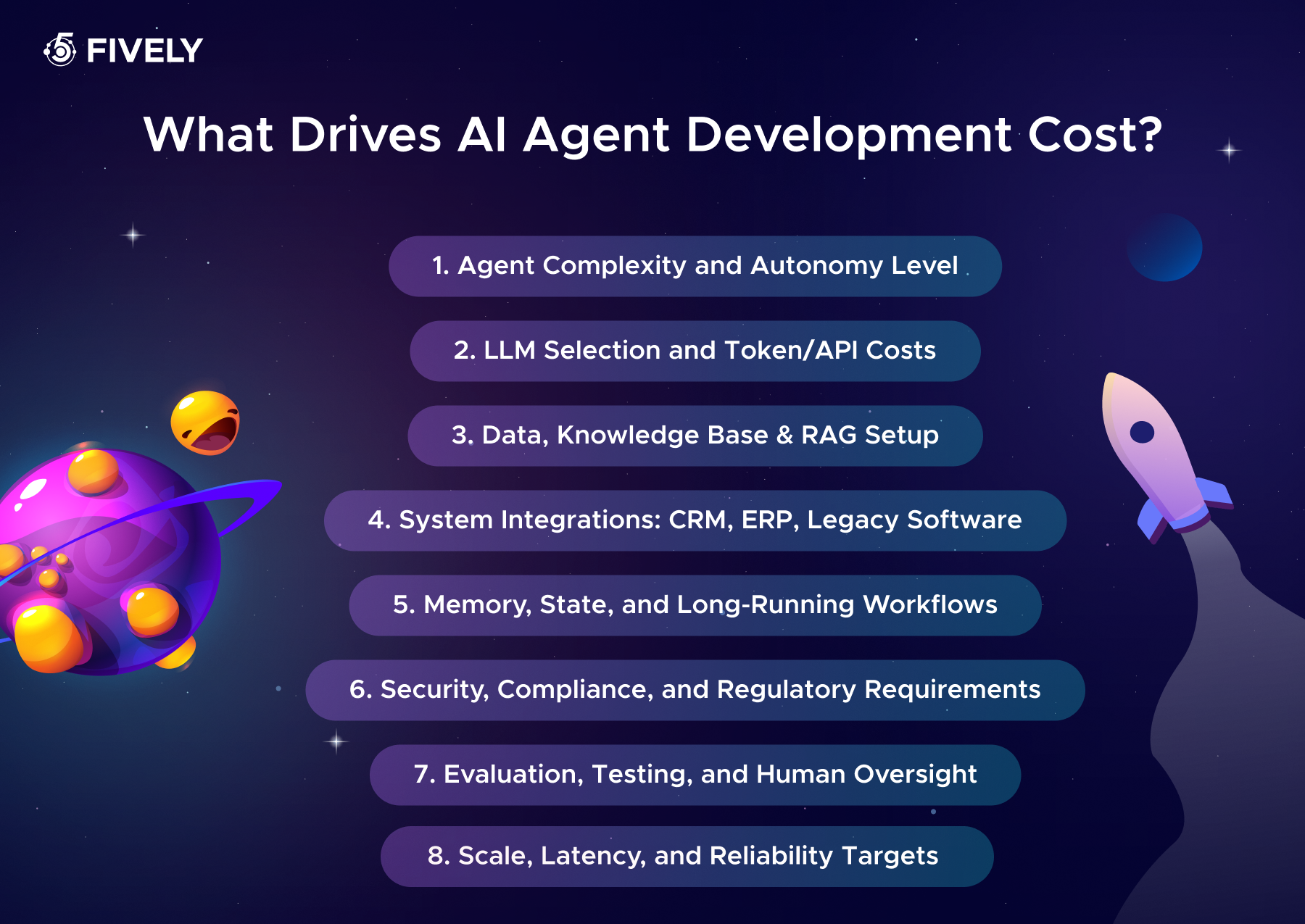
What Drives AI Agent Development Cost?
1. Agent Complexity and Autonomy Level
Autonomy is the biggest multiplier because every additional action the system can take expands the number of things that can go wrong. An assistant that proposes a refund for a human to approve is cheaper and safer than an agent that can issue the refund itself. An agent that can also edit account status, email the customer, update the CRM, and trigger fulfillment needs a much stronger control plane.
A useful way to control cost is progressive autonomy: start with read-only access, then recommendations, then approval-gated actions, and only automate low-risk actions after the system has enough evidence. Human-in-the-loop can add UI and workflow cost, but it often reduces the amount of safety engineering required for full autonomy.
2. LLM Selection and Token/API Costs
Model choice affects both build quality and operating economics. In September 2026, hosted frontier-model pricing spans a wide range, and providers increasingly differentiate cached input, long context, batch processing, reasoning effort, and tool calls. That means a single “price per million tokens” is not enough to forecast an agent.
The cheapest model in the AI agent development is not always the cheapest workflow. A weaker model that retries twice, retrieves more context, or needs extra validation can cost more per successful task. Track cost per completed business outcome—not only cost per request.
3. Data, Knowledge Base & RAG Setup
RAG cost starts with data readiness. If documents are duplicated, stale, poorly permissioned, or full of inconsistent identifiers, the retrieval layer inherits those problems. A basic knowledge setup may be a small five-figure task; a permission-aware enterprise knowledge platform with continuous ingestion, multiple repositories, evaluation, and lifecycle controls can become a major workstream.
A production RAG pipeline normally includes:
- Choose a vector or hybrid search layer appropriate for volume, tenancy, metadata filtering, and operational constraints (for example, Pinecone, Weaviate, Qdrant, or an existing database/search platform);
- Build the embedding and ingestion pipeline, including incremental updates, deletion, deduplication, and source metadata;
- Clean and chunk content by document structure and retrieval behavior rather than applying one arbitrary chunk size everywhere;
- Expose retrieval/search services with access control, filters, reranking, and traceable source references;
- Integrate retrieval into the agent orchestrator and evaluate whether the retrieved evidence actually improves task success.
RAG also creates ongoing cost: re-indexing, embedding new content, vector storage, reranking, monitoring retrieval quality, and investigating answers that were plausible but grounded in the wrong source.
4. System Integrations: CRM, ERP, Legacy Software
A modern REST API with OAuth, a sandbox, stable schemas, and good documentation is cheap compared with a legacy platform that requires middleware, brittle exports, browser automation, or custom reconciliation. Integration cost also depends on whether the agent only reads data or can mutate it.
The Model Context Protocol (MCP) can reduce repeated connector work when systems expose compatible servers or when a reusable MCP layer makes architectural sense. It is not magic integration dust: authentication, authorization, data contracts, tool safety, and observability still need engineering. The July 2026 MCP specification strengthened authorization and routing, but adopting a protocol does not eliminate application-specific controls.
5. Memory, State, and Long-Running Workflows
A stateless assistant is much easier to operate than an agent that must remember customer history, resume a workflow tomorrow, coordinate parallel tasks, or preserve a durable audit trail. Memory introduces storage, retention, summarization, privacy, retrieval, conflict resolution, and deletion requirements.
Long-running workflows also need checkpoints and idempotency. If a tool call times out after creating an invoice, the agent must know whether to retry or reconcile—not create a second invoice. These “boring” distributed-systems details are often where real agent budgets grow.
6. Security, Compliance, and Regulatory Requirements
An agent with tools is a privileged software actor. It can be manipulated by malicious instructions, poisoned context, over-broad permissions, compromised tools, or unsafe memory. OWASP now maintains a dedicated Top 10 for Agentic Applications, while its 2026 GenAI guidance covers risks across modern LLM applications. Production budgets should include threat modeling, least privilege, secret management, tool allowlists, output validation, audit logs, red teaming, and incident controls.
Regulation can also affect architecture. The EU AI Act is now generally applicable, with transparency rules in force from August 2026 and later deadlines for specified high-risk systems. Depending on the use case, sector, geography, and whether the company is a provider or deployer, teams may need documentation, logging, human oversight, data governance, and compliance review. NIST’s AI RMF and Generative AI Profile remain useful voluntary frameworks for structuring risk management even when they are not legal requirements.
Do not budget “compliance” as one final legal review. If a regulated agent needs traceability, approval gates, retention controls, or reproducible evaluations, those requirements change the product architecture from day one.
7. Evaluation, Testing, and Human Oversight
Traditional QA asks whether software returns the expected deterministic result. Agent testing must also ask whether the system chooses the right tool, uses the right evidence, refuses unsafe actions, recovers from failure, stays within policy, and produces a useful outcome across probabilistic model behavior.
A serious evaluation program can include golden datasets, task-success metrics, retrieval metrics, model-graded checks, human review, adversarial prompts, tool-failure simulations, regression suites, and production sampling. The cost grows with the number of workflows and risk classes. This is not optional polish: without evaluation, a team cannot tell whether a new prompt, model, retriever, or tool schema made the agent better or simply different.
8. Scale, Latency, and Reliability Targets
A pilot used by 30 employees can tolerate architecture that a customer-facing agent processing 50,000 tasks a month cannot. Higher volume means concurrency management, caching, model routing, queues, rate-limit handling, autoscaling, observability, and cost controls. Low-latency requirements may force smaller prompts, faster models, precomputation, or parallel tool execution.
Reliability targets matter too. “Works most of the time” may be fine for an internal drafting assistant. It is unacceptable for an agent that moves money or changes customer entitlements. The higher the consequence of failure, the more you spend on deterministic controls around the probabilistic core.
How to Develop an AI Agent: Costs by Project Stage
These categories overlap in real projects. A regulated deployment may spend far more on testing and governance; a data-poor project may spend more on knowledge preparation than on agent orchestration. The useful budgeting exercise is not forcing every project into identical percentages, but making sure every stage exists in the estimate.
AI Agent Development Cost by Industry
FinTech AI Agents
Finance agents can automate research, reconciliation, customer operations, document processing, anomaly triage, and internal analysis. Their cost rises quickly when the agent can execute transactions or influence regulated decisions. Teams need precise permissions, approval thresholds, audit trails, deterministic validation, and strong incident handling. Real-time market or account data can also add commercial data-provider fees that never appear in the model bill.
HealthTech AI Agents
HealthTech agents may assist with administrative workflows, patient communication, knowledge retrieval, documentation, scheduling, and operational decision support. Costs rise around protected data, integration with clinical systems, domain evaluation, access control, and the need to separate assistance from decisions that require qualified human judgment. If the product enters regulated medical-device territory, the compliance path changes materially and should be assessed with specialist counsel.
eCommerce AI Agents
eCommerce is often a practical starting point because many actions are measurable: find a product, recover a cart, answer an order question, create a return, update a CRM record, or escalate a high-value customer. The hard part is connecting catalog, inventory, pricing, order, payment, support, and marketing systems while preventing the agent from inventing discounts, promising unavailable stock, or taking an irreversible action outside policy.
 Services Account
Hidden & Ongoing Costs Nobody Tells You About
The build budget gets attention because it is visible before the project starts. Operating cost is where agent economics are actually proven. A production agent consumes models, retrieval, storage, tools, monitoring, human review, and engineering time every month—and some costs scale with interactions while others scale with complexity.
A mid-complexity agent at meaningful production volume can easily add tens of thousands of dollars per year beyond the initial build. Treat any universal “10% maintenance rule” cautiously: agent operating cost depends much more on traffic, model mix, tool usage, human review, data refresh, and regulatory burden than on the original development invoice.
Custom Build vs. Off-the-Shelf vs. Outsourced Development: Cost Comparison
Off-the-shelf wins when the process is standard and the vendor already solves 80–90% of it. Custom wins when the workflow, data, integrations, controls, or customer experience are strategic. Outsourcing is not automatically cheaper than SaaS; its advantage is getting custom ownership and specialist delivery without carrying the full cost and hiring lead time of an internal team.
Fively Case: Insurance Claims Automation and What We Can Honestly Say About Cost
A useful case study should not invent an “AI agent” label just because agentic AI is fashionable. Fively’s public B2B Insurance Claims Automation case predates today’s LLM-agent wave and is described as machine-learning-powered claims automation. It is relevant because it shows the economics and engineering pattern behind autonomous business decisions—but it should not be presented as proof that the system uses a modern LLM agent unless the project team confirms that architecture.
 Services Account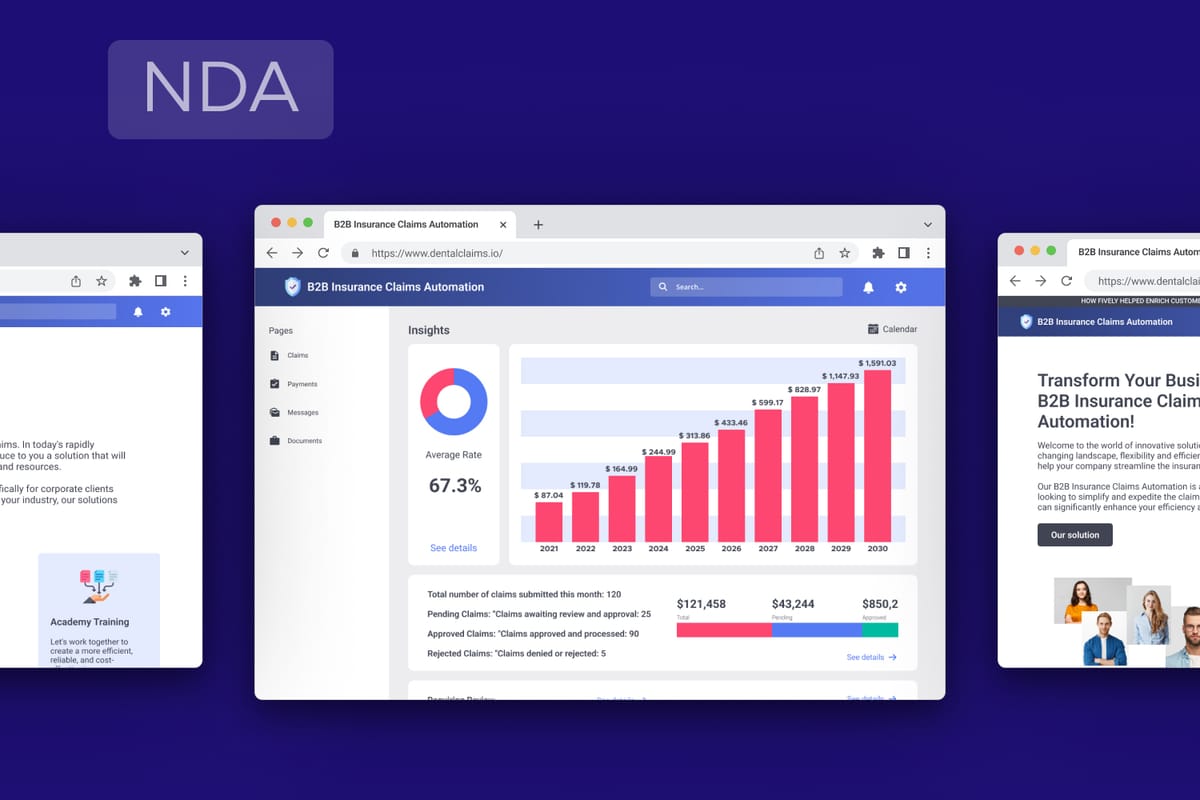
The Challenge
The client, a US InsurTech startup serving dental clinics and B2B insurance companies, needed to automate claims-processing work that becomes expensive and slow when performed manually at scale. Claims are not simple chat messages: the workflow depends on structured and unstructured data, validation rules, exceptions, task management, and reliable handoffs.
What We Built
Fively participated as part of the client’s engineering team in a custom platform combining machine-learning algorithms and AI-driven workflow automation for the dental insurance revenue cycle. The public case lists Python, React, and Node.js in the stack and reports a 26-month engagement with a team of 5–10 developers.
That architecture is a useful reminder for 2026 buyers: the valuable part of an “agent” is often the software around intelligence. Even when a modern LLM is added, production value still depends on workflow state, integrations, business rules, data pipelines, permissions, and operational UX.
The Result
According to Fively’s published case study, the system robotically validates 80% of insurance claims with no human involvement and processed more than 1.5 million claims in 12 months. Those are strong automation and scale metrics.
The project budget is not public, so this article does not invent one. If Fively later receives permission to disclose commercial figures, the most useful additions would be total build cost, monthly operating cost, and a before/after unit-economics metric. Until then, the honest lesson is the measurable outcome, not a fabricated price tag.
How to Reduce AI Agent Development Costs Without Cutting Corners
Cost optimization works best when it reduces unnecessary uncertainty, not when it removes the controls that make the system production-ready.
- Start with one narrow workflow. Pick a task with measurable volume, clear inputs, a defined successful outcome, and an obvious human fallback. Prove it before expanding autonomy.
- Use hosted, pre-trained models before training from scratch. Fine-tuning can help stable repetitive tasks, but it should follow evidence from prompts, retrieval, and evaluations—not precede them.
- Choose a contract model that matches uncertainty. A fixed-fee pilot can work well when scope and acceptance criteria are genuinely bounded; time-and-materials is often safer for discovery-heavy work where requirements will change. “Fixed price is always cheaper” is not a reliable rule.
- Run a 4–6 week pilot before a broad rollout. A focused pilot in roughly the $25K–$50K band can validate data, integration feasibility, task success, latency, and operating economics before the organization funds a larger system.
- Design for model portability. Keep prompts, tool schemas, business rules, and evaluations separate enough that changing model providers does not require rewriting the product.
- Use standards such as MCP where they reduce connector duplication, but do not skip application-specific authentication, authorization, validation, and monitoring.
- Control token usage. Trim irrelevant context, cache reusable content, route simple tasks to cheaper models, cap loops, and set cost budgets per workflow.
- Hire a team that has shipped AI into production. The expensive learning curve is rarely calling an LLM API; it is discovering production failure modes after customers do.
It may be also interesting: Best Tech Stack for Vibe Coding: A Guide for Product Leaders
Questions to Ask Before You Sign an AI Agent Development Contract
A credible development company should be able to answer these questions with architecture, assumptions, and trade-offs — not just a model name and a demo.
- What engagement model are you proposing—fixed fee, milestone-based, or time-and-materials—and exactly what is included or excluded from scope?
- Who owns the source code, prompts, orchestration logic, fine-tuned artifacts, evaluation datasets, and any training or customer data created during the project?
- What happens when the base LLM is deprecated, repriced, or changes behavior? How portable is the architecture?
- What does the evaluation framework look like? Which task-success, retrieval, safety, and business metrics become release gates?
- How are tool permissions designed? Which actions are read-only, approval-gated, reversible, or prohibited?
- How do you test prompt injection, malicious documents, tool misuse, memory poisoning, data leakage, and failure recovery?
- What are the realistic 12-month operating costs at our expected traffic, including models, retrieval, third-party tools, observability, and human review?
- How do you trace the decision to build AI agent after the fact? Can we see the evidence, tools, policy checks, and outcome without exposing sensitive chain-of-thought?
- Have you shipped AI or automation in our industry or a similarly regulated environment, and can you show a relevant case or reference where permitted?
A Practical Budgeting Framework: Estimate the Workflow, Not the Agent
Before asking vendors for a quote, write down one workflow in operational terms. This produces a much better estimate than “we need an AI sales agent.”
Once those answers exist, an estimate can be decomposed into product engineering, agent orchestration, integrations, data/RAG, evaluation, security, deployment, and operating cost. That is far more useful than multiplying an hourly rate by a guessed number of “AI development hours.”
Conclusion
AI agent development cost in 2026 is less about buying intelligence and more about engineering controlled autonomy. Model APIs are increasingly capable and competitively priced; the hard part is connecting them to real business systems without losing security, reliability, auditability, or economic control.
That is why two projects both called “AI agents” can differ by an order of magnitude. A narrow internal assistant may need one model, one knowledge source, and one approval step. An enterprise agent may need dozens of tools, durable state, policy enforcement, red teaming, human escalation, compliance evidence, and 24/7 observability.
The best way to keep the budget sane is to start with a measurable workflow, give the agent the minimum autonomy needed to create value, instrument everything, and expand only after the evidence supports it. Build the smallest agent that can prove the business case, not the largest architecture that looks impressive on a diagram.
If you want custom AI agent development services, Fively can help turn the workflow into a production architecture, estimate the real build and operating cost, and deliver from focused pilots to enterprise agentic systems.
 Services Account
Need Help With A Project?
Drop us a line, let’s arrange a discussion
Frequently Asked Questions
For planning, expect roughly $25,000–$60,000 for a focused production agent, $60,000–$180,000 for a workflow agent with RAG and several integrations, and $180,000–$500,000+ for complex multi-agent, regulated, or enterprise deployments. Very narrow prototypes can be cheaper; broad enterprise programs can exceed $800,000. Scope the workflow and risk level before trusting any single benchmark.
A focused proof of concept can take four to six weeks. A production agent with integrations commonly takes two to four months. Enterprise multi-agent systems, difficult data programs, or regulated deployments can take four to nine months or longer. Data readiness and integration access often affect the schedule more than model selection.
For a one-off or early-stage product, outsourcing usually avoids the fixed cost and hiring time of assembling a complete AI/product/DevOps/QA team. In-house can make more economic sense when AI is a long-term core capability with a continuous roadmap and enough work to keep the team fully utilized. Many companies use a hybrid model: an external team accelerates delivery while internal engineers retain product knowledge and ownership.
Budget for model/API usage, vector or search infrastructure, cloud compute, third-party tools, observability, evaluation, data refresh, security, model migrations, human review, and engineering support. A flat maintenance percentage can be misleading. Build a 12-month usage model with low, expected, and high-volume scenarios, then calculate cost per successful business task.


